‘Good equipment is also part of working sustainably’
Drenthe-based landscaping contractor Van Regteren Groenvoorzieningen
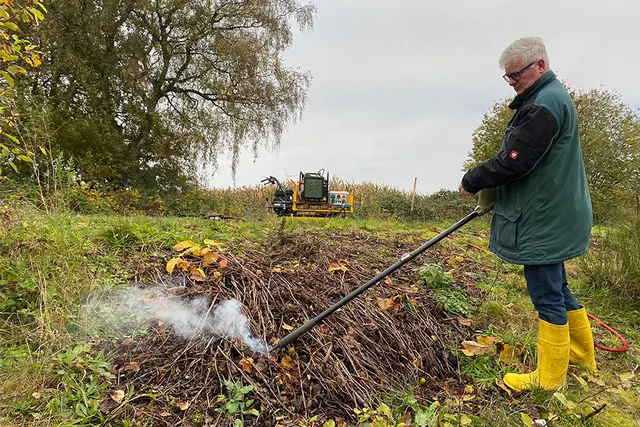
Much of the work at Van Regteren Groenvoorzieningen still starts on the verge and along the ditch. That is where the company began, and Herbert van Regteren says it is still the foundation of the business. “The company grew out of verge and ditch maintenance. That is really our biggest activity. It is what we do for most of the year.”
Over the years, however, the landscaping business has expanded considerably. Traffic management was added because it is inseparable from working alongside roads. Van Regteren has been providing winter services since the 1980s. Biomass and forestry work bring extra work during the colder months. But the common thread remains the same: large-scale, mechanised green-space maintenance in the public realm.
This work has changed considerably over the years, not only because of larger machines and stricter requirements, but above all because of consolidation. Provincial work used to be divided into many small lots; now it is awarded in a handful of large lots. Municipalities no longer outsource just a small part of the work, but often the maintenance of an entire area. “The projects have become much bigger,” says Van Regteren. “And it all goes through tendering.”
Peak after the summer construction holiday
One of the biggest challenges is the seasonal pressure. Changes to mowing regimes, ecological requirements and the bird-breeding season mean less mowing takes place before the summer construction holiday. As a result, a lot of the work is pushed back until afterwards. “We’re seeing less and less work before the summer construction holiday, while the post-holiday peak just keeps getting bigger.”
That may make ecological sense, but in practice, Van Regteren says, it is not always the best solution. He is not calling for mowing more often as a matter of course, but he does want the work to be spread out better. “I’d rather look at how we can smooth out that peak so that we can distribute the work more evenly throughout the year. That would also create more variety in the landscape.”
He has also seen well-intentioned policies backfire when it comes to ditch maintenance. Mowing once every three years may seem nature-friendly, but sometimes it means heavy machinery is needed to clear ditches that have become overgrown. “Then you have to use a forestry mulcher. That just destroys everything. Mow once a year and you can keep the ditches manageable.”
Hitachi in green-space maintenance
The machinery fleet plays a key role in this work. Van Regteren deliberately opts for premium brands, including Hitachi excavators, Fendt tractors and Mercedes vans. It is not simply about brand loyalty, but about reliability. “With good equipment, you have less downtime, which ultimately means lower emissions too. You can get more done in one go.”
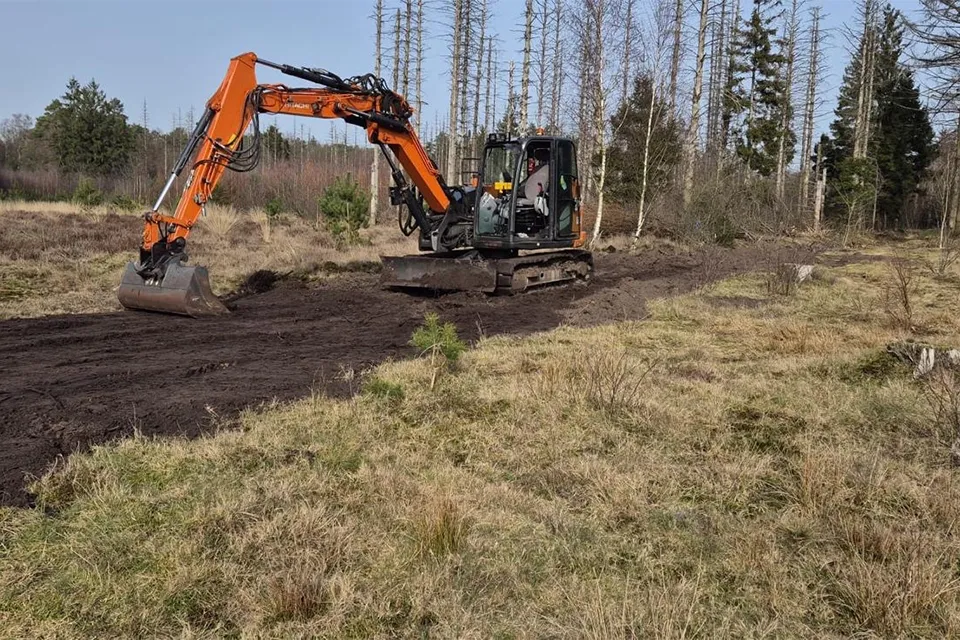
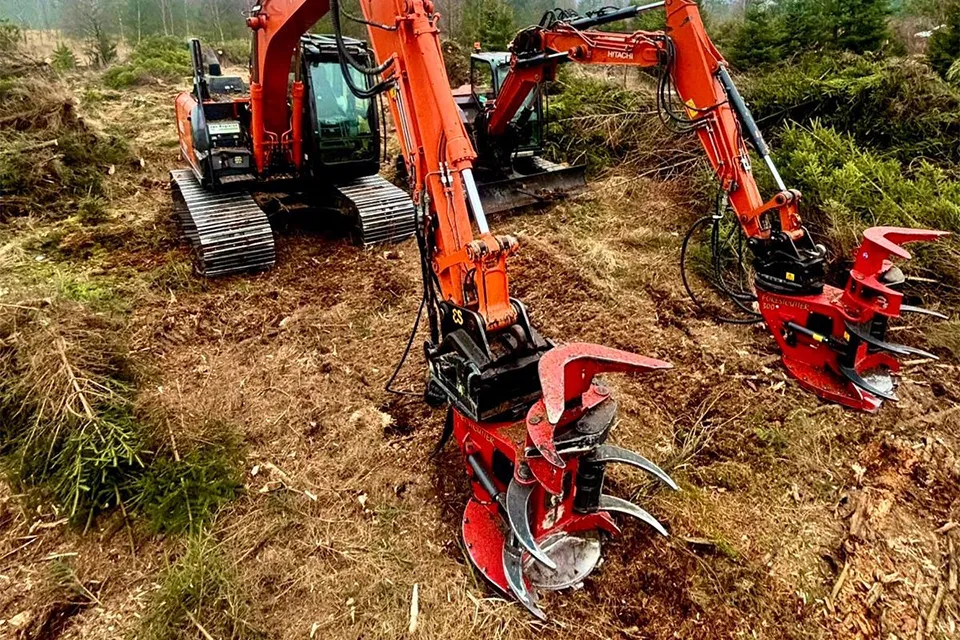
The company operates several Hitachi excavators: two ZX150-7 wheeled excavators with Stage V engines, a ZX130 crawler excavator, a modified and raised ZXUS with a long front for narrow-track work, and a compact ZXUSB85-6 zero-tail-swing excavator. The machines are used for a wide range of tasks: mowing buckets, clearing ditch debris, working with sorting grabs and forestry cutters, forestry mulching and work in waterways.
The choice of Hitachi is a practical one. The machines perform well, but just as important is the service. The Hoogeveen branch is close by, and the relationship with the service team is good. “We’re not the type to keep shopping around. If you’ve found something that works and people are there for you, you stick with it.”
Machines are often modified for green-space work. Additional pumps provide sufficient hydraulic capacity. Booms are extended or made rotatable. Lights and vulnerable components are protected. Much of the expertise lies in the company’s own workshop and with the operators themselves. “We’ve all operated machines ourselves. So we know what works and what doesn’t.”
Training people
The people operating the equipment are just as important. Van Regteren sees work placements as an important source of new employees. Several students do placements with the company each year, and many end up staying. “I think 60 to 70 per cent of the people who have joined us in recent years came through a work placement. That shows the potential of good supervision and training. If you don’t offer that, a company shouldn’t complain that it can’t find people.”
The variety helps. Operators do not spend the whole year on the same machine. During quieter periods, they carry out maintenance, drive tractors or take on other work. That is necessary because an excavator in this type of green-space work does not clock up 1,800 hours a year, as it would in earthmoving. The bird-breeding season and seasonal peaks mean the figure is often limited to 1,200 to 1,400 hours.
A realistic approach to sustainability
Working electrically? Van Regteren is not against it. The company has electric vans, electric hand tools and an electric ride-on mower. But he is cautious about excavators and tractors. Battery capacity, charging infrastructure and grid congestion mean that going fully electric is still difficult, in his view.
In the short term, he believes the biggest gains lie elsewhere: switching to Stage V machines sooner and using HVO fuels wherever possible. “You can make huge gains that way. But you also have to think about what to do with the old machines. Scrapping them all would be best, because if you sell them, they just keep running somewhere else.”
His view of the future is down-to-earth but entrepreneurial. He already uses AI for work plans, scheduling and ecological protocols. Office work is becoming smarter. But the person in the excavator cab? They are here to stay. Because, as Van Regteren shows, progress in green-space maintenance still comes down to a combination of craftsmanship, common sense and machines that can take a beating.
Question about this story? Ask your question
Keep following this
Get an email when a new story is published. No account needed.
- SubjectGeneral