‘We suffer from nature amnesia in the Netherlands’
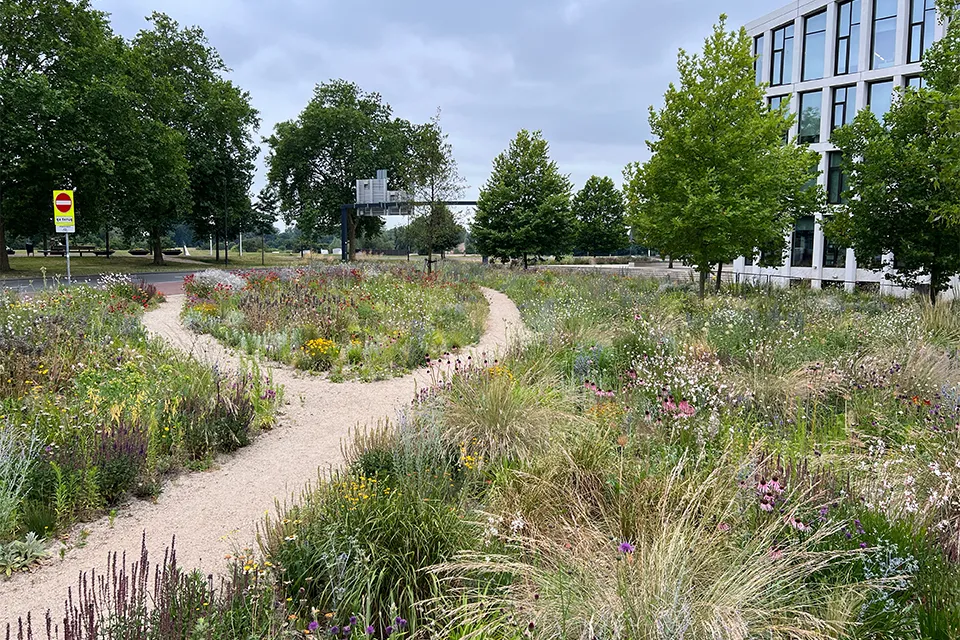
Buyer Group Groenvoorzieningen brings forces together
In Buyer Group Groenvoorzieningen, public-sector clients are working together on a vision and strategy for their tenders, with a strong focus on ecological green spaces. Programme lead Maik Knuiman: “Now is the time to move from pilots to wider application.”
“We suffer from nature amnesia in the Netherlands,” says Maik Knuiman. “We have forgotten how rich nature used to be. Seventy-five per cent of the insect population and sixty per cent of Dutch landscape features such as hedgerows and ponds have disappeared. As a child, I loved playing in a ditch near my home, with sticklebacks and other creatures. Now there are places where you would rather not go into a ditch, let alone find sticklebacks living in it. Nature is under severe pressure, even though green spaces have so much to offer. The starting point for Buyer Group Groenvoorzieningen is to return to living alongside nature, and to having better nature.”
Which comes first?
Knuiman is strategic adviser and lead for Buyer Group Groenvoorzieningen on behalf of the Ministry of LVVN and Rijkswaterstaat. The group brings together public-sector clients such as Rijkswaterstaat, Rijksvastgoedbedrijf, municipalities, provinces and water authorities to develop a shared market vision and procurement strategy for ecological green spaces. “With transition challenges, it is often a chicken-and-egg situation,” he explains. “For the market, investing in innovation is only attractive if demand is high enough. But demand often emerges only when there is sufficient supply. As a Buyer Group, we are pooling our efforts. We define a market vision: where are we now, where do we want to go, and what opportunities and obstacles are there? This leads to a strategy for using procurement criteria and contract requirements in tenders to achieve the desired situation.”
Green spaces as a catalyst
The focus is on Basic Quality of Nature (BKN). BKN aims to improve the conditions that common species need to continue to thrive sustainably. “Public-sector buyers can have a major impact, because they are responsible for all green spaces that are not nature reserves or privately owned, such as farmland. This includes dykes, verges, parks, cemeteries and sports fields. Our aim is to make green spaces contribute more to regional nature recovery. Public authorities that use ecological criteria when tendering for the creation and management of public green spaces act as a catalyst. Procuring ecological green spaces starts with identifying the landscape type, target species and the conditions required for the area. The tender then asks contractors to help strengthen these features. Bringing together approaches through the Buyer Group and the BKN Toolbox will strengthen the coherence and impact of both public and private green-space projects.”
Market consultations
The market is closely involved, Knuiman emphasises. “We hold market consultations to establish what is realistic for the market. For example, can we already require all plants to be grown without pesticides, or do growers need more time? We also seek validation from knowledge institutes. The triple helix of government, industry and knowledge institutes is working together to get this right.”
A consistent approach
The Buyer Group is seeking consistency where there used to be fragmentation. “Green-space projects are often small, or form part of a larger project. As a result, there is no consistent approach at system level. For example, clients who want more biodiversity-rich green spaces find that requirements vary everywhere, including the percentage of native plants. This makes it difficult for the market to work together and develop further. It is inefficient to have to rethink things for every project.” Knuiman also sees fragmentation in knowledge-sharing. “There are various platforms. That is a good thing, because it means people are thinking about these issues in different places, but the knowledge is not coming together effectively. Bringing the platforms together will make more knowledge and experience available.”
Soil quality
Knowledge about soil life, in particular, could be brought together more effectively, says Knuiman. “Soil quality is still rarely factored into decision-making, even though soil life has a major influence on how a green space develops.” He cites road verges as an example. “The Netherlands has made great progress with ecological verge management. If you want to replace the monoculture of perennial ryegrass with more varied planting, the first step is to impoverish the soil. You need to remove the cut grass to prevent nutrients returning to the soil and the monoculture persisting.” This ultimately saves money. “That becomes clear when you look at the full lifecycle. In the first few years, you need to invest more to make the soil suitable for other species: you have to mow at different times and remove the cuttings. But once the soil is suitable for other species, the ecological verge costs less to maintain.”
Beyond the pilots
“You only know that an ecological verge will ultimately be cheaper once you have tried it,” he continues. “That is why pilots matter. A transition starts with a pilot phase. You are up against something that has been developed over many years, with the whole system designed around it, so you need to try out how a different approach works. That is why subsidies are so important. Invest in it once and see what it delivers. Strong examples attract attention, which is important too. Take the high-profile Superbloei project in Arnhem, for example, for which Knuiman was the client; see also GreenPro 2025-04, ed. But you do have to move beyond pilots and work towards harmonisation. I think we are at the stage where we can start applying this more widely.” This requires a systemic change. Knuiman says: “At the moment, requirements and ideas are fragmented. What we want now is to provide a framework for setting those requirements. What habitat types are there? What conditions do you want to create for species? How do you make them measurable, and how do you adjust your approach based on populations? If we harmonise requirements more and take into account when the market is ready, we can make progress together. It is about a new mindset, in which we learn to think long term. Buyer Group Groenvoorzieningen can make a major contribution to that.”
If you work for a public authority and want to act as a catalyst, sign up at:
Question about this story? Ask your question
Keep following this
Get an email when a new story is published. No account needed.
- SubjectPublic green spaces