









‘Why do we have a parking standard but no green-space standard?’
Text Armand LandmanImage Sweco

Sweco experts Joeri Meliefste and Gijs Meijer on biodiversity in the city
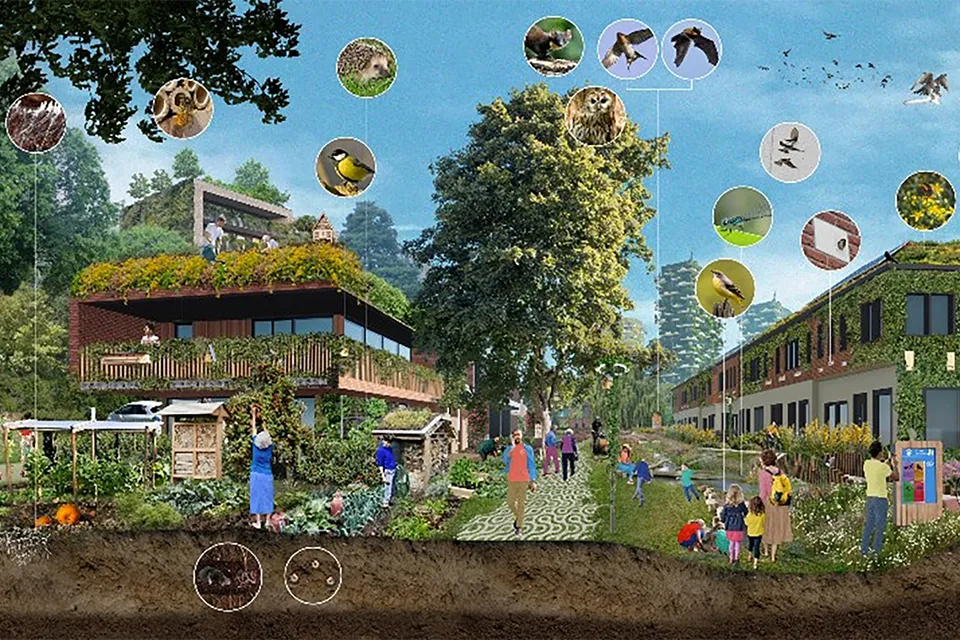
Attention to green space and biodiversity in cities has grown substantially in recent years. Municipalities are developing policies, developers are talking about nature-inclusive building, and urban plans are giving a prominent place to trees, flower-rich vegetation and water storage. Yet putting these plans into practice is challenging. Policy does not automatically translate into planting beds. A rendering is not an ecosystem. And biodiversity does not appear simply by putting up a nest box at the end of a project.
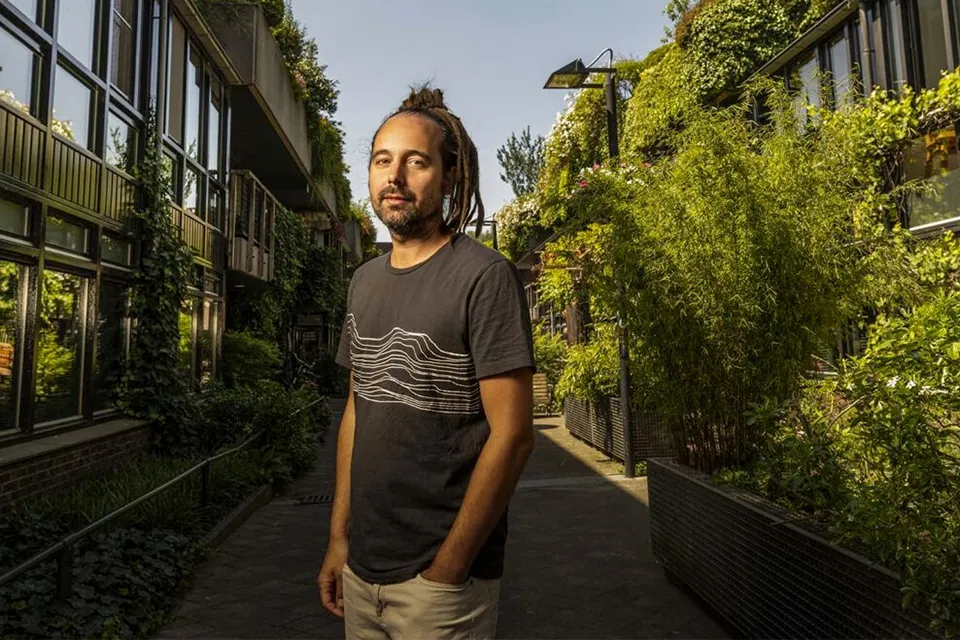

That is the thread running through the conversation with Joeri Meliefste, Expert in Urban Greening at Sweco, and his colleague Gijs Meijer, ecologist and specialist in biodiversity and nature-inclusive design. Both see the subject being taken more seriously. At the same time, they believe the pace needs to pick up. “Things are moving in the right direction, in a way,” says Meijer. “But at the same time I also think: come on, let’s get a move on. We know it matters and how to do it, but that is still not really reflected in practice.”
From policy to practice
According to Meijer, the Netherlands is in a transitional phase. There is ambition, but it runs up against other policy areas when it has to be put into practice. Housing, parking, cables and pipes, maintenance budgets and political choices all compete for the same square metres. “Municipalities adopt policies on green space and biodiversity, but these often clash with rules on parking, infrastructure, housing, energy generation, material use, political priorities and other issues. They have all been set separately, but when you have to combine them on the ground, you run into difficulties.”
Meliefste recognises the picture. He sees frontrunners taking a different approach to design, landscaping and management. But biodiversity does not yet carry the same weight in decision-making as climate adaptation. Stress tests, risk dialogues and programmes have been developed for climate adaptation. There is national government direction, people have been hired to work on it, and funding is available. The same cannot be said of biodiversity.
“There is not as much money or pressure behind it as there is for climate adaptation,” says Meliefste. In his view, the European Nature Restoration Regulation could bring change by requiring public authorities to preserve green space and take a more structured approach to nature restoration.
Pointless paving
Meliefste is known for his campaign against “pointless paving”: unused paved areas that can be replaced with green space without much loss of function. Using a tool developed by Sweco, he has helped dozens of municipalities identify such places. “Every municipality has paving that is not being used. It is very easy to turn it into valuable green space.”
Yet more green space does not automatically mean more biodiversity. Many cities look green but are ecologically poor. Large lawns are mown intensively. Trees are often crown-lifted high and are all the same species. In many places, the shrub and herb layers have disappeared.
“The whole structure has been stripped away,” says Meliefste. “Because of budget cuts, concerns about public safety and all sorts of other reasons. Yet the shrub and herb layers are precisely what make a place so interesting for nature, and ultimately for people too.” He calls intensive lawn mowing “completely pointless” from a biodiversity perspective. What is more, he says, it is not necessarily cheaper. “The irony is that intensive mowing often costs more.”
Green space is not a backdrop
Ambitions for new-build projects are often high at the outset. In images and plans, green space seems a given. But once land has to be made available for sale, parking spaces are needed and maintenance teams join the discussion, there is less room. “New-build projects give you the chance to get it right,” says Meliefste. “But sometimes what actually gets built outside as new green space is quite disheartening.”
Green space is still too often seen as a cost rather than a source of value. Yet its benefits to society are wide-ranging: cooling, water storage, health, quality of life, property values and biodiversity. The problem is that these benefits do not always go to the party making the investment. “The benefits accrue to society, not directly to the municipality or developer paying for them.”
This is especially true of trees. A tree only really delivers ecological and climate benefits if it can grow to a large size. “Ultimately, you want trees that are sixty, eighty or a hundred years old. The bigger, the better.” All too often, however, trees are squeezed into narrow paved strips between cables, pipes and parking spaces. They are then left without enough root space, water or oxygen. “It is a wonder they grow at all,” says Meijer.
Plan for maintenance from the outset
Maintenance is another sticking point. Ecological green space does not necessarily require more maintenance, but it does require a different approach. Staggered mowing, tailored management, knowledge of vegetation development and patience are all important.
That conflicts with maintenance organisations that have spent years being judged on efficiency, appearance and cost reduction.
Meijer believes maintenance teams should be involved much earlier in the design process. “If a different type of green space is being introduced and we want more nature, that also needs to come with a certain budget.” Without extra funding for maintenance, it is understandable that maintenance teams are reluctant. They are given more green space, and more complex green space, but not the resources to manage it properly.
Meliefste sees the same thing in municipalities. “Funding is arranged to create more green space. But people forget that extra green space also needs to be maintained. So you need to increase your maintenance budget too, and often that does not happen.”
Native species and diversity
The balance between native and non-native species is a recurring topic of debate in the green sector. Meijer is clear on the matter. “From an ecological perspective, there is no doubt that native species are the basis for biodiversity, including in cities.” That does not mean, he says, that everything has to be native. Non-native species are needed, especially for trees in stony urban environments, for example because they are better able to withstand heat, drought, paving and salt.
But Meijer sees less reason to routinely choose non-native species for shrubs and herbs. Many insects are largely or entirely dependent on native host plants. Adult butterflies can find nectar on all sorts of plants, but most caterpillars grow only on specific native species. And many pollinators can get their nectar and pollen only from flowers that occur here naturally.
Meliefste adds another point: diversity. Uniform avenues planted with a single tree species are vulnerable to disease, pests and climate stress. “We like to plant the same species in a row, but that is a designer’s reflex. In my view, the structure of an avenue comes much more from the line and the regular spacing between the trees than from having exactly the same leaves.”
Towards a green-space standard
To move green space and biodiversity out of the realm of voluntary action, both Sweco experts are calling for clearer standards. Meijer sees local assessment frameworks and nature-point systems as a way to make biodiversity part of spatial development. Not because he thinks the Netherlands needs even more rules, but because issues without a standard or requirement often lose out. “In a country as heavily regulated as the Netherlands, if there are no rules for green space too, it simply will not happen.”
Meliefste is calling for a national green-space standard, comparable to the parking standard. It should not prescribe the same percentage everywhere, but be adapted locally for each neighbourhood or area type. The standard should also look beyond tree-canopy cover alone. “You do not just want trees, you want layers. Pollinators are not looking for trees alone. And species richness does not tell the whole story either. It is about how the system functions.”
His question is simple, yet politically sensitive: “We have a parking standard everywhere in the Netherlands and consider that normal. So why not a green-space standard?”
Question about this story? Ask your question
Keep following this
Get an email when a new story is published. No account needed.
- ThemeSpace for urban green
- SubjectGeneral







