The lawn after the football frenzy
Text and images Eliet Europe NV
How to keep a lawn looking good after summer
If there’s one thing we’ve all been glued to over the past month, it’s the lawn. The FIFA World Cup had the world enthralled, filling hours of airtime and pages of newspaper articles and press releases. For a while, ‘the most important side issue’ seemed to have become the main event.
Although the vast majority of people were mainly focused on what was happening on the pitch, many readers of this magazine will no doubt also have been keeping an eye on the quality of the turf on which the spectacle unfolded. As a landscape contractor, you know how difficult it is to keep a lawn in top condition. All the more impressive, then, to achieve this under the extreme conditions to which a World Cup pitch is exposed: high temperatures and intensive use. We have the utmost respect for the work of the groundskeepers who managed it all, despite the stress and overtime involved.
World Cups naturally involve unlimited budgets, with all the cameras focused on the pitch. This is in stark contrast to the reality for landscape contractors, who also want to create a beautiful lawn for their domestic clients, but generally have to do so on as limited a budget as possible.
Private lawns are often looking rather worse for wear after summer, too. The combination of summer heat, drought, World Cup parties, BBQs and other holiday excesses takes its toll. As a lawn-care specialist, it is therefore important to take the right steps in autumn to get the lawn back into shape. ELIET explains how a carefully planned, budget-friendly renovation programme can completely transform a lawn in just a few weeks. Autumn is the ideal season for this kind of treatment, so don’t miss the opportunity.
Good preparation
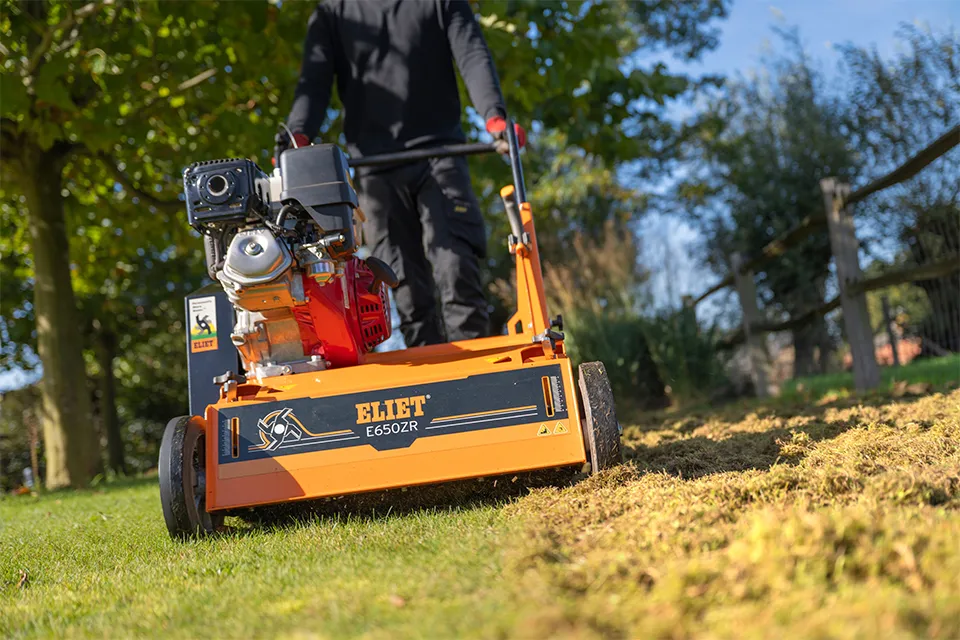
Drought is often the main culprit behind significant grass loss. It is therefore essential to remove dead material from the turf first, creating space for new grass to grow. The latest generation of self-propelled E-ZR scarifiers offer a number of important advantages. They feature extra-thin Permanent Puntige™ blades spaced just 15 mm apart, allowing the turf to be thoroughly cleaned in a single pass while disturbing the grass as little as possible.
Unlike a conventional scarifier, the rotor carrying these blades turns in the opposite direction. This rotation allows the blades to scoop up dead grass, moss and thatch completely, lifting it all out of the lawn for efficient removal. These E-ZR scarifiers are self-propelled and run on a roller, so the lawn is rolled as it is being treated and is immediately ready for the next step in the renovation programme.
Ensure successful rejuvenation
Once the lawn has been cleared, the next step is to restore its density. A strong, healthy lawn has dense growth, leaving no room for weeds or other invasive plants. We fill the gaps between the grass plants by sowing new grass seed, which also gives the turf a welcome rejuvenation.
Overseeding the existing turf can be done effectively with the ELIET DZC450 overseeder. The key to success is ensuring that the grass seed is actually placed in the soil. The ELIET DZC cuts grooves 0.8 cm deep into the lawn. Thanks to an ingenious patented seed distribution system, the machine injects the grass seed into each groove immediately after cutting it. It then rolls over the seeded groove to close it straight away, neatly enclosing the new seed in the soil. The earth displaced when cutting the grooves is spread evenly over the seedbed as a protective cover.
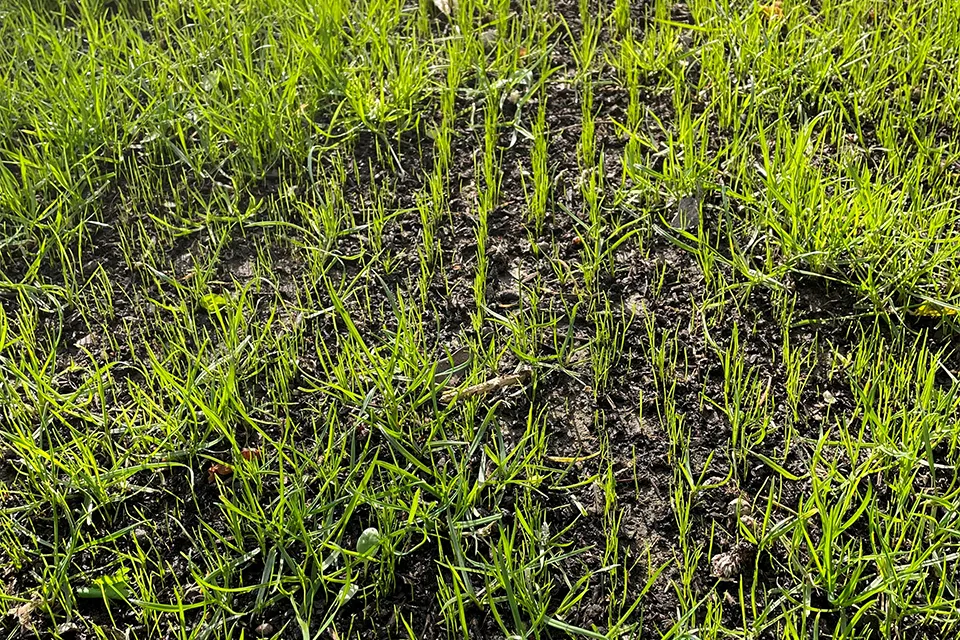
The DZC450’s seed rows are just 25 mm apart, making for a fairly dense pattern. Once the grass has emerged, it is as if a completely new lawn has appeared within the existing one. The clear, continuous seed rows show that, thanks to the ELIET DZC’s seeding technology, not a single seed is wasted.
The transformation is nothing short of spectacular. Lawn owners can normally see the effect around two weeks after overseeding, and landscape contractors can expect an enthusiastic call from their clients during that period.
Autumn is the best time for this kind of overseeding treatment. The soil has warmed evenly over the summer, and grass germinates best at a soil temperature above 12°C, which is consistently the case in autumn. As well as warmth, grass seed needs sufficient moisture to start the germination process. In autumn, temperature fluctuations between day and night increase, leading to more condensation and therefore heavier morning dew. Rainfall also becomes more frequent, keeping the moisture level in the topsoil constant. Ideally, schedule overseeding to coincide with an approaching spell of rain, as the combination of high soil temperatures and sufficient moisture will make the grass emerge in record time.
Manage aftercare
Overseeding in autumn has a further advantage: young grass has plenty of time to develop a deep root system and form a mature leaf canopy without disturbance. Its first real test comes during the next prolonged dry spell, and in recent years spring has consistently brought a period of rainfall deficit. A well-developed root system enables young grass to survive this drying out of the surface layer.
It is important to encourage grass growth in a targeted way after overseeding. Fertiliser can be applied, preferably a slow-release organic fertiliser. A heavy application of nitrogen would stimulate the existing grass too strongly and hinder the development of the young grass. In the worst case, it will scorch the young seedlings and undo the results of the renovation programme.
Topdressing the renovated lawn with a compost mix is recommended. The benefits are numerous: the dark colour of the topdressing material raises the soil temperature and stimulates germination. The compost activates soil life in the top layer, making it friable and encouraging root development. It also improves drainage, allowing rainwater to be absorbed more effectively. Organic matter helps bind nutrients that become available to the young grass, while the compost retains dew and condensation moisture at the surface, which is crucial during the grass seedlings’ initial growth phase.
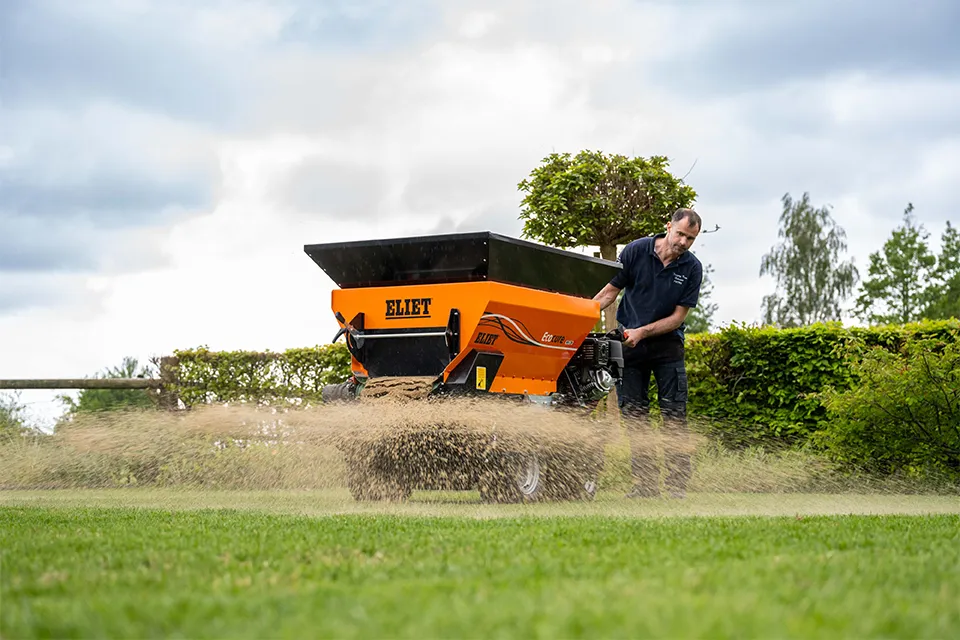
Ideally, topdress immediately after overseeding. The ELIET EcoCure ZR WS, a 600L wide-spreader, allows you to distribute topdressing material quickly and evenly across the lawn at a controlled rate. With an adjustable spreading width of up to 6 m, the job is completed efficiently. Its many adjustment options make it suitable for a wide range of topdressing mixes. This fully hydraulic topdresser is also highly manoeuvrable on small areas.
Conclusion
Renovating a lawn in autumn is no unnecessary luxury, it is an investment that pays off. Taking the right steps after summer gives the lawn a chance to recover thoroughly and go into spring in stronger condition. With the right ELIET machines, from the E-ZR scarifier and DZC450 overseeder to the EcoCure ZR WS topdresser, landscape contractors have a complete, carefully planned renovation programme at their disposal. It is efficient, budget-friendly and delivers results that speak for themselves. A beautiful lawn does not start in spring, it is made in autumn.
Question about this story? Ask your question
Keep following this
Get an email when a new story is published. No account needed.
- ThemeKeeping sports pitches and lawns in condition
- SubjectMachinery & equipment