Making green-space management easier with electric and (semi-)autonomous machines
This year, Husqvarna’s Living City focuses on more greenery in cities and smarter tools
“Rethinking urban green space” was a loose translation of the theme of Living City 2022, held in London in mid-October. Organiser Husqvarna wants to help green-space managers with state-of-the-art maintenance machines that save time and money. They are not only fully electric, but can also work autonomously or be operated remotely. The conclusion: green-space management is changing, and our surroundings are all the better for it (and, ultimately, so are we!).
e in our cities are used to. As a masterstroke, he even transformed the bare lawn around the Tower of London into an attractive sea of flowers and plants (see photo). According to Nigel, it is precisely this untamed growth that will benefit cities: more colour, more diversity, more insects and, ultimately, more satisfied residents. His advice: don’t mow everything down again too quickly. That may be bad news for lawnmower suppliers, but it is better for the future we all share.
Too close together to make room for greenery
Another point of concern is the traditional practice of packing buildings closely together, leaving barely any room for green spaces between them. The call to urban planners is essentially to sit down with landscape architects more often, so that we can move from a lifeless, paved environment to a greener, more vibrant place to live and work. It is not only residents’ health and wellbeing that matter here. The need to make our cities climate-resilient is also becoming increasingly apparent, for example by retaining rainwater for longer in green spaces, including on roofs, and increasing CO2 absorption by planting more trees and avoiding felling existing ones too soon.
It is also clear that the coronavirus pandemic has given policy-makers an extra incentive to focus on green spaces. More working from home calls for a relaxing outdoor environment where people can enjoy short social, sporting and recreational activities.
Innovation in machines and tools
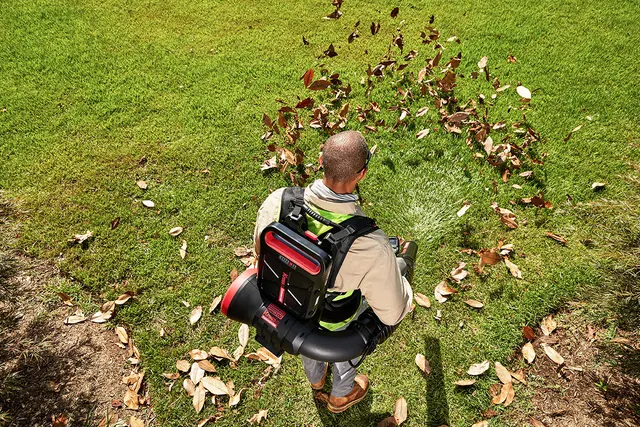
Husqvarna is clearly keen on innovation, with several smart machines and devices demonstrated at Living City 2022. They are intended, among other things, for managing and maintaining large city parks, sports fields, golf courses and even airports and landscaped solar parks. The Swedish company is taking two approaches. The first is electrification, including of mowers. This is a logical step, following the move from petrol to battery power for handheld tools. No fumes, no mess, less physical effort needed to start them and less danger. And, of course, much lower CO2 emissions. Battery power has now proved its worth in terms of power and run time, and more and more machines and tools can be electrified.
The new Husqvarna BLi-X 36V batteries, for example, come in three different capacities and feature ActiveCool. They are part of the 525i series of electric grass trimmers and brushcutters, due to launch in 2023. According to Husqvarna, they perform as well as the 25cc petrol models.
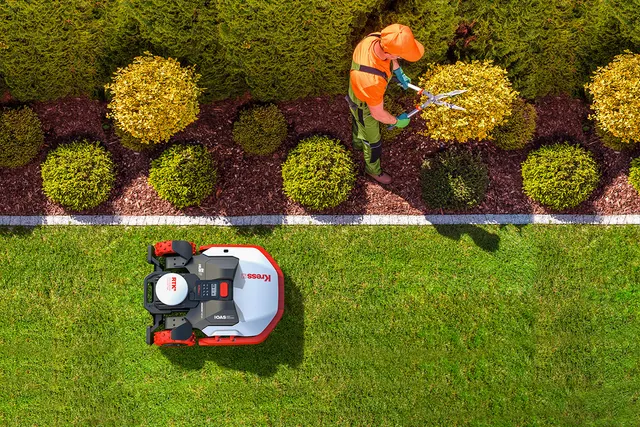
The second approach is even more interesting: making lawnmowers more autonomous. Husqvarna now describes itself as the ‘world leader’ in robotic mowers, and plans to build on that claim in the coming period with new and improved machines.
Working safely on steep slopes
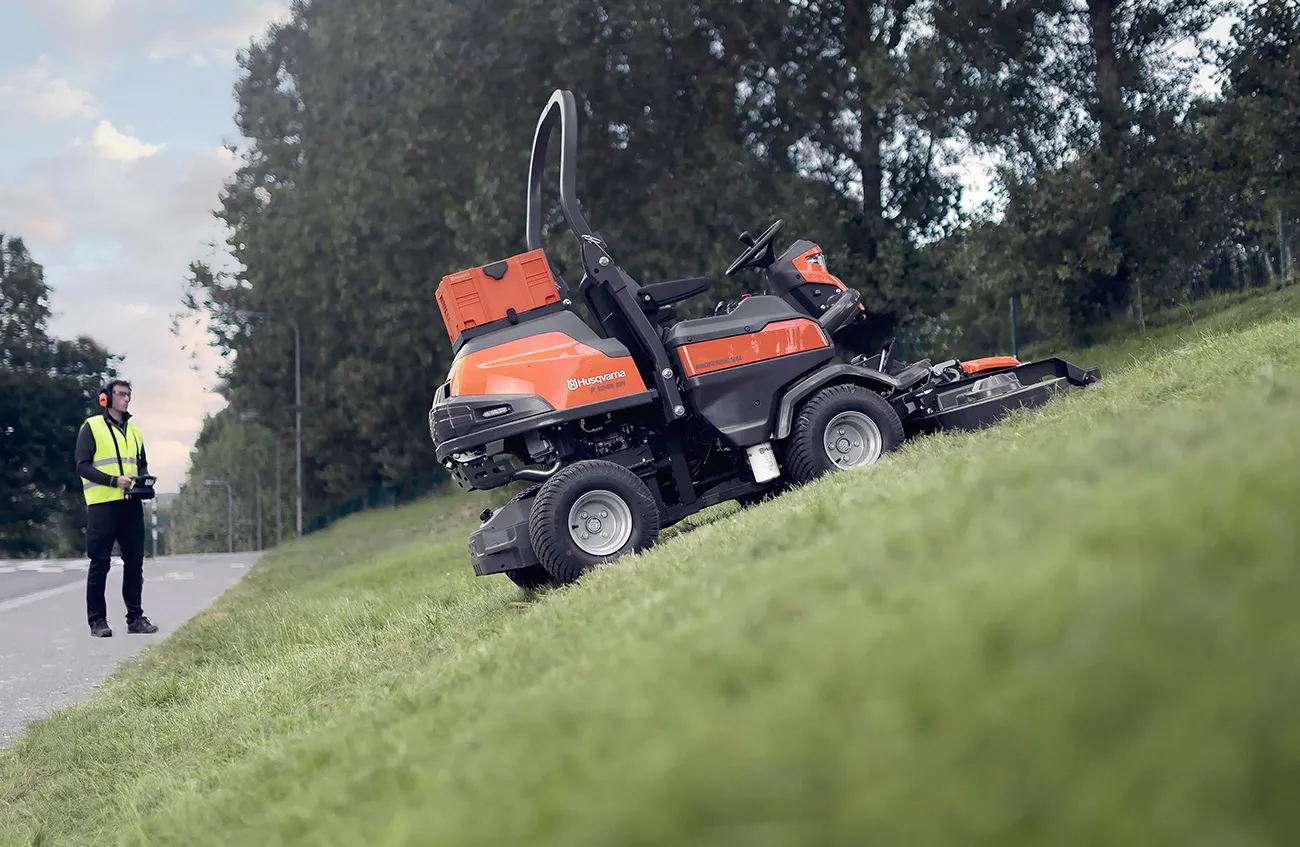
Operating a large mower on a slope after rainfall presents risks for the driver. It therefore makes sense to keep the operator at a safe distance and let the machine do the mowing on the steep slope, which can be as steep as 60 degrees. The P 524XR EFI commercial front mower has therefore been fitted with a remote control in the form of a belt-mounted transmitter. It is quick and seamless to switch between onboard and remote control. The front mower can also tackle areas that are often missed, such as beneath overhanging branches. The newly facelifted X model of the P 524 mower, which still has a petrol engine, also features a new 137 cm-wide cutting deck, a digital user interface and built-in Husqvarna Fleet Services connectivity.
Mowing solar parks and airports
Autonomous mowing is more cost-effective, but has always been difficult to implement on large sites such as airports, where safety is a concern, and solar parks, with their many obstacles and GPS signal obstructions. The Autonomous Operation System for Professionals is designed specifically for these challenging situations. It uses a highly accurate satellite navigation system that provides improved real-time positioning accuracy. Location accuracy is 2-3 centimetres, and as an additional safety measure an operator can manoeuvre and control the system remotely. The machines are fully electric, powered by solar energy in the solar park. Husqvarna plans to demonstrate the potential applications of this technology through a pilot project at a Swedish airport.
CEORA takes on the varied demands of golf courses
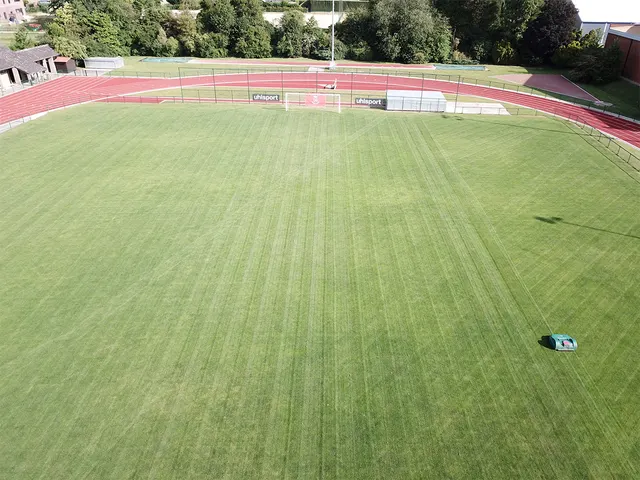
Husqvarna is introducing the CEORA professional robotic mower, with its new, lower 43L cutting deck, for large and varied areas of grass. With a capacity of 20,000-25,000 square metres per day, CEORA can mow up to three standard-sized fairways a day. Its electric cutting-height adjustment allows the same robotic mower to mow fairways, semi-rough, rough and other sports areas at cutting heights of 10 to 60 mm. The autonomous, electric mower reduces maintenance costs and can cut CO2 emissions over the machine’s lifetime by as much as 83% compared with a diesel Husqvarna P 525DX ride-on mower.
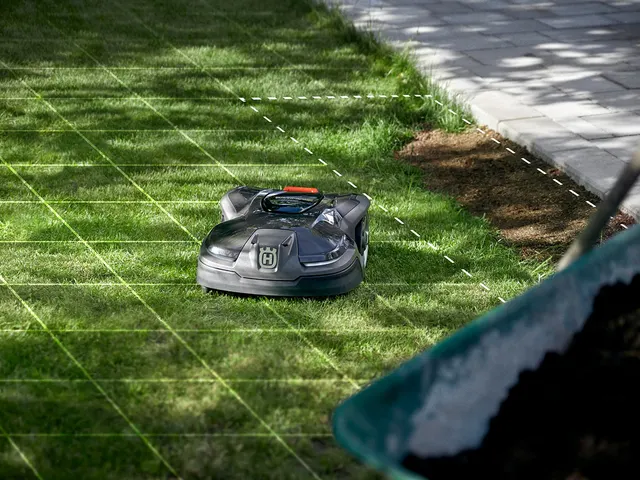
A further improvement is planned for 2023: an upgrade to Automower 550 EPOS, the first robotic mower to use ‘virtual boundary EPOS technology’. It no longer needs physical boundary wires. Instead, a working area is assigned digitally, after which the mower can work autonomously, mowing systematically and doubling its capacity to 10,000 square metres per day. EPOS technology is a highly accurate satellite navigation system, delivering accuracy of 2-3 centimetres and enabling multiple mowing patterns.
Question about this story? Ask your question
Keep following this
Get an email when a new story is published. No account needed.
- ThemeCleaner and safer working
- SubjectSports pitches