









The growing importance of high-quality scarification
Text and images Eliet Europe NV
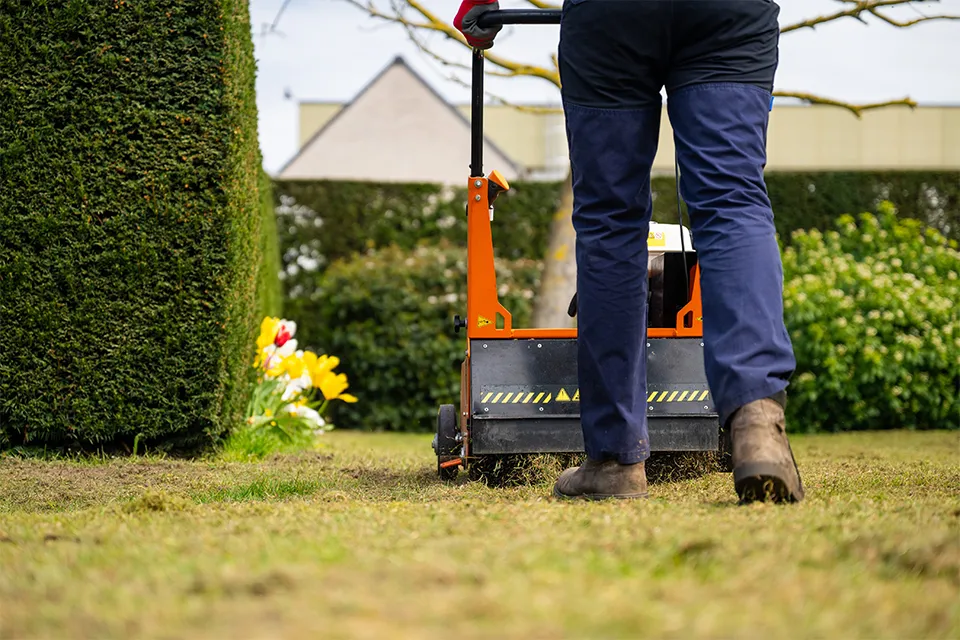
Extreme weather calls for more lawn care
A beautiful garden significantly increases a property’s value. More than that, it plays a key role in the wealth a homeowner builds or wants to protect. When a client entrusts the care of their garden to a landscaping contractor, they can regard this as the proper management of a valuable investment. Lawn quality plays a crucial role in the garden’s appearance. This is also why lawn care has received increasing attention in recent years. However, managing a high-quality ornamental lawn has become much more complex as the climate changes. Fortunately, machinery is evolving too, enabling you as a landscaping contractor to continue offering the best care.
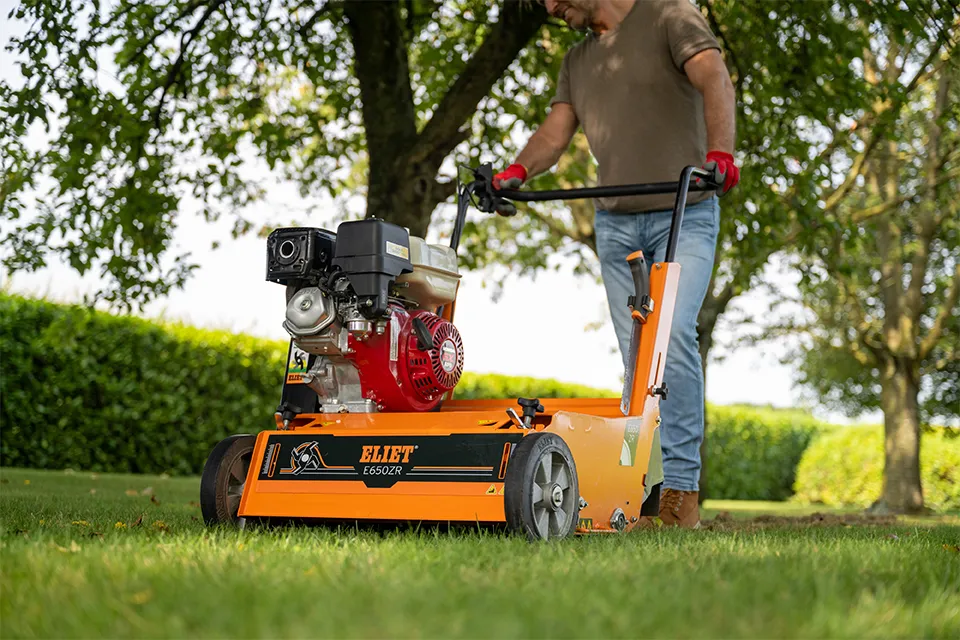
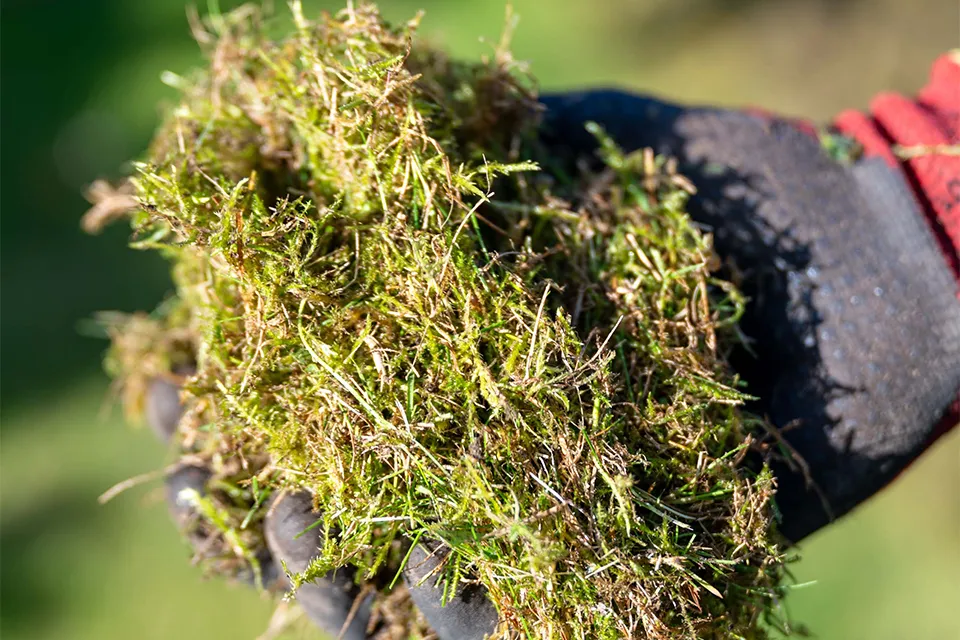
One essential treatment that has once again become increasingly popular as a result of recent climate fluctuations is scarification. The reason is simple: extreme drought during the spring and summer months causes grass to die. This dead grass forms a thatch layer that suffocates the sward and makes recovery more difficult. At other times, excessive rainfall encourages moss growth, preventing dense grass growth.
Scarification ensures that this build-up of organic material is removed in a controlled way. This clears the space between the grass plants, allowing light and air to penetrate and stimulating renewed growth. The density of the sward is, after all, one of the most important factors in a lawn’s appearance. As a landscaping contractor, you can only work on this once the ‘burden’ has been removed from the lawn.
Minimal recovery, maximum results
As the climate changes, lawns are under greater stress and the window in which you as a landscaping contractor can act is becoming increasingly narrow. It is therefore essential that your interventions do not put the lawn under additional stress and that the recovery period is kept short.
Scarification is inherently an invasive operation. The vertically rotating blades cut through the sward and rake away debris, but inevitably come into contact with the grass sheaths and surface roots. You can think of this as a form of pruning that ultimately stimulates growth, but in the short term it creates a ‘wound’ that demands energy from the plant.
As a manufacturer, ELIET has more than 40 years’ experience in building scarifiers. The recently launched E-ZR generation was specifically developed to carry out this process as precisely as possible: the lawn is thoroughly cleaned while disturbance to the grass is kept to a minimum.
The technology behind the E-ZR range
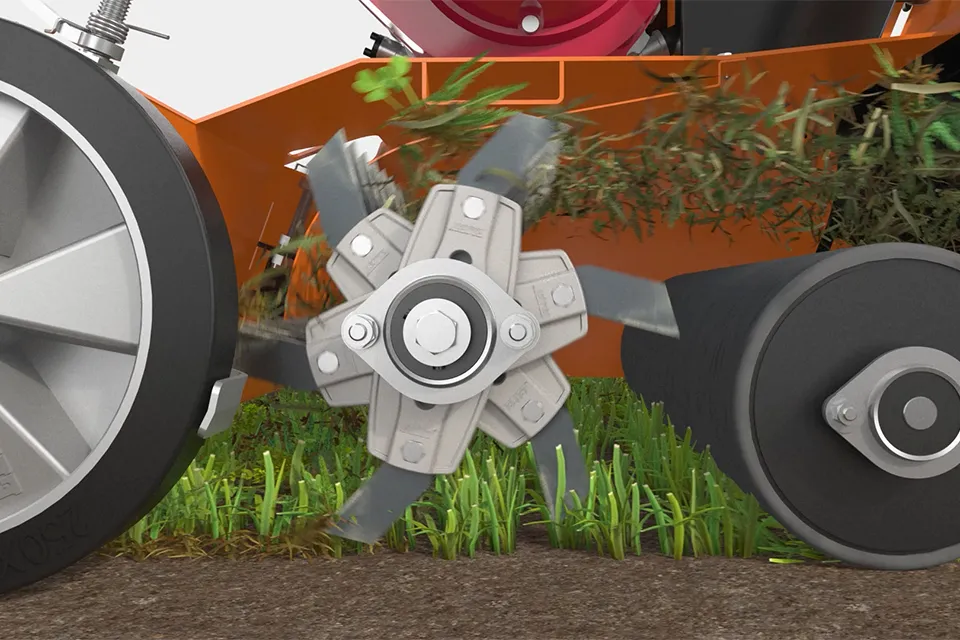
What makes the E-ZR range so special? One important development is that these machines are self-propelled. This drive system enabled ELIET to make the blades rotate in the opposite direction to travel without this affecting the operator. This reverse rotation is essential for high performance: the blades dig into the thatch or moss and lift it completely out of the sward, ejecting it over the top of the machine. This gives you, as a professional, confidence that the debris has actually been removed.
The E-ZR machines are fitted with ELIET DoubleCut™ blades, mounted just 15 mm apart. This means that every 1.5 cm of the sward is worked intensively. As moss and thatch are interwoven structures, they are inevitably caught by this close-set arrangement of blades. The DoubleCut™ blades are fixed, wafer-thin blades measuring just 1.5 mm. Their path is very narrow, allowing them to target thatch and moss precisely while causing minimal damage to the grass. Where conventional machines with loose flails often wreak havoc, the E-ZR works almost surgically.
These blades also feature Permanent Sharp Blades™ (PPM) technology. Thanks to their self-sharpening function, they retain their sharp edge, which is essential for gripping moss. Despite natural wear, the blades therefore never lose their efficiency throughout their entire service life.
An extra advantage for an attractive ornamental lawn
The combination of these features gives ELIET E-ZR machines unrivalled results, both in terms of the volume of material removed and the quality of the finish. Another advantage is that the E-ZR scarifier runs on a rubber roller at the rear rather than on wheels. This rolls the ground straight away, one of the hallmarks of a top-quality lawn.
During scarification, small irregularities, such as worm casts in spring, are neatly levelled by the rubber roller. This requires no extra effort or operation from the landscaping contractor. Another advantage of the roller is that it presses the grass flat before the ejected moss and thatch land on top of it. This prevents the material from catching in the sward again, making clean-up considerably easier. As a bonus, the machine leaves behind the coveted stripe pattern, making the quality of your work immediately visible in the overall appearance.
Whether you scarify in spring or autumn, this technological development ensures a thorough clean without putting the grass under unnecessary stress. It also provides the perfect foundation when scarification is part of a wider renovation plan, such as overseeding, aeration or topdressing.
Question about this story? Ask your question
Keep following this
Get an email when a new story is published. No account needed.
- ThemeGardens from design to maintenance
- SubjectGeneral







