Greater awareness needed of solution that saves councils a great deal of money
Text Carolien KleesImage Peter Farla/GreenMax
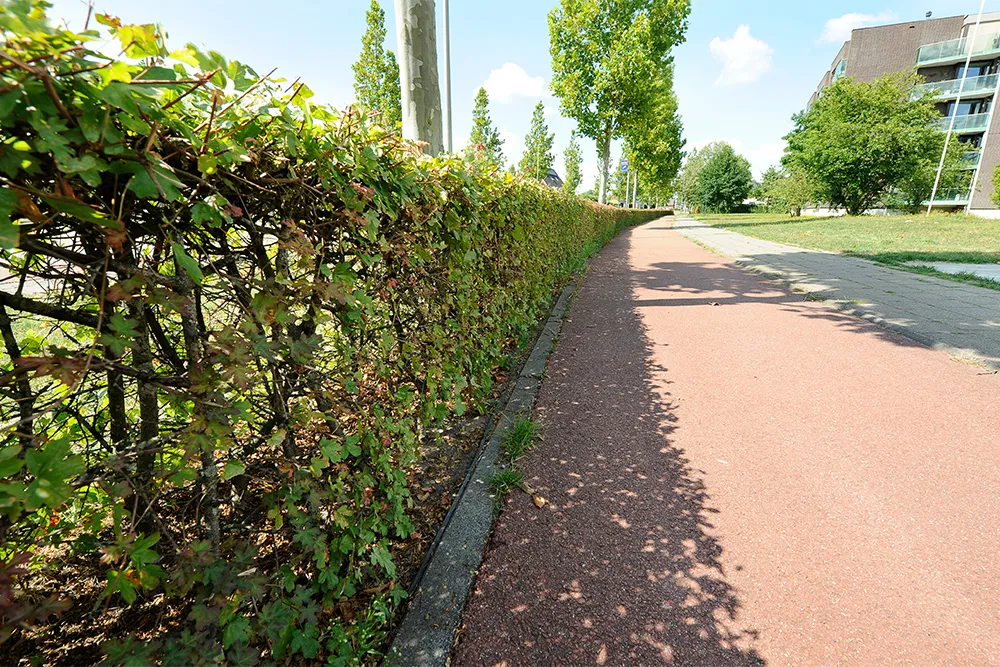
Preventing root damage to paving
An interesting fact about tree biology is that, in our hemisphere, roots bend to the left. At least, in our hemisphere. On the other side of the equator, the Coriolis effect makes them grow to the right instead. Using this knowledge, GreenMax has developed an effective long-term solution to prevent root damage to paving. The problem causes numerous traffic accidents and costs communities millions of euros every year in repairs to roads and utilities. GreenMax’s underground solution has been used on countless projects worldwide for over 20 years, from the Eiffel Tower and Disneyland in Paris to the Pearling Path in Bahrain. Let’s take a closer look at this hidden underground system, which has already successfully prevented many cases of root damage to paving.
Bert van Gils, a growing-site specialist and arborist at the GreenMax Group, advises on avenue, park and street trees. “Root damage to paving is a major and costly problem. Sometimes a cycle path has to be resurfaced after just three years because the adjacent tree has damaged the pavement. Laying asphalt is expensive and not very sustainable. What’s more, root damage to paving creates unsafe traffic conditions.”
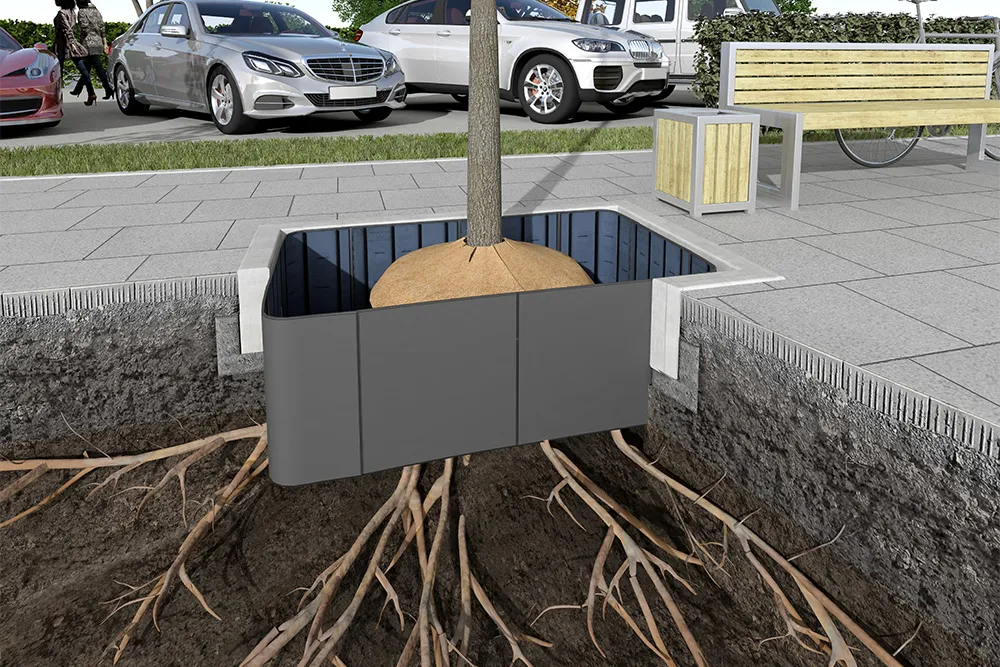
Tree biology
“Roots seek the path of least resistance and tend to grow towards the surface, where condensation and nutrients are available. But there’s something else of interest. The Coriolis effect, caused by the Earth’s rotation, also plays a role in root growth. This means that tree roots grow anticlockwise in the northern hemisphere and clockwise in the southern hemisphere.”
A unique solution
Using this knowledge, GreenMax developed the Tree Root Guide (TRG) guiding system. This unique, circular system consists of special panels with guiding ribs. “The ribs, set at right angles, guide roots vertically downwards, deeper into the soil. Once the roots reach the bottom of the panels, they can continue growing horizontally. This allows the tree to anchor itself securely without damaging the road surface or utility network.”
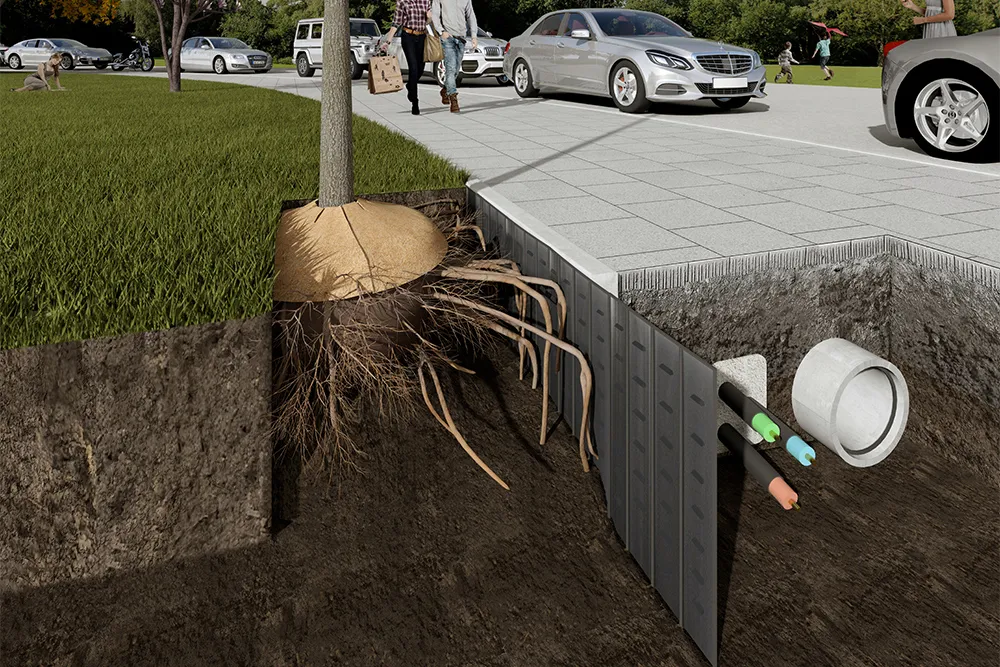
New planting
With several panel types available, TRG offers solutions for a range of situations. Sliding panels are ideal for trees completely surrounded by paving, such as in squares and on pavements. They form a neat 90-degree angle and have a sturdy double edge that can withstand foot traffic.
Preserving mature trees
TRG can also be used to preserve the value of mature trees. After the roots have been cut, the system can be installed to prevent future root damage to paving. “For mature trees, combining the panels with our TreeRaft SandwichPanels creates the optimum conditions. This sandwich panel creates an air gap between the paving and the soil, making it completely unappealing to tree roots as a direction of growth. And if roots do grow towards it over time, the surface will develop only a gentle slope. This is not the sharp bump that is more dangerous and causes the asphalt to crack. This approach buys you extra time and postpones future repairs. Another advantage is that the sandwich panels distribute pressure across the ground more effectively. This is useful, for example, when vehicles need to be parked on the paved area.”
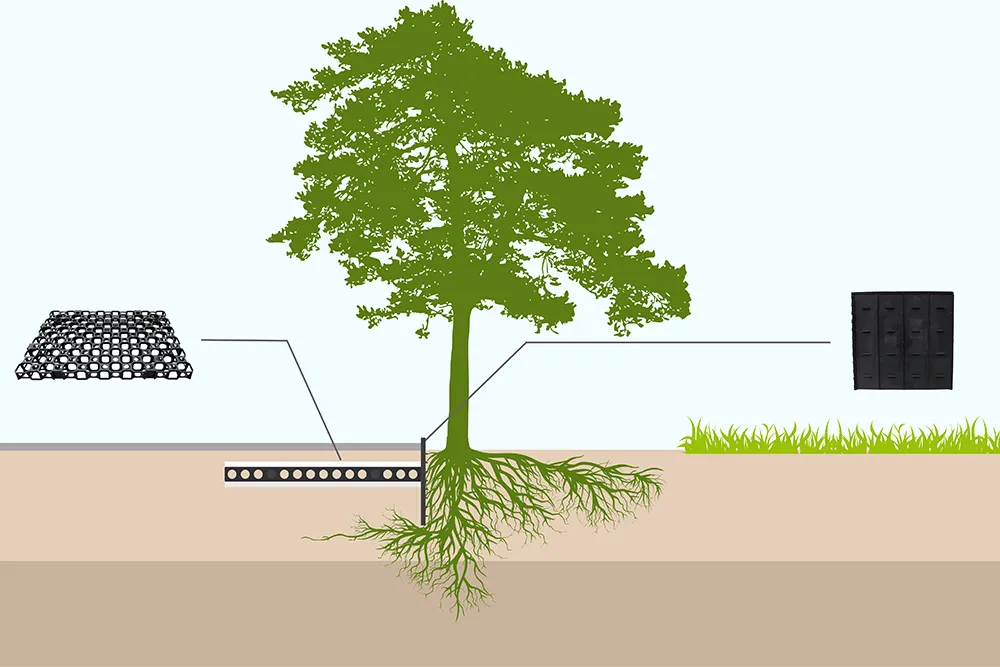
Root barriers
“Although TRG is the best solution in most situations, root barriers are preferable in some circumstances. In those cases, our RootControl root barrier fabric or RootBlock root barriers are the answer. These barriers can also be installed mechanically using a chain trencher, saving a great deal of time, especially on large projects.”
Question about this story? Ask your question
Keep following this
Get an email when a new story is published. No account needed.
- SubjectPublic green spaces