









A sustainable future for wheel loaders and articulated loaders
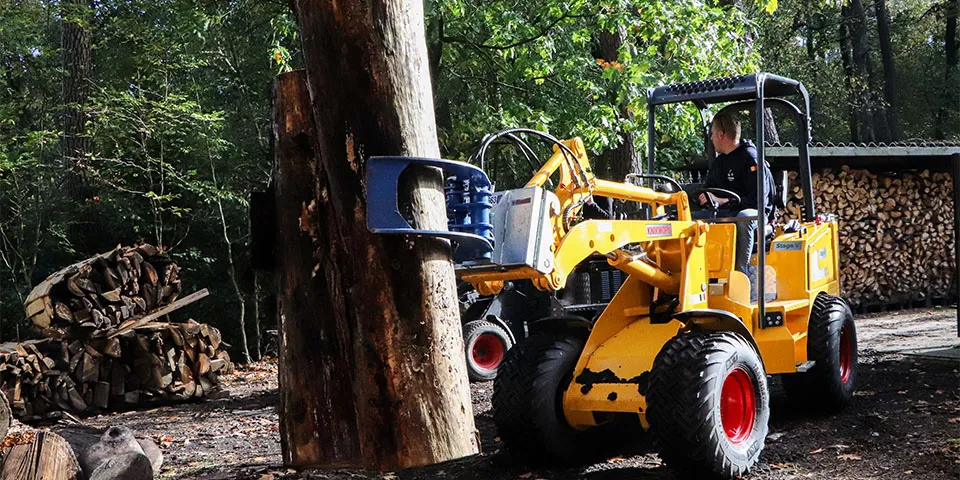
For more than thirty years, Gebroeders Geens NV’s factory in Hoogstraten has been designing and manufacturing versatile machines for landscaping and paving, among other applications. The family business remains true to its core values while keeping a firm eye on the future. With several new developments, the second generation of the Geens family is striving for sustainable top performance and greener prospects.
Stricter emissions standards drive new technology
Gebroeders Geens NV’s mission has remained unchanged for thirty years: with its now well-known yellow Knikmops, the company aims to take the heavy work off the hands of a range of contractors, quite literally. The compact articulated loader is distinguished not only by its high breakout force and impressive lifting capacity, but also by its versatility, thanks to an extensive range of hydraulically powered attachments. Various buckets and mowers, log splitters, weed brushes, rotary tillers and levelling frames make the Knikmops an exceptionally useful machine for landscaping professionals, among others.
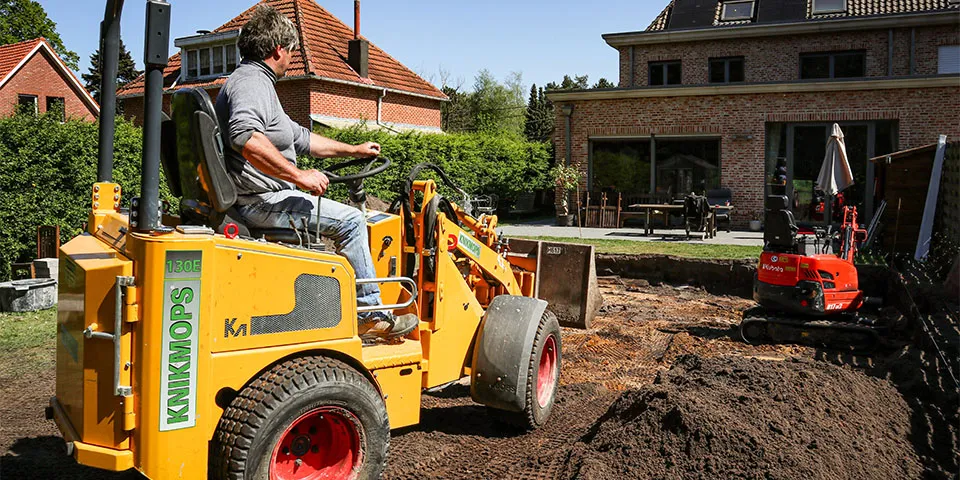
The electric Knikmops prototype is already undergoing extensive testing. At this swimming pool construction site, its quiet motor is helping to keep the neighbours in peace and quiet.
Developed in-house
Like hand tools, however, wheel loaders and articulated loaders are also facing calls for more sustainable performance. The European requirement to bring only machines with Stage V diesel engines to market is drawing steadily closer, and various manufacturers are already looking for electric alternatives. Gebroeders Geens NV has its own dedicated engineering department, which is currently working to ensure that sustainable drive systems also meet the company’s core values of comfort, quality and reliability.
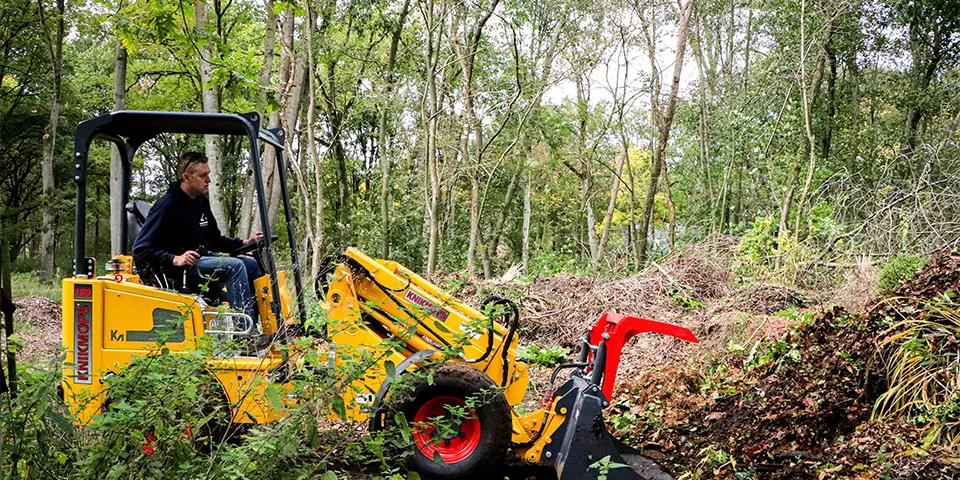
Bigger jobs call for bigger machines, such as the Knikmops 180 TE, shown here fitted with a claw bucket.
Stage V
To limit emissions from (diesel) engines, Europe has been imposing production standards since the beginning of this century. These are being tightened gradually, culminating this year in the Stage V standards. What does this mean? From 2021, only machines fitted with Stage V diesel engines may be produced in the classes up to 56 kW and above 130 kW. These engines significantly reduce emissions, but are generally larger and more complex than their predecessors. “Installing an engine like this requires quite a few modifications to the machine,” says product specialist Bert Geens. “To keep the chassis of our Knikmops articulated loaders as compact as possible, without compromising operator comfort, we took the time to get the engineering just right.”
The smaller models could continue to be produced with Kubota engines after minor modifications, but upgrading the larger models proved a more substantial challenge. “On the Knikmops 180 and 250, with outputs of 33 kW and 36 kW respectively, fitting the new Stage V engines smoothly required more adjustments, for example to accommodate the large particulate filter in our compact chassis. However, with support from the engine manufacturer, we managed to achieve that too. The new engines also give the machines excellent throttle response and quieter operation. The latter is often a decisive factor, particularly in urban areas.”
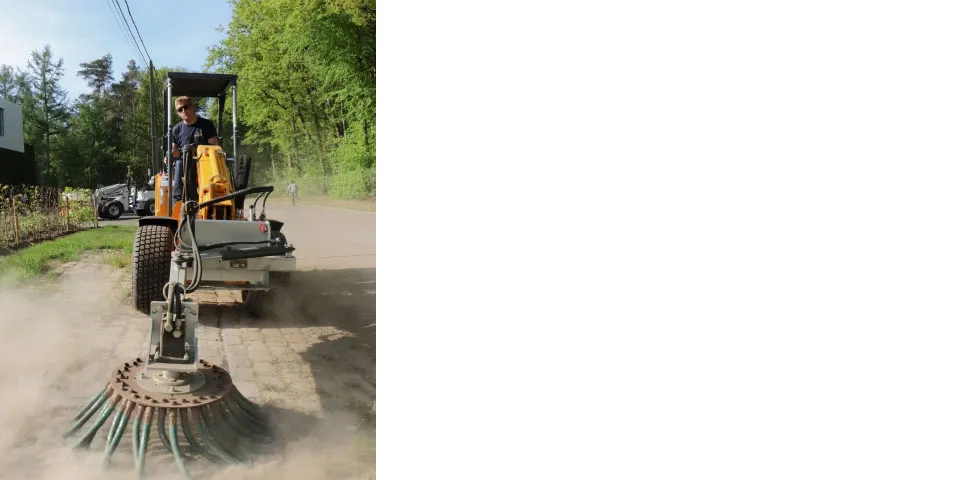
Thanks to its wide range of attachments, such as this weed brush, the articulated loader can be used for a wide variety of tasks.
Electric
An electric motor is quieter still, of course. “Following the automotive industry and the hand tools market, there are also calls for further electrification in our sector,” says communications manager Marleen Geens. “But, as in those other sectors, battery life is a sticking point here too. If we are to launch a sustainable electric solution, it must, in our view, be just as reliable and easy to use as its diesel-powered counterpart. That means it must be able to work a full day.”
Two prototypes have already been through the engineering department. “We have now developed a concept that is particularly energy-efficient, allowing it to deliver long battery life even with a small battery, and therefore at a relatively low cost.”
“Several of our regular customers are now putting that prototype to the test,” Marleen Geens continues. “They are using the machine in their day-to-day operations, comparing its performance with that of their trusted diesel-powered Knikmops and sending us a weekly logbook with detailed information on battery charge, work carried out, energy loss, charging time and so on. This gives us a clear picture of exactly how energy-efficient our electric Knikmops is and how our customers find the machine. So far, the results point to a bright future in which sufficient battery life is definitely achievable.”
Question about this story? Ask your question
Companies in this story
Keep following this
Get an email when a new story is published. No account needed.
- SubjectGeneral
- CompanyGebroeders Geens







