









Brussels Mobility opts for smart tree-watering system
Brussels Mobility is responsible for mobility strategies and infrastructure projects in the Brussels-Capital Region. Public green spaces also fall within its remit. In this area, like many other European cities, the organisation has faced a number of challenges. Many urban trees are suffering from climate change, water shortages, hard surfaces, and the emergence of new diseases and harmful insects. To ensure trees receive enough water, Brussels Mobility recently put a new automated watering system into operation.
A remedy for looming water shortages and disease
Important decisions
Brussels has more than 32,000 trees in public spaces and along regional roads. Monitoring and maintaining these trees continually requires important decisions. Which trees should be felled and replaced, and which can still be saved? Should weak specimens be felled and replaced individually as the need arises, or should all the trees along a particular avenue be dealt with at the same time?
Monoculture or diversification?
To prevent diseases from spreading, a number of European cities have already opted to plant different tree varieties along the same street. Most diseases mainly affect a particular tree variety. Diversifying tree varieties could well become the norm in the future.
At present, for example, chestnut trees are facing a serious problem. ‘Chestnut blight’ is a highly contagious and fatal disease that inevitably kills the trees. Yet one of the basic requirements for healthy urban trees is to provide them with enough water, but not too much or too little. With this in mind, an automated watering system has been developed.
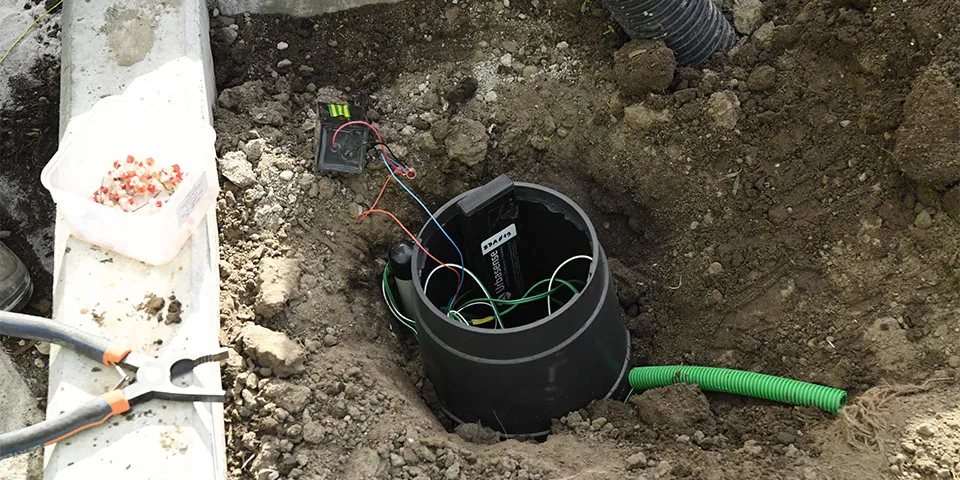
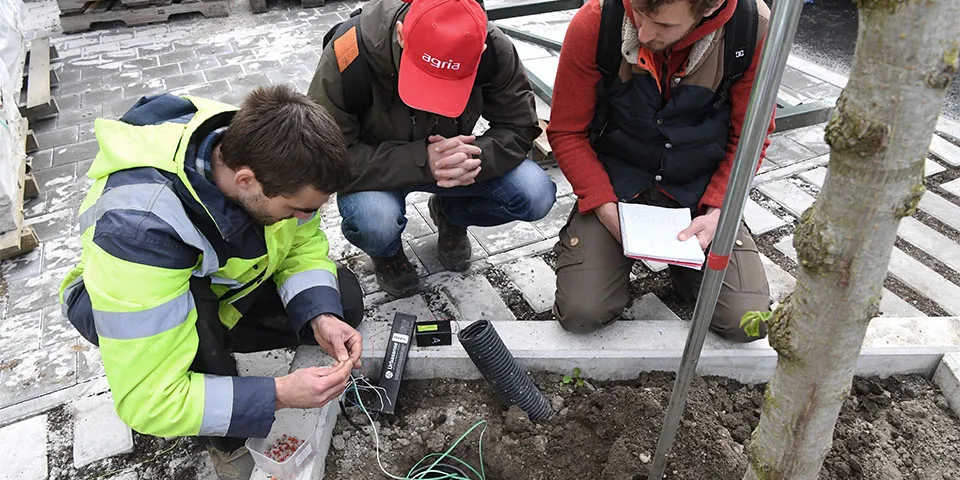
Installing the tensiometric probes. (Copyright GOB)
Tensiometric probes
Hundreds of trees are now equipped with tensiometric probes that continuously monitor the moisture levels at their planting sites. The probes measure the trees’ water requirements, based on their physiology and the climate, as well as the amount of water available in the soil. The readings are sent to an application that allows the administration to monitor the trees regularly and issues alerts to help schedule watering for individual trees. It was also decided that every newly planted tree would be equipped with the system.
Saving water
Under normal conditions, each tree needs around 120 litres of water per watering. At a time of water scarcity, the probes can help save substantial amounts of water. A tree should receive water only when it really needs it. A tree that gets too much water will suffocate and stop root activity. Overwatering is certainly harmful. The probes ensure that each tree receives the amount of water it needs, without wasting water unnecessarily.
By 2020, more than 560 trees were already benefiting from this technology, and further projects are currently being developed. Recent or planned examples include Steenweg op Bergen, Pol Burysquare, Docks-ovonde, Hallepoort, Olympische Dreef, Regentlaan and Henri Simonetlaan.
Efficient maintenance
Thanks to a cartographic management system with geolocation, Brussels Mobility can monitor the characteristics and condition of every tree along regional roads and in public spaces. This greatly improves the efficiency of monitoring and maintenance and makes it possible to take highly targeted action. Further climate changes in our region call for vigilance, and these probes make a major contribution to that effort. Their real-time data supports the right decisions, enables a rapid response and therefore plays a key role in preserving Brussels’s tree population, and possibly that of other cities in the country too.
Question about this story? Ask your question
Keep following this
Get an email when a new story is published. No account needed.
- SubjectGeneral







