









Building without forgetting the residents
Text Fleur DilImage Vivara Pro
Turning ecological ambitions into practical solutions in construction and public spaces
How can we combine the enormous construction and insulation challenge with ever higher ecological ambitions? From its main site in Vierlingsbeek, Vivara Pro develops and produces solutions that prevent birds, bats and protected species from disappearing from our built environment. ‘We are really the link between construction companies, local authorities, architects and nature organisations,’ says Frank Peeters, commercial adviser for ecology and biodiversity.
Demand for nesting facilities is growing rapidly. Homes are being insulated and new buildings are sealed tight, eliminating openings in vertical masonry joints, cavity walls and roof tiles. This leaves less and less space for species that live in buildings. Compensation and mitigation are therefore increasingly becoming a standard part of construction projects.
To meet this growing demand, Vivara Pro manages development and production in-house, with production sites in the Netherlands, Poland and Lithuania. Its customers range from local authorities and water boards to construction companies and holiday parks. Quality remains paramount throughout the production process. ‘All our nesting facilities are made from wood-concrete containing FSC®-certified wood chips and are subjected to rigorous testing,’ says Peeters.
More than nest boxes
Vivara Pro’s core business is nesting facilities for species that live in buildings, such as house sparrows, common swifts and various bat species. But a box alone is not enough. ‘A healthy habitat is essential for a nesting facility to succeed,’ says Peeters.
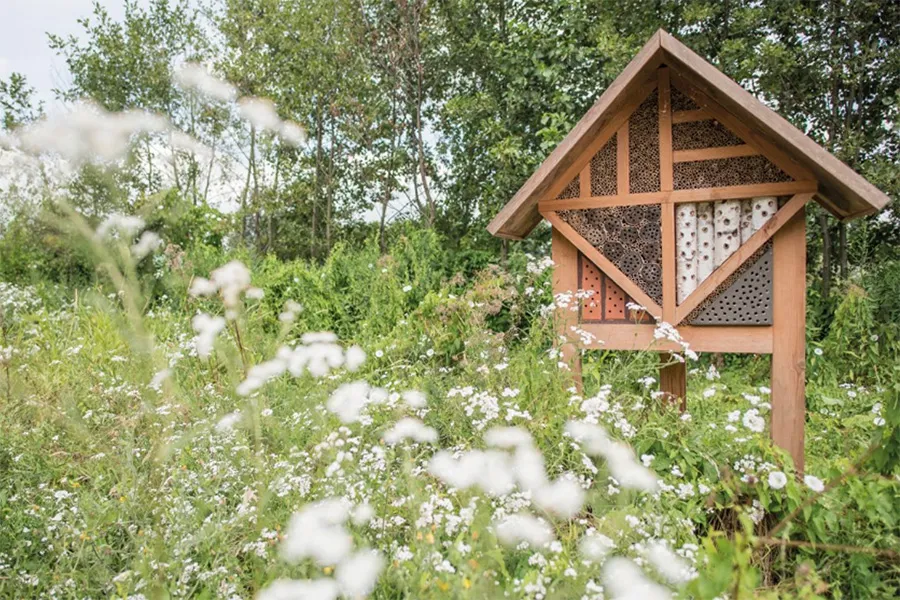
That is why the company works closely with nature organisations such as Vogelbescherming Nederland and Zoogdierenvereniging Nederland, as well as species specialists. Their expertise underpins new solutions that are practical to implement. The result is a wide range of nest boxes, from integrated bricks and summer roosts to maternity colonies and boxes on poles. ‘Variety is essential,’ says Peeters. ‘The better the solution suits a species, the greater the chance of success.’ This integrated approach has also led to a wider range of products, including green façades, insect hotels, sand martin walls, amphibian ramps and native planting.
Designing for species
For new-build projects, Vivara Pro uses building plans and ecological reports to determine which facilities are needed and where they should be placed. Sun exposure, species present and façade finishes all play a part. ‘At the construction industry’s leading edge, these facilities are often already included in the building plans. Then it is simply a matter of installing them.’
Peeters praises the construction sector, where major contractors are increasingly incorporating biodiversity into their designs voluntarily. ‘I sometimes hear of projects going back to the drawing board if nature-inclusive measures are missing. The Netherlands is an absolute pioneer in this respect.’
Technology as a catalyst
The world of nature-inclusive construction is changing rapidly, Peeters notes. The introduction of the Species Management Plan (SMP), for example, has significantly changed how ecological surveys are carried out. Area-based surveys of roosting sites and flight paths mean that surveys no longer need to be conducted at each individual home. This makes improving the sustainability of homes much more practical for residents and local authorities.
At the same time, Vivara Pro is investing heavily in technological development. Sensors, smart cameras and AI recognition automatically record common species. ‘This means ecologists spend less time on lengthy field surveys for common species and can focus instead on rarer ones.’ Thanks to this monitoring technology, the company can now also carry out SMP surveys itself.
The gaps and holes in our homes once provided ideal shelter for species that live in buildings. ‘But that is no longer an option,’ says Peeters. ‘We need to provide good alternatives.’ That means a variety of roosting places and a suitable habitat to go with them. Ultimately, it is all about how everything fits together.
Question about this story? Ask your question
Companies in this story
Keep following this
Get an email when a new story is published. No account needed.
- SubjectGeneral
- CompanyVivara Pro
- CompanyPeeters Group







