









Four claims about drainage. True or false?
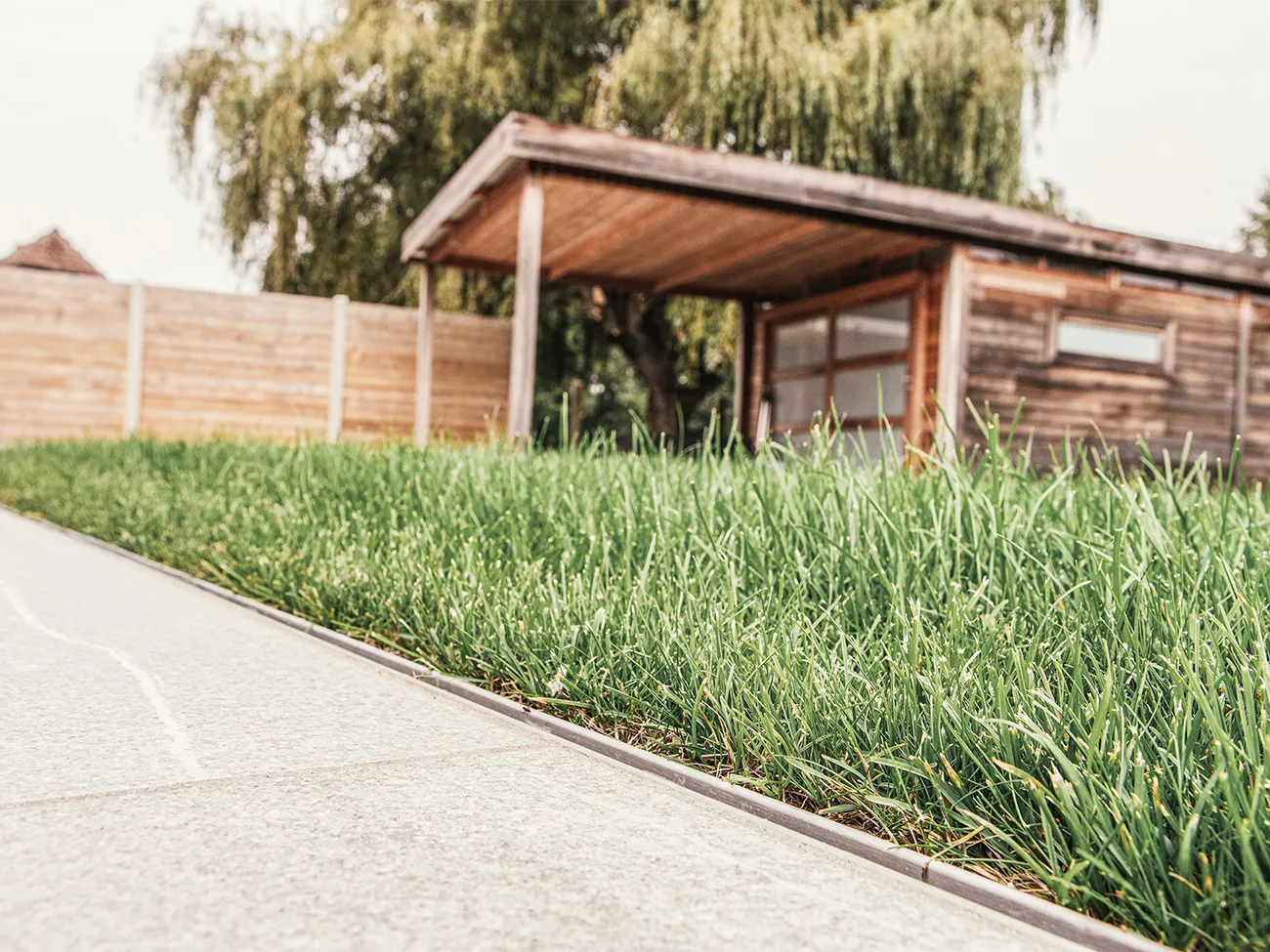
Water is the blue gold. Periods of prolonged drought highlight just how poor the state of our water management is. Yet problems also become apparent when it does rain.
Drought makes it harder for the soil and sewer system to cope with increasingly intense downpours. Starting from four common assumptions, Karolien Vanovertveld of ACO explains the importance of good water management.
“Terrace drainage is unnecessary”
False. “A terrace should be laid with a slope of around two per cent, in line with best practice, usually towards the garden. If water is allowed to run into the garden without a drainage channel, a large volume of water will suddenly be discharged onto a small area along the edge of the terrace. Particularly during intense or prolonged downpours, this can leave the lawn waterlogged.”
“By contrast, installing a drainage channel at the lowest point of the terrace allows you to collect rainwater and control its outflow. It can be discharged directly into the sewer, or the outlet can be connected to a rainwater tank or infiltration system.”

“Rainwater is best kept on your own property”
True. “Local rainwater management is always the preferred option, for several reasons. First, water is a scarce resource nowadays. Allowing usable water to run off into the sewer is far from an environmentally friendly solution. What is more, sewers can become overloaded during heavy rainfall, leading to flooding. Reusing rainwater, by contrast, eases the pressure on the drinking water network, while gradual infiltration helps maintain groundwater levels. Both are essential measures for safeguarding our environment and water supply.”
For rainwater reuse, it is enough to connect downpipes to the rainwater system; there are various solutions for local infiltration. “The principle is always the same: store water and gradually release it back into the ground. Infiltration crates, such as our Infiltra 2.0, are the best-known solution. A 60x60x60 centimetre plastic crate, wrapped in geotextile and connected to the outlet, can hold up to 205 litres of water.”
“Our Infiltration Line is also unique. This system uses rock wool blocks to absorb water and then release it slowly. It was designed fully in accordance with the Flemish infiltration regulations and has a storage capacity of over 112 litres per block. Measuring 100x20x60 centimetres, it only requires a narrow trench to be dug.”
“Drainage channels are functional, but not attractive”
False. “It goes without saying that a drainage channel must be functional. It needs to drain water adequately and efficiently. But that does not mean it has to be an eyesore for the homeowner. Our range is so extensive that even the most seasoned designer will find something to suit.”
For example, traditional channel grates are available in a range of colours and materials. “Galvanised steel, cast iron and stainless steel are all options, and various coatings make it easy to match the colour of the grate to, for example, terrace paving or joinery. There are also narrower channels, 6 rather than 10 centimetres wide, and designer versions such as the cast-iron Euroline Voronoï grating.” Then there are the subtle, virtually invisible slot channels. “Although the channel itself is still 10 centimetres wide, only a 1.6-centimetre slot is visible on the terrace.”

“Slot channels are difficult to maintain”
False. “Compared with a channel with a grate, which you can simply lift to clean the channel, slot channels do require a little adjustment. That is why you need to provide an access cover at each end of a slot channel, and, for longer channels, possibly one in the middle as well. We supply the necessary materials, which can be finished with the same terrace paving. You then simply open the access cover, remove any debris and flush out the channel with a garden hose.”
Question about this story? Ask your question
Keep following this
Get an email when a new story is published. No account needed.
- ThemeSoil and water in balance
- SubjectGeneral







