









GrootGroenPlus preview: sustainability in planting and forest management
Since Henk Huijsman started his own business in 2017, he and his colleagues have developed Laxsjon Plants into a specialist supplier of high-quality forestry and hedge plants for landscaping contractors, local authorities, landscapers and road builders. The company is also firmly rooted in the Zundert area. No wonder GrootGroenPlus is firmly in Laxsjon’s diary.
With Laxsjon Plants, named after an idyllic lake in northern Sweden, Henk Huijsman went into business for himself after several decades in horticulture. He brought with him 30 years’ experience in buying and selling plants, while Loek Jochems had expertise in management and systems integration in the green sector. The company has two sites: its head office in Otterlo (Gelderland) and its logistics department in Zundert (North Brabant). The company does not produce plants itself: production is commissioned from contract growers. Laxsjon Plants sells not only in the Netherlands, but also exports to Ireland, the UK, Scandinavia, France, Belgium and Germany, among other countries, with exports to 24 countries in total.
Sustainability is a priority
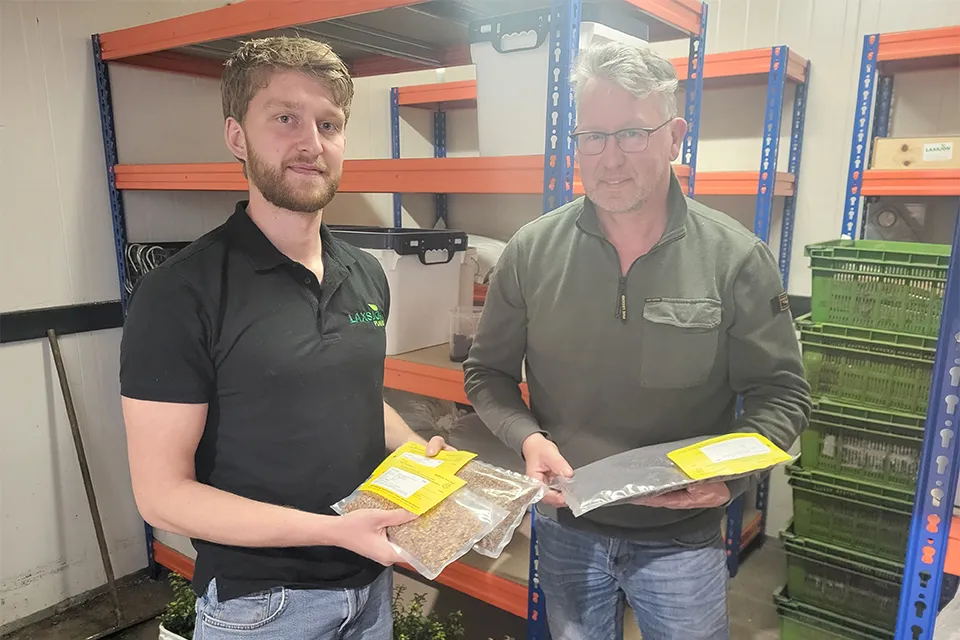
Luuk Aarts (25) recently joined the company as a forestry specialist, focusing on the growing native-seed market. Luuk first visited Laxsjon as a student, while working on his graduation project at the horticultural college in Velp. Henk then hired him in September to further develop Laxsjon Plants’ work with native seeds.
“In recent years, demand for ecologically responsible plants has been growing. Native plants are considered to have greater ecological value than imported ones. For example, the life cycle of native insect species is in sync with their flowering period. The availability of native seeds is a challenge, as interest is increasing among both public and private organisations.”
This kind of work is not for office workers, however. Harvesting native seeds is very labour-intensive, Luuk explains. The seeds are harvested in the field with the help of a team of student workers, armed with ladders and aprons. “We depend on sites that have previously been surveyed and where a native population has been identified. That’s where we can harvest. These include nature reserves, private landscapes and country estates. So the seeds are collected ‘in the wild’. That’s very different from simply shaking a tree in an orchard and coming back with several kilos of seed. Supplies of native hazel and lime are very limited.”
The harvest takes up just a small stack of plastic crates in the cold room, but represents a commercial value of tens of thousands of euros.
No plastic in the forest
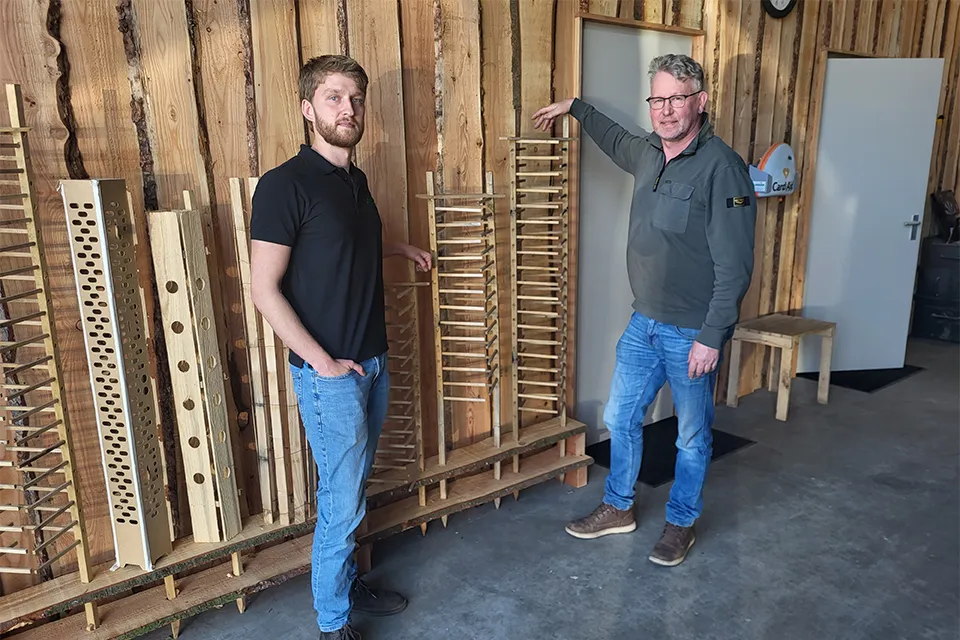
Another sustainable product Laxsjon Plants is investing in is the wooden tree guard. To protect young plants from herbivores and rodents, they are still often fitted with plastic guards. “Using plastic in a forest is outdated,” says Luuk. “In Germany, where they are several years ahead of us in this area, wooden guards have been used for much longer. Wood is a material that breaks down naturally once it has served its purpose.”
The guards are available in various sizes, depending on the plant species they need to protect and the animal population in the area. For use in the Veluwe nature reserve, close to Laxsjon’s head office, for example, they need to be taller and sturdier to withstand damage from deer. In dune areas, the guards are lower and designed to keep rabbits out. Unlike plastic guards, wooden tree guards do not need to be removed after they have been installed. The product decomposes naturally.
Meet in Zundert
Laxsjon will also be exhibiting at the GrootGroenPlus trade fair in Zundert in September. “It’s a regular fixture for us, and the great thing is that it’s a real trade fair for horticultural businesses to meet one another,” says Luuk. The Zundert area is familiar territory for Laxsjon Plants. The company works with contract growers in the region. “If you trade in forestry plants, you simply can’t avoid Zundert,” says Luuk.
Henk agrees: “It’s a regular fixture, yes. We also meet our English customers there, for example. It’s a small world, of course, and over the years we’ve built up a lot of contacts. We’ve become one of the bigger players in the market, and all in just nine years.”
Question about this story? Ask your question
Keep following this
Get an email when a new story is published. No account needed.
- ThemeTrees and plants for tomorrow
- SubjectGeneral







