









How Mecanoo plans to tell the story of Kamp Westerbork through landscape and management
Text Armand LandmanImage Sake Elzinga/Herinneringscentrum Kamp Westerbork, Mecanoo, Armand Landman
Landscape as witness
On a sunny autumn day, the woods around Westerbork turn red, orange and gold. The sky is clear blue and the silence almost tangible. On the horizon, ASTRON’s large dishes stand like futuristic sentinels in the fields. In this stillness, a plan by the architects at Mecanoo for Herinneringscentrum Kamp Westerbork lets the landscape itself speak. No props, no reconstructed barracks, but paths, grasses, flowers and herbs that make the past visible. “It is a very special place, given everything that happened here,” says Francine Houben, creative director and founding partner of Mecanoo. “We want to enhance what is already here with very subtle interventions. That way, the landscape can offer space for remembrance and reflection.”
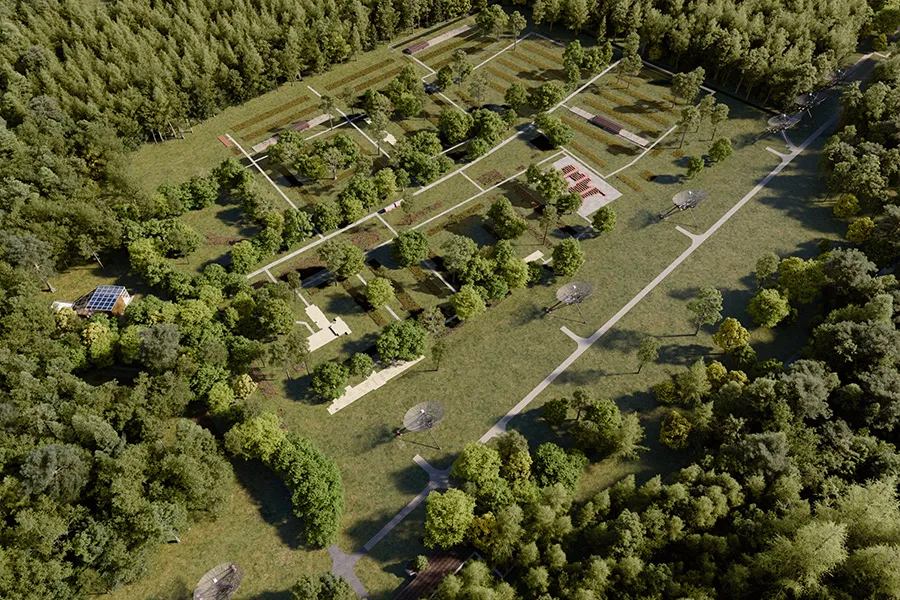
Mecanoo drew up the landscape plan for the redevelopment of the camp site and visitor route. Commissioned by Herinneringscentrum Kamp Westerbork, the design team is working in phases: first a pilot with barrack fields and trial plots, followed perhaps by a wider roll-out across the site. The ultimate aim is to make the camp legible through the landscape and guide visitors calmly and respectfully through the area.
As you walk onto the site today, you immediately notice a quiet grid. The former camp site is impressive simply because of its size. This is not down to buildings, but to stakes driven into the ground to mark the outlines of the former barracks, and to different mowing and management regimes for the green spaces. Some fields are left taller and rich in flowers, while others are kept shorter. This makes the old barrack fields appear as light and dark areas. You sense the scale of the camp without anything having been reconstructed. Houben: “We do not want to create an illusion. The management will become our design, that is the idea.”
Ecology as the starting point
Ecologists from Eco Reest surveyed the entire site for the design. The area proved to be a patchwork of habitats: paths are mown more often, while further away there are large, quiet fields of herbs, flowers and grass. The soil varies: dry, nutrient-poor sandy soils, with pockets of loam, create wet fingers in the north-east. In the east, the soil is damper, and more reeds and sedges grow there. “We work with the canvas that is already here,” says associate landscape architect Anne Marie van der Weide. “The soil, water and species already present determine where we add something and where we leave things as they are.”
This calls for precision. The area lies within the Natuurnetwerk Nederland, is a groundwater recharge area for the Drentsche Aa and is also a radio-quiet zone because of the radio telescopes. Anything done here, from the choice of materials to planting and lighting, must therefore be considered and carefully planned.
The camp’s layout at the time of its liberation in 1944 is to be interpreted through the planting. By tailoring mowing regimes to the different habitats, the aim is to create a palette that reflects the area as faithfully as possible, making the barrack fields easier to read. The plans include additional interpretation at ten locations: a paved area showing the full-size floor plan of the barrack that once stood there, along with stories and audio clips. These could relate to a registration barrack, the hospital, punishment barracks or a Moluccan residential barrack.
A number of vulnerable areas are scattered across the camp site. These are zones of heathland and nutrient-poor grassland, where vulnerable and threatened species such as sand sedge, Dianthus deltoides and large thyme grow. The most suitable management regime for these zones is being carefully assessed. Some may benefit from further nutrient depletion to create a distinction between the barrack fields and the surrounding site. Other vulnerable zones will need a different approach. There are also nutrient-poor, grass-dominated areas that require another approach to make the barrack fields legible. The coming year will therefore involve some trial and error, with close coordination between Staatsbosbeheer, the province of Drenthe and ecologists needed to achieve the desired outcome while respecting nature.
Tailor-made seed mixes
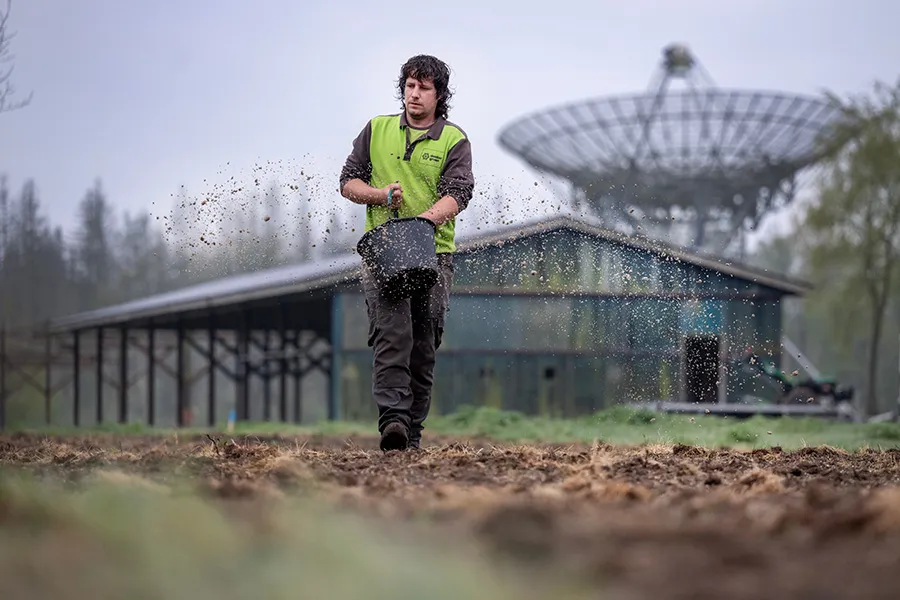
For the pilot, the team worked with seed grower Cruydt-Hoeck and contractor Donker Groen. Project adviser Roelof Jan Koops: “The soil is always the starting point. Moisture and nutrient levels determine what will grow, as does the natural distribution of species in Drenthe.”
For the pilot, Koops created a flowering sequence, with species that flower early and late so that insects have food throughout the season. “We added some annuals in the first year,” he says.
“That means there is something attractive to see straight away, while the perennials in the mix are still developing.” The exact mix depends on each species’ germination rate, space requirements and seed weight. As the site lies within a larger nature area and is owned by Staatsbosbeheer, the team chose a mix of species that occur here naturally.
Lupin as a reminder
Seed supplier Cruydt Hoeck works with regional genetic material. In the wild, seed is collected carefully and with the land managers’ permission from species that occur there naturally. The seed is first propagated on a small scale and then production is expanded to an agricultural scale. This preserves the characteristics of the regional flora, and the plants are well suited to the insect life that recognises them as ‘plants from here’.
Lupin has a special role. It is linked to the history of forestry: it was sown as a green manure when the new forest was planted and seeded. This can still be read in old stand registers held by Staatsbosbeheer. The plant also features in diaries and recollections of people who stayed at Kamp Westerbork. This makes the species part of the collective memory. Roelof Jan Koops of Cruydt Hoeck: “Lupin can spread rapidly in the area, however. So we have to take a two-pronged approach: we recognise its commemorative value, but must guard against it becoming dominant.”
Future management and maintenance
The pilot is drawing to a close. The barrack fields have finished flowering, but the silhouettes of the drying flowers and herbs still offer a striking impression of what the camp looked like in the past.
Over the coming period, all the parties involved will meet several more times to discuss the results and findings. In Mecanoo’s plan, mowing will become a design choice rather than a routine task. Eco Reest, Staatsbosbeheer, the province of Drenthe and Herinneringscentrum Kamp Westerbork will decide in close consultation which parts of Houben and Van der Weide’s plan can be put into practice. The barrack fields may be mown just once a year, or even once every two years. Along paths and at crossings, mowing will be more frequent, maintaining the contrast and therefore the legibility of the site. Van der Weide: “We tailor management to plant phenology: when plants flower and set seed. Sometimes, mowing later is precisely what helps vulnerable species thrive.”
Vulnerable species such as marsh gentian grow in and around Kamp Westerbork. This calls for caution: constant monitoring, measurement and adjustment. At the same time, invasive alien species such as giant hogweed and Himalayan balsam must be kept in check; lupin, too, can spread rapidly in the area. The rules are simple: keep machinery clean, do not spread roots or seeds, and remove them in good time before they set seed.
The memorial avenue
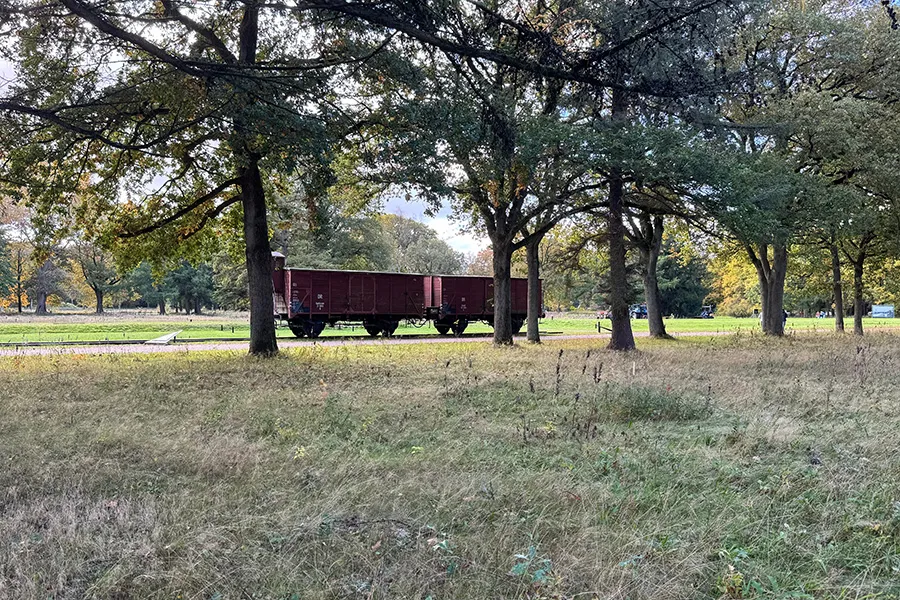
A paved road of around three kilometres runs between the museum and the camp site, serving as a memorial avenue. Along the road are the dates on which the 93 transports departed, carrying more than one hundred thousand Jews and Sinti and Roma from the transit camp at Westerbork to the extermination and concentration camps in Germany and Poland. In Mecanoo’s plan, this route becomes a green spine along which people can walk, cycle or travel in electric vehicles between the camp site and the museum. Markers set out at intervals reminiscent of railway sleepers will guide visitors through the woodland edges and open fields. The journey will deliberately slow down, giving visitors time to look and reflect.
“This may well be my most emotional project,” says Houben. “When Westerbork director Bertien Minco asked me to take on this commission, I drove there straight away. Of all the former camps from the Second World War, Westerbork has a special place: it was a transit camp, not a concentration or extermination camp. What is more, unique film footage of life in the camp has been preserved. No other camp has footage like this. We absolutely do not want to reconstruct anything that is no longer there, but to design an experience: visitors will feel the scale and the silence, hear the wind in the grass and see the difference between mown and unmown areas. The commandant’s house, a national heritage site, will not be a focal point but a second, quieter entrance. Materials will be matt and earthy, and lighting will be kept to a minimum so as not to harm nocturnal wildlife. Information will also be presented in measured amounts, through sound and touch wherever possible. This allows the greenery to carry the story, while leaving space for visitors to feel and understand for themselves.”
Question about this story? Ask your question
Keep following this
Get an email when a new story is published. No account needed.
- SubjectGeneral







