









‘Make the landscape part of the decisions’
Text Armand LandmanImage Planbureau voor de Leefomgeving
On measurement, steering and the tension between systems and practice
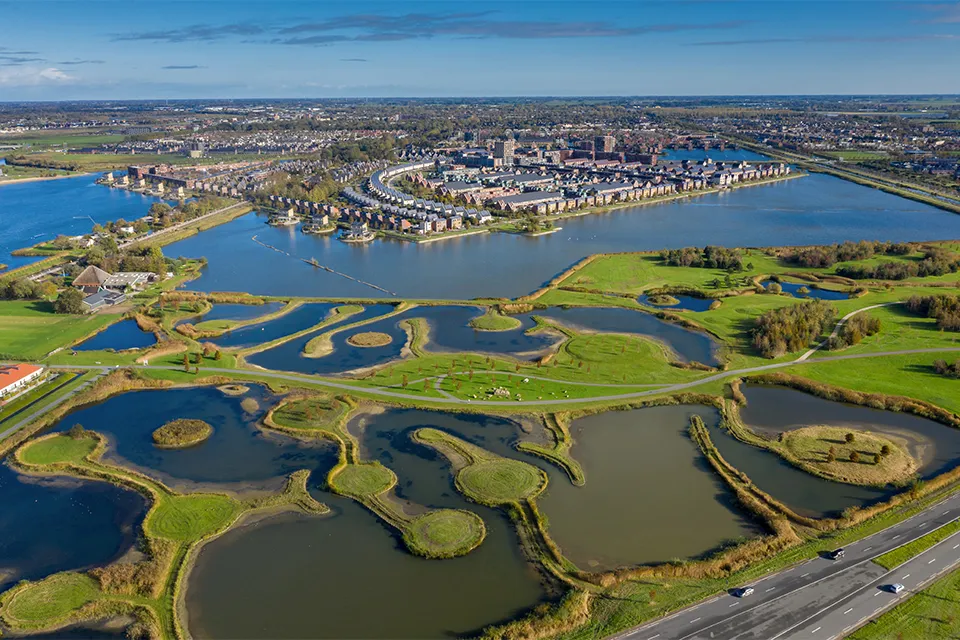
The debate about how the Netherlands should be organised is often framed in terms of a lack of space. Too little room for housing, energy, nature or agriculture. But a closer look at the recent work of the Netherlands Environmental Assessment Agency reveals a different reality: the issue is not so much a shortage of space as the way we make choices and organise that space.
In conversation with David Hamers and Frank van Rijn, the focus quickly shifts from square metres to questions about the system. How do we define urban green space? What are we actually measuring? And, more importantly, what does that tell us about the quality of our living environment? Hamers, programme leader for Integrated Spatial Development, and Van Rijn, scientific researcher, contributed to the baseline assessment of urban ecosystems in the Netherlands. They stress that the analysis is not an end in itself, but a tool for getting to grips with the spatial challenges that are piling up. “What we show,” says Hamers, “is that the way you define and measure things ultimately determines what you see, and therefore what you set out to steer.” That observation may sound abstract, but it has direct implications for policy and practice. Take the question of what exactly falls under ‘urban ecosystem area’. The European methodology uses standardised grids and urban clusters, which do not always fit neatly with the Dutch reality. Van Rijn: “You might see this as a technical exercise, but it isn’t. It is a choice with spatial and administrative consequences. Do you draw a tight boundary around the city, or include the surrounding landscape too? That affects what you need to protect, develop or compensate for.”

The role of the landscape
This touches on a more fundamental question: is the landscape a residual category between competing sectoral claims, or can it also provide a framework for choosing between them? “Historically, we have often thought in terms of functions,” says Hamers. “Housing here, agriculture there, nature somewhere else. But the challenges we face now, climate adaptation, biodiversity and the energy transition, can no longer be separated so neatly. The landscape itself then becomes a foundation for spatial development and part of the decisions to be made.”
In practice, this idea often clashes with the way policy is structured. Article 8 of the European Nature Restoration Regulation, for example, focuses on quantitative indicators: how much green space there is, how much tree canopy cover, and how this changes over time.
That provides a useful basis, but also raises concerns.
“The advantage of indicators like these is that they can be measured and compared,” says Van Rijn. “But they don’t tell the whole story. You can add green space without improving ecological quality, or without contributing to cooling, water storage or biodiversity.” Hamers adds: “The risk is that you start steering by percentages rather than by systems. ‘More green space’ then becomes an end in itself, when the real question should be: what kind of (urban) landscape do we want, and how does it function?”
A false sense of certainty
The tension between measurement and understanding runs through the conversation. The baseline assessment shows, for example, that a considerable proportion of municipalities have sufficient green space on paper, but that this masks risks. There is a danger of decline, monitoring is lacking, or the quality is vulnerable.
“The figures give you an initial picture,” says Van Rijn, “but they don’t tell the whole story. To understand that, you also need to look at management, connections and use. These are much harder to capture in a single indicator.”
Restoration obligation
The European Nature Restoration Regulation is an important framework for this discussion. Whereas previous nature legislation focused mainly on protection, this regulation introduces an explicit restoration obligation for the first time. This also applies to urban areas, a relatively new domain in European nature policy. “This really is a turning point,” says David Hamers. “We are moving from preventing decline to actively improving systems. And that directly affects how we organise our cities and their surroundings.” The regulation requires member states to prevent the loss of urban green space and, from 2030, achieve an upward trend in areas including green space and tree canopy cover. That sounds clear, but in practice it is a complex task. Frank van Rijn: “On paper, it seems straightforward: you measure, monitor and adjust. But the reality is much more challenging. Exactly what do you count? How do you deal with temporary interventions? And how do you ensure that this growth actually contributes to ecological quality?”
The regulation therefore touches on a fundamental tension. On the one hand, there is a need for clear, comparable indicators at European level. On the other, effective nature restoration requires local knowledge, tailored approaches and long-term management. “Europe needs to be able to compare,” says Van Rijn, “but ecosystems cannot be standardised. What works in southern Europe may not work here. And even within the Netherlands, there are major differences.”
A concrete and telling example is the way the regulation deals with tree canopy cover. In principle, anything that is lost must also be compensated for. That sounds simple, but in practice it often works out differently. “If you fell a mature tree,” Van Rijn explains, “you lose a large amount of canopy cover all at once. You can’t simply make that up by planting one new tree.” As a result, several young trees are often needed to compensate for the same area, and they also take years to provide the same function. Hamers: “That shows just how great the difference is between quantity and quality. You may be able to make the figures add up on paper, but ecologically and spatially, you are not replacing what you lose on a one-to-one basis.” This obligation once again highlights the importance of looking not only at numbers and areas, but also at maturity, connections and the long-term development of urban green space.
Thinking more explicitly
Hamers points out that the regulation is therefore not only an ecological challenge, but also an administrative one. “It forces governments to think more explicitly about scale and responsibility. What do you regulate nationally, what regionally, and what do you leave to municipalities?” The regulation also leaves room for choices. Under certain conditions, member states can exempt some municipalities from the obligation to maintain green space, for example when they already have a relatively large amount. “That sounds attractive,” says Van Rijn, “but it is not without risk. You take the pressure off, when you may actually need to stay alert. Especially when you know that quality and management are often vulnerable.” Hamers says there is a broader lesson here. “Rules and exemptions can help, but ultimately the question is how you make the system robust. Not just today, but also in ten or twenty years.” “If done well,” says Van Rijn, “this regulation can act as a catalyst. Not because Europe tells you exactly what to do, but because it forces you to think more carefully about what you want to achieve.” At the same time, both researchers warn against expecting too much. The regulation provides a framework, but no ready-made solutions. “The real work happens in practice,” says Hamers. “In plans, design and management. That is where it ultimately has to take root.” And that is where the landscape comes back into view. Not as the sum of hectares of green space, but as an interconnected system in which nature, use and experience reinforce one another. “The regulation can help get that conversation started,” concludes Van Rijn. “But whether it actually leads to better landscapes depends on how we put it into practice.”
Professional expertise
This may be even more true of the role of design and professional expertise. In the practice of urban green-space management, and in the work of designers, what matters is knowledge of planting, long-term development and maintenance. These are elements that cannot easily be reduced to data. Hamers recognises this tension. “Design and management are crucial to the quality of the landscape. But policy tends to abstract. That is sometimes necessary, but you have to be careful not to lose sight of the essentials: biodiversity, cooling and water storage in specific locations, as well as the recreational function of green space for particular user groups.” The balance will become even more important in the coming years. After 2030, the aim will not just be to maintain urban green space and tree canopy cover, but to achieve a demonstrable increase in both. At the same time, pressure on space is growing as a result of housing construction, energy infrastructure and climate measures.
“That naturally brings us to the question of how to combine functions,” says Van Rijn. “Can housing development go hand in hand with the development of green space? Can water management challenges be linked to biodiversity? That calls for new approaches to design and planning.” Hamers says regional and provincial levels also have an important role to play. “Many of these challenges extend beyond municipal boundaries. If you want to take a systems approach to the landscape, you also need to think and act at that scale.”
Practical value
The discussion does not remain at an abstract level, however. Both researchers stress that translating ideas into practice is essential, particularly for professionals working every day on spatial planning, management and development.
“What we are trying to do,” says Hamers, “is provide a framework. Not a blueprint, but a way of looking at things, so that you can make better decisions in specific projects.”
Van Rijn nods. “And that starts with recognising that space is not a neutral backdrop. Every choice you make has consequences for other functions and for the system as a whole. If you take that seriously, it also changes the way you look at the landscape.”
Question about this story? Ask your question
Keep following this
Get an email when a new story is published. No account needed.
- SubjectGeneral







