









PDPO project brings together practical examples from East Flanders
With the changing climate bringing alternating periods of water scarcity and excess, it can sometimes be difficult to preserve the quality and functionality of green spaces. The PDPO project ‘Towards efficient water management in green spaces’ addresses this challenge, bringing together and sharing knowledge and practical examples of efficient water management through purpose-designed demonstration green spaces in East Flanders.
Towards efficient water management in green spaces
Text Eva Reybroeck & Jesse Tavernier | Images PCS
The extreme weather conditions of recent years have not gone unnoticed. Since records began, the rainfall deficit in the run-up to summer has never been so great, and for the fourth year running, we have faced exceptional drought in recent months. The winter months, by contrast, are getting increasingly wet, leading to seasonal flooding. Trees and plants suffer as a result.
However, by choosing drought-tolerant plants and efficient water management techniques when creating and maintaining green spaces, it is possible to make them climate-resilient. PCS is investigating and demonstrating the options in three municipalities in East Flanders, and this article discusses the initial results.
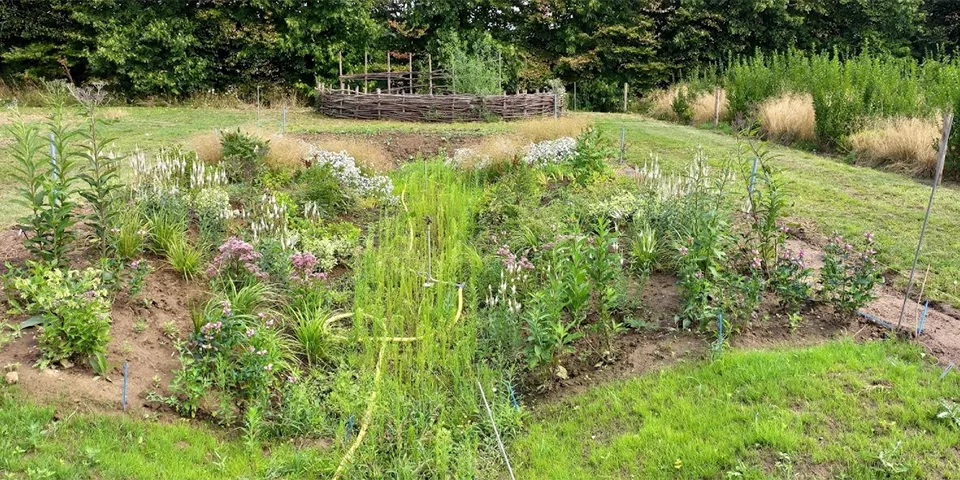
A wadi planted with various vegetation types at PCS.
Demonstration projects
Three demonstration areas were created last spring in Oudenaarde, Dendermonde and Aalter. Various soil preparation and improvement techniques were applied, and the use of mulching materials and anti-transpirants is also being demonstrated. PCS is also testing different planting types for a wadi.
PCS monitors the various green spaces regularly. Plant quality, including plant losses, flowering, growth and stress indicators, is assessed, and soil moisture content is measured. The municipalities, in turn, record how often the plants need watering.
Improved flowering and growth
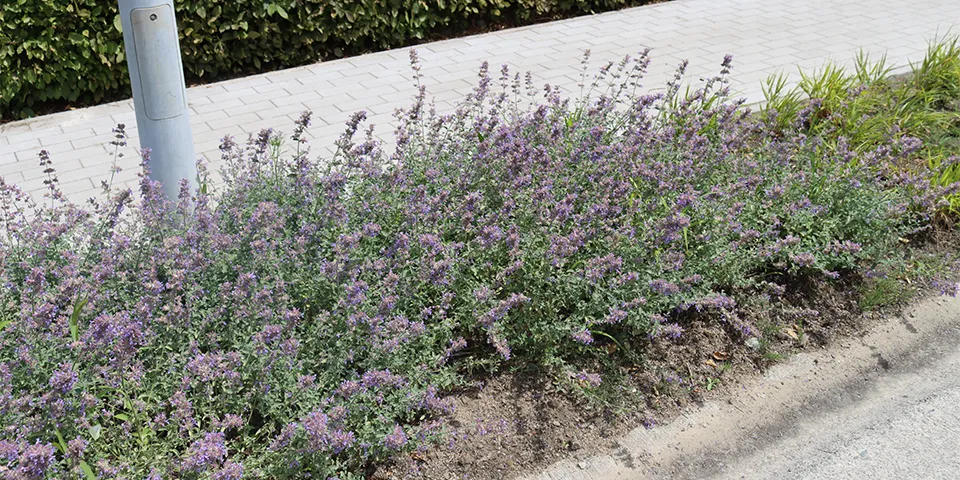
In Dendermonde, Hagewijkpark was planted with various shrubs: Berberis, Symphoricarpos, Hydrangea, Hypericum, Spiraea, Rudbeckia and Nepeta. Various soil amendments were used at planting, including compost, bentonite granules, water polymers and a combination of all three, and compared with untreated soil. The amendments help the soil retain water, creating a water reserve in the planting beds and reducing the need for frequent watering. Compost and the combination of soil amendments have already been shown to improve flowering and growth in Nepeta.
Higher soil moisture content
Roses were planted in eight green spaces in Oudenaarde, where the products Karisol, Oenosan and TerraCottem are being tested. Karisol is an organic soil improver that increases the soil’s organic matter content and promotes better plant growth; Oenosan is a natural lime fertiliser that activates the plant’s defences; and TerraCottem is a physical soil improver that, thanks to its biostimulants and water polymers, also increases resistance to drought stress. Compared with the control, all these products increased soil moisture content, although it remains to be seen whether the green spaces will actually need less water as a result.
Container mulch was also applied as a ground cover to half of the planting beds. This resulted in a 17.8% higher soil moisture content than in the green spaces without container mulch.
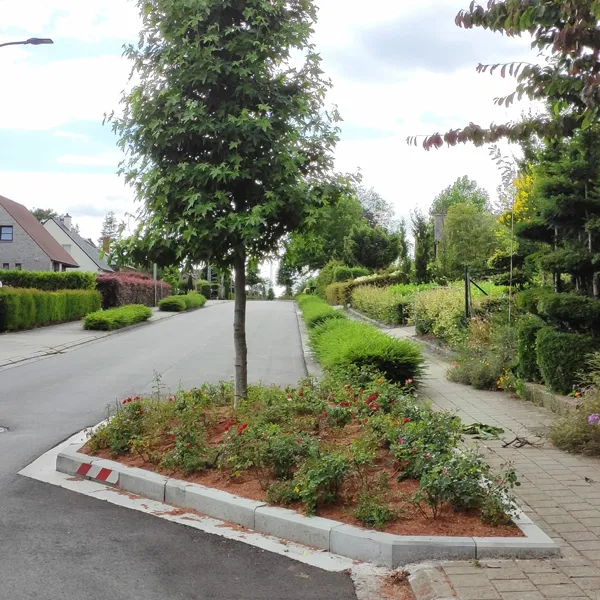
Container mulch was applied to the planting beds in Oudenaarde, with a clear impact on soil moisture content.
Greater biodiversity in wadis
With weather conditions becoming increasingly extreme, it is also necessary to reduce pressure on our sewers and maintain groundwater levels, for example by creating wadis and infiltration basins. Rather than planting these basins, as is usually done, with a uniform, monotonous grass mix, two wadis were created at PCS to demonstrate alternative approaches.
The first wadi demonstrates two types of substrate: sand on one side and clay on the other. Both were planted with vegetation suited to conditions that alternate between wet and dry. The Iersel system can be used to adjust the water level in the wadi artificially, creating both wet and dry conditions and allowing the planting to be monitored optimally.
The second wadi is being used to demonstrate various natural vegetation types: natural vegetation managed by mowing, an area with natural herb and flower mixes, and an area with native shrubs.
Have your say!
To help develop the project further, PCS is seeking feedback from the sector. Which water management techniques are already in use? What has your experience been with them? How do prolonged periods of drought affect the creation and management of green spaces? Do you know of any inspiring examples of water-efficient design?
Research supported by the Flemish Government, the Agency for Innovation and Entrepreneurship, the European Union, the Province of East Flanders, Boerenbond and AVBS, the ornamental horticulture and green industry federation.
Question about this story? Ask your question
Keep following this
Get an email when a new story is published. No account needed.
- SubjectGeneral







