









‘Put green before Excel’
Text Armand LandmanImage TANGRAM
TANGRAM’s vision for green and sustainable property
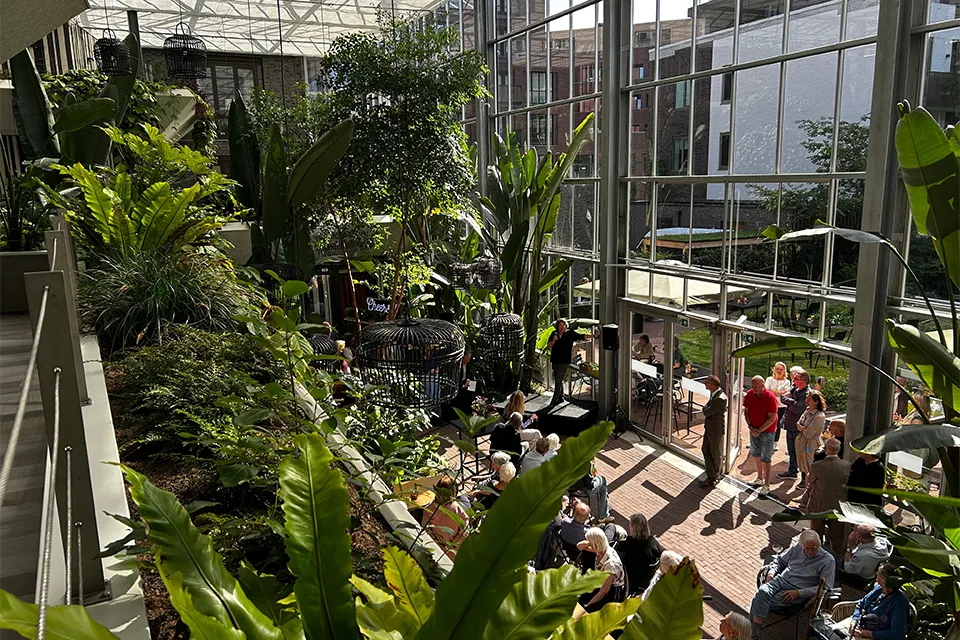
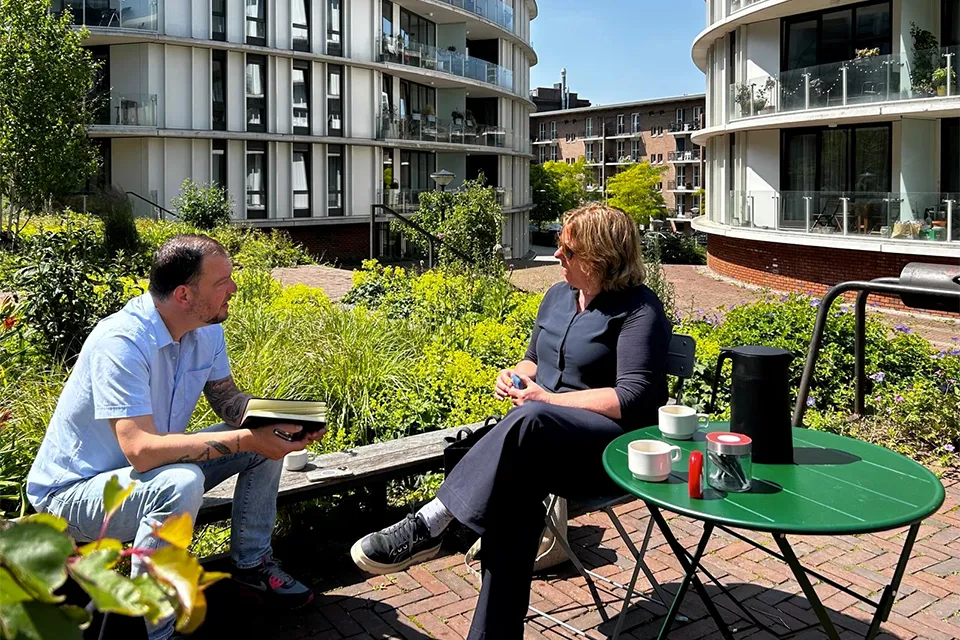
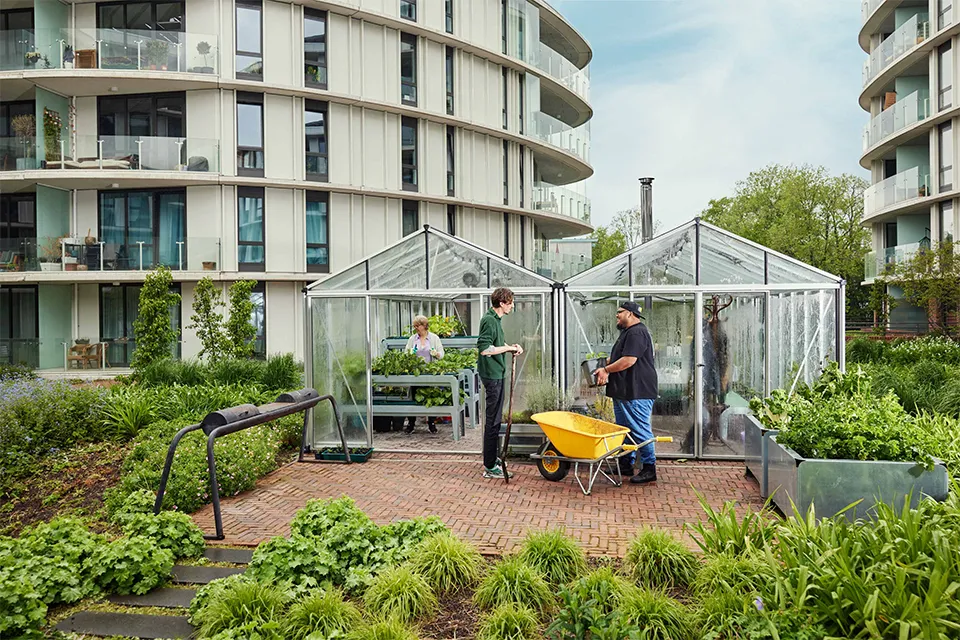
In a serene, green greenhouse among the residential buildings of Rhapsody in West, right next to the A10 in Amsterdam, Charlotte ten Dijke and Bart Mispelblom Beyer, founders of architecture practice TANGRAM, voice their sharp criticism of current urban property development practices. They argue for a fundamentally different approach, one that puts liveability, green space and social cohesion at its heart.
“We are increasingly seeing spreadsheet architecture,” says Ten Dijke pointedly. Projects are reduced to spreadsheets and key figures, threatening the intrinsic value of high-quality, people-centred living environments. The trend towards individualisation and antisocial behaviour, and the hardening of the urban environment, both physically and psychologically, are reinforced by this one-sided approach to the task of building. Ten Dijke stresses that green space and social interaction are “soft values” that are not easy to quantify, but are crucial to residents’ wellbeing.
Rhapsody as a model project
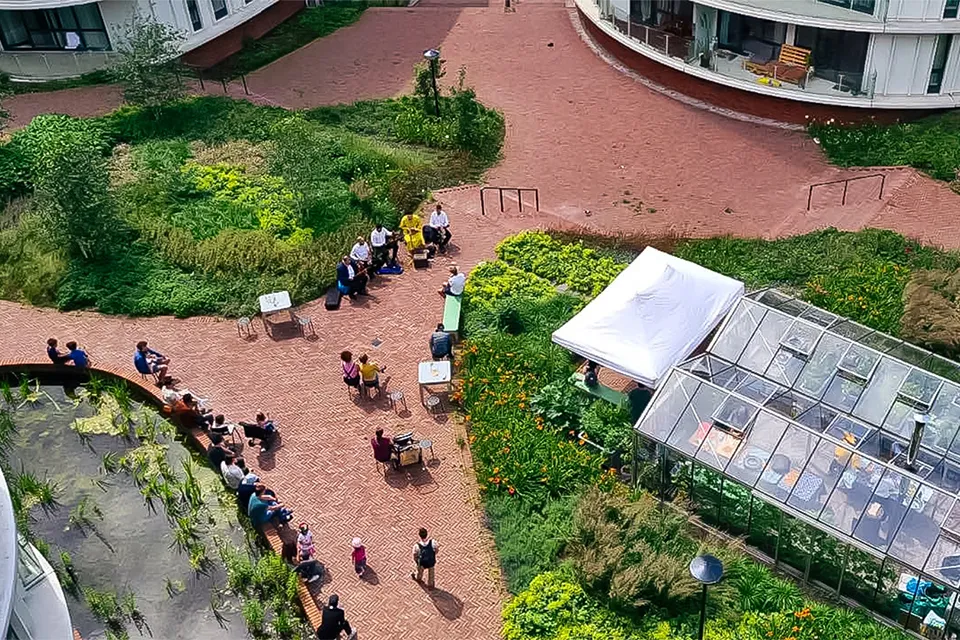
According to Ten Dijke and Mispelblom Beyer, the residential building Rhapsody in West proves that a different approach is both possible and successful. “Here, people experience peace and social connection in the middle of the city,” says Mispelblom Beyer. The site, which for years seemed impossible to build on and unacceptable to property developers and investors, turned out to have hidden qualities when viewed from a different perspective on its development potential. An RIVM study into the effects of the building confirmed that residents consider green space essential to their wellbeing. “Residents say the traffic noise is barely noticeable because of the greenery. It feels as though they are in a park, where people meet and a sense of community develops,” Ten Dijke adds.
Criticism of the lack of vision
Both architects see a lack of conviction and courage within their profession to put a social vision forward in opposition to this ‘spreadsheet approach’. According to Mispelblom Beyer, the architecture sector needs to make the value it brings much clearer, so that it is not cut out of processes to save costs. He sees a risk that the architect’s role will be increasingly marginalised in construction processes unless architects communicate and defend their unique contribution more effectively. He therefore even argues for reducing the role of the developer, unless they are explicitly focused on creating long-term value.
“Developers regularly take margins that come at the expense of essential aspects such as social interaction, green space and long-term sustainability. The importance of investors with a long-term vision, who are willing to invest in the community and in the liveability of projects, has never been greater. Such investors are often less focused on quick profits and instead consider the lasting impact of their investments.” Mispelblom Beyer points to the Canadian city of Vancouver, where building plans are granted additional development rights in return for rezoning or densification. In exchange, developers must provide public amenities or make a financial contribution.
As a concrete example from the Netherlands, Ten Dijke cites the ZuidOever project, which combines housing and care. Here, TANGRAM and its client Cordaan have demonstrated that a considered integration of the building layout, green spaces and care concept can deliver significantly higher financial returns in the long term. ZuidOever is thus an example of how sustainable, green architecture can offer not only social benefits, but also make financial sense and stand the test of time.
Sustainability as a necessary investment
Ten Dijke and Mispelblom Beyer do not see their approach as idealistic, but as an absolute necessity. “We need a form of development that puts nature, social cohesion and human scale at its heart,” they stress. They criticise short-sighted thinking in which community spirit no longer plays a role and green space is treated as an afterthought, often subject to cuts. “Taking nature as the starting point from the very beginning leads to more sustainable, attractive and ultimately more economically robust projects,” says Mispelblom Beyer.
Ten Dijke points out that better-integrated green space makes the urban fabric more liveable and strengthens social cohesion. “Well-designed buildings are ultimately more valuable and more financially attractive,” she explains. She also argues for bringing back enthusiasm instead of cynicism. Too few architects today dare to stick their necks out and ask what lies behind the question. The property sector needs vision and a love of the built environment. “We need to invest in projects that offer more than just square metres and financial returns.”
The architects say that local authorities and long-term investors have a crucial role to play. With clear, ambitious guidelines and room for design vision, they can ensure that property developments take long-term goals into account from the outset. “Local authorities should take a proactive, collaborative approach by setting conditions that encourage sustainable property,” says Ten Dijke. “It takes political courage to formulate such requirements, but ultimately they lead to better, more sustainable cities.”
Ten Dijke and Mispelblom Beyer are currently working on a promising future project in the Beemster. The project, which Tangram is undertaking in collaboration with Architekten Cie., is intended to show how sustainability, heritage and community spirit can go hand in hand. The design takes the historic water systems and green features of the landscape as its starting point. By creating a much-wanted meeting place for local residents, with local amenities, they aim to encourage social interaction and connection. “We are using the landscape and history of the Beemster as our guide. This will not only give the area a new lease of life, but also strengthen local identity and community,” says Ten Dijke.
Tangible sustainability
As Ten Dijke and Mispelblom Beyer speak, residents visibly enjoy the peace and beauty of the greenhouse in Rhapsody’s lush garden, bringing the architects’ argument to life. “That’s what it’s really about,” they conclude together, “creating sustainable living environments where people can genuinely be happy. It’s certainly not just about building blocks, but ultimately a stepping stone towards truly sustainable property.”
Question about this story? Ask your question
Keep following this
Get an email when a new story is published. No account needed.
- SubjectGeneral







