









Rooted in the North, recently also in Utrecht
Text Armand LandmanImage LAOS landscape urbanism, Marleen Annema
Designers of the future
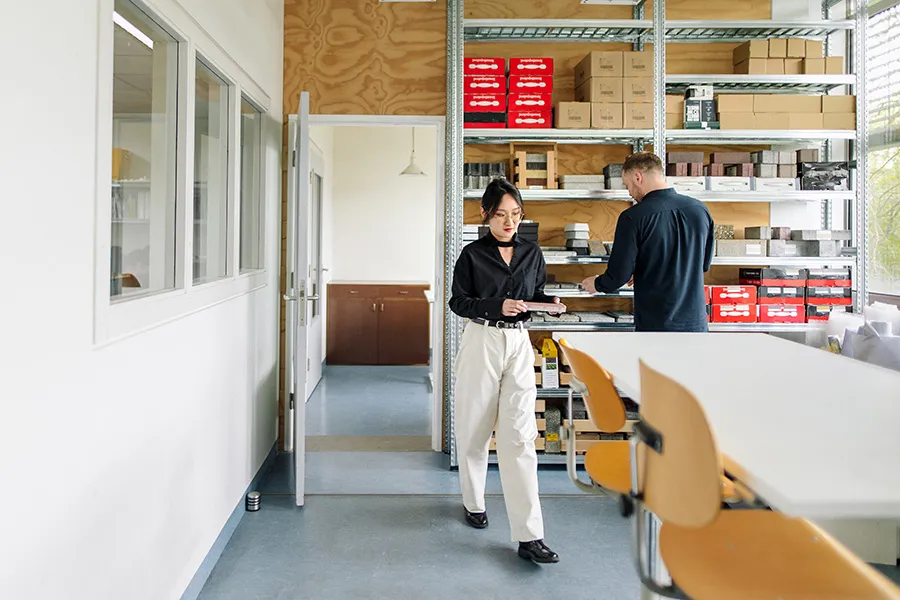
As you walk through the corridors of De Biotoop in Haren, the former laboratory and teaching complexes that have grown into a creative hub, you hear the gentle hum of computers and coffee machines, the rustle of rolls of drawings and even the sound of a piano. Here, among artists, musicians, microbrewers and designers, the team at LAOS, a landscape architecture and urban design practice, is tackling one of the most urgent challenges of our time: shaping a living environment that is resilient, healthy and distinctive.
The practice, founded by landscape architect Mathijs Dijkstra, now has twenty employees and will soon open a second office in Utrecht. Yet its beating heart remains in the North. “That makes sense,” says Dijkstra. “We always work from the existing context: the landscape, the history, the identity of a place. Here in the North, you feel those layers every day.”
Dijkstra, who trained in Wageningen, initially started the practice on his own. But it soon became clear that he needed a team able to think as broadly as the landscape itself. LAOS now deliberately brings together a balanced mix of urban planners and landscape architects trained in Delft, Antwerp, Leuven, Wageningen and elsewhere.
That breadth is no coincidence, says urban planner Alaleh Kouhkan, who worked in Iran, Belgium and the Netherlands before joining LAOS.
“Everyone looks at a place from the perspective of their own background,” she says. “That enriches our work. But we share one conviction: you never design from a tabula rasa. You always start with what is already there.”
This philosophy is deeply woven into the practice’s work. It informs both small projects, such as a park or village square, and large regional visions for places including Lauwersmeer, the Hunzedal and the water system of the northern Netherlands.
Capturing complexity in simplicity
The challenges LAOS works on are considerable: climate adaptation, drought, salinisation, biodiversity, health, housing and mobility. That is precisely why the practice aims to design with simplicity in mind.
“The world outside is complex enough already,” says Dijkstra. “Our designs need to be clear, almost self-evident. But they should also have something that makes you stop and look at your surroundings differently. A design should bring a sense of calm, but also spark curiosity.”
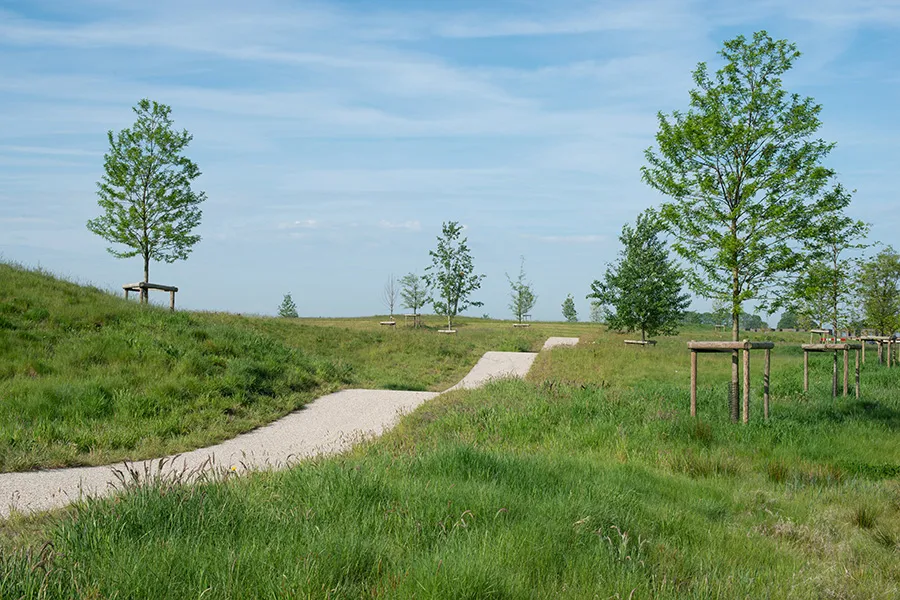
That balance between calm and tension runs through their work. At Park Meerstad, for example, they created a park landscape that changes subtly through the seasons and over the years, with different biotopes combining to form a single whole. “It needs to reveal something new each time, without becoming showy,” says Dijkstra.
Kouhkan puts it succinctly: “You always need to take a step back. Does it work as part of the bigger picture? Does it reflect the identity of the region? That applies just as much to a neighbourhood as to a regional landscape.”
Often, that means clearing things away rather than adding more. “Many places have become cluttered over the decades,” says Dijkstra. “In those cases, we remove things so the original qualities can once again be seen.” The area biography LAOS created with historian Marinke Steenhuis for the Eemsdelta is one example: a story that not only brings the past to light, but also guides future decisions. “Change does not have to come at the expense of identity,” says Kouhkan. “Quite the opposite.”
Design as a way to bring people together
At a time when space is scarce and interests are in conflict, between farmers and nature, residents and decision-makers, the economy and ecology, LAOS sees design as an important language for dialogue.
“Design is not just about making beautiful things,” says Dijkstra. “It is a way to bring people into alignment, to put emotions and interests on the table. To build trust.”
The practice learned this, among other things, through the complex Lauwersmeer project, where discussions centre on salinisation, nature, agriculture and water safety.
Dijkstra says: “You have to start by understanding why someone wants something. Only then can you work towards a long-term vision.”
This approach, workshops with stakeholders, gathering stories and visualising alternatives, works at every scale, from a village square to a regional vision.
LAOS is known for its aesthetic sensibility, but also for its practical outlook. That is why the practice involves maintenance teams in almost every project from the earliest design stage.
“Maintenance is often underestimated,” says Dijkstra. “But if something cannot be maintained, the design does not work.”
Dijkstra adds: “You have to be realistic. What can a local authority manage? How will someone work with a tractor or mower? You need to explain why something matters while taking their expertise seriously.”
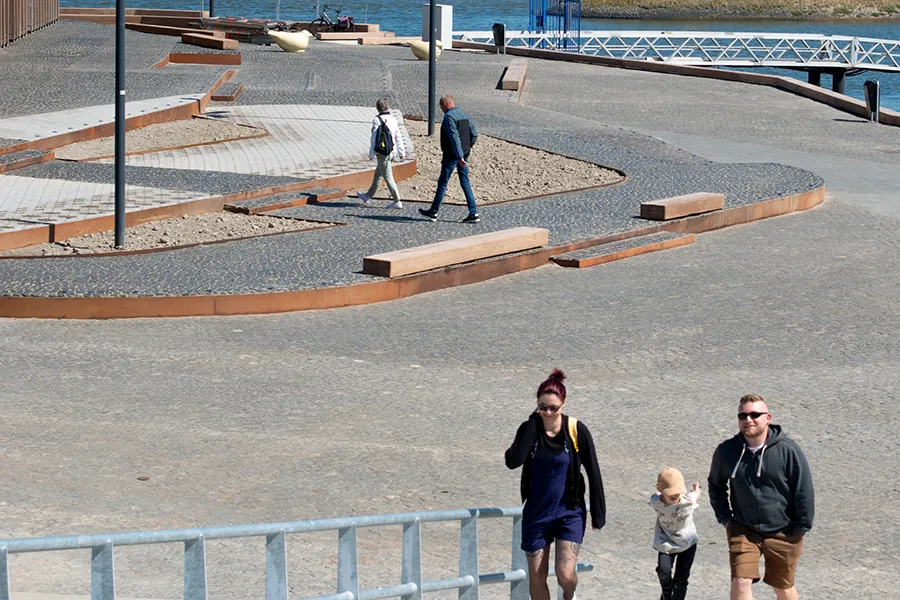
The design for the outdoor space at the Wadden Sea World Heritage Experience Centre (WEC), designed by internationally renowned Danish architect Dorte Mandrup, illustrates this. With a limited budget, LAOS opted for a circular approach, using second-hand cobblestones, old mooring posts and material recovered from marine litter. Salt-tolerant plants can be submerged from time to time. The design was both affordable and more robust, and has since become a much-loved place.
Responsibility after completion
Many designers deliver a plan and move on. LAOS does not. “We often come back,” says Dijkstra. Not to be strict, but to learn: is it working as intended? Is it growing? Is it changing in ways you did not anticipate?
Kouhkan says: “A design is alive. That is the beauty of our profession. And sometimes, in hindsight, you think: we would do that differently now. That is part of it.”
Dijkstra says LAOS’s decision to open an office in Utrecht now is not opportunistic, but necessary.
“It is important to our way of working to be close to our projects. We are already delivering some great projects in the north of the country, and now we also have a team based in the central and southern parts of the Netherlands. Some of the team will work across both offices. There will be a core team in Groningen and a core team in Utrecht. Our distinctive style, our refined pragmatism, will remain.”
The timing is right for LAOS. Local authorities and provinces are increasingly realising that the major challenges can only be solved if the landscape takes the lead.
“That is exactly what we have been saying for years,” says Dijkstra. “First the landscape, then the construction. First the water system, then the neighbourhood. First the identity, then the design.” It is an approach that suits both the practice and the major transition facing the Netherlands.
Small interventions
Landscape architecture is a patient profession. “Major changes to the water system or peatland areas take decades,” says Dijkstra. “But ultimately, you see that all those small interventions add up to make a difference.”
When he drives through the North, he sometimes sees places that he and his team have helped shape over the past twenty years. “You have a moment when you think: hey, we made a difference here. It may be small, but still,” he says. “And that is enough. The landscape is never finished. Nor should it be.”
Now that LAOS is also working from Utrecht, the practice will not change its approach: still rooted in the landscape, still focused on bringing people together, still seeking simplicity in complexity. But it is ready to show more places across the Netherlands that good design can make the difference between something that is merely attractive and something that is fundamentally better.
Question about this story? Ask your question
Keep following this
Get an email when a new story is published. No account needed.
- SubjectGeneral







