









Soil improvement is essential when establishing a lawn. A sound foundation for a strong lawn
Soil improvement is often overlooked when establishing a new lawn. “Every soil is different, so the landscaper is best advised to start with a soil analysis and tailor the nutrients accordingly.”
Jo Verschueren, technical and commercial adviser at Compo Expert Benelux, explains. The fertiliser and biostimulant manufacturer has two of its own factories: in Krefeld, Germany, and in La Vall d’Uixó, Spain. Compo Expert offers professional users solutions for turf and public green spaces, fruit and vegetable production, agricultural crops, tree nurseries and ornamental horticulture. “Our product range includes biostimulants based on seaweed extracts and beneficial soil bacteria,” says product & crop manager Robin Van Havermaet. “This is also important because the use of pesticides is no longer permitted. We have specific formulations for particular crops and for the stages they are at. In landscaping, we are best known for our Floranid® fertiliser brand.”
A carefully planned fertiliser programme
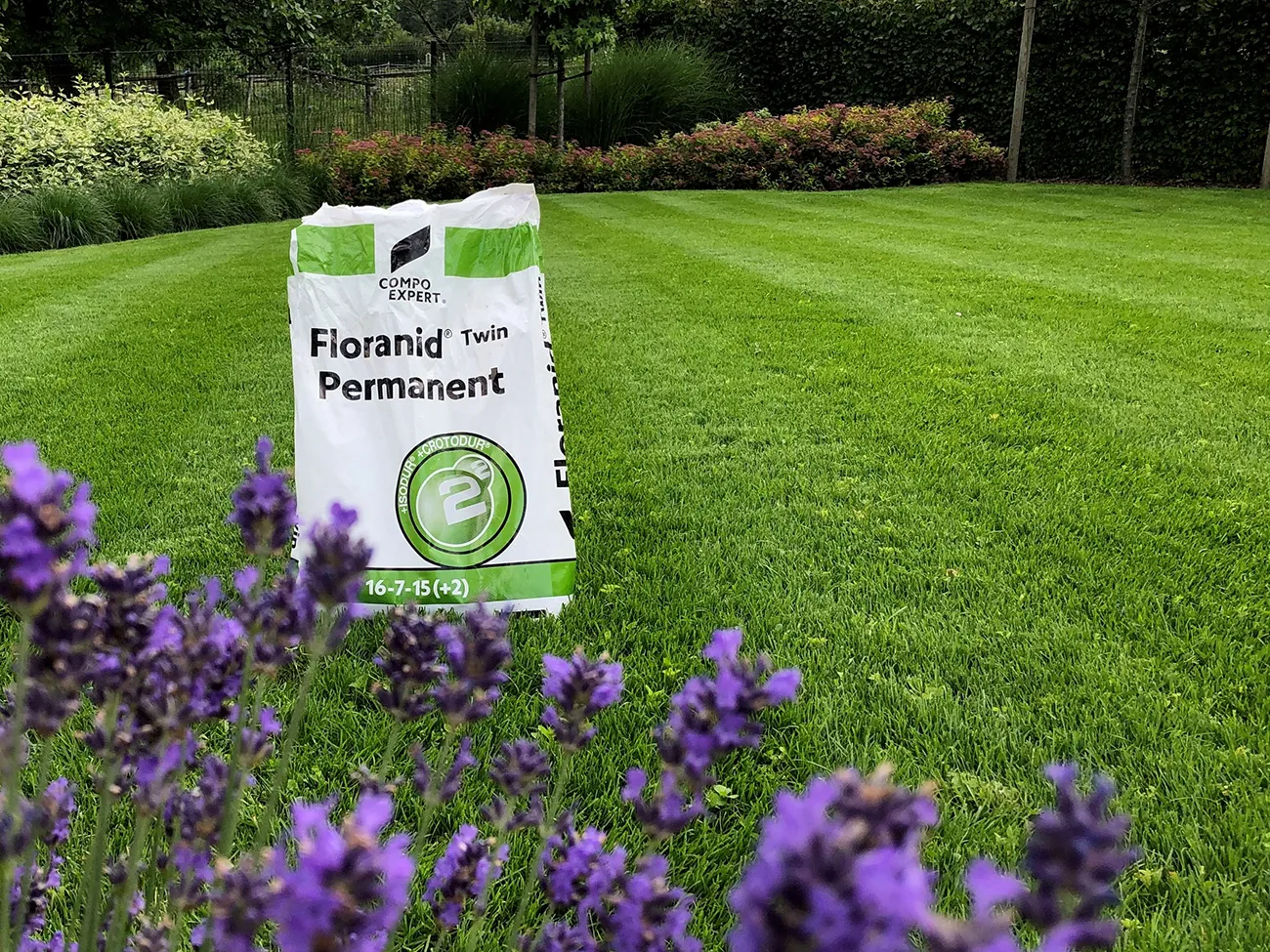
In lawn care, the two are seeing a clear shift from sowing seed to laying turf. But this makes no difference to soil preparation or maintenance. Verschueren says: “In a typical lawn, grasses need about 150 units of nitrogen a year. However, this requirement is not evenly distributed throughout the year. The highest dose of nitrogen is needed in spring. Less is needed in autumn, otherwise the grass will continue growing for too long. In autumn, you also want to protect the grass against cold and foot traffic. The fertiliser programme needs to be tailored accordingly.” Compo Expert therefore supplies different types of Floranid® for spring, summer and autumn. For landscapers who prefer to work with a single product, there is Floranid®Twin Permanent, which contains all the nutrients needed to establish and maintain lawns and borders.
But it all starts with the soil. “Ideally, the landscaper takes a soil sample, so it is immediately clear what its quality is and what is needed to achieve a good, open soil structure,” says Verschueren. Van Havermaet adds: “The acidity level is also important. Grass grows best in slightly acidic soil. Homeowners often think they need to lime the lawn to prevent moss. But moss is often caused by mowing too short and too much shade. If the soil is not acidic enough, peat can still be incorporated during establishment. Many problems can be avoided by adjusting the fertiliser programme, from once a year to three or four times at the correct rate. This prevents weeds and moss from taking hold in the lawn.”
Choosing the right product at establishment
In short, landscapers are not yet familiar enough with soil analyses. “As a result, they may eventually receive complaints from their customers,” says Verschueren. “This often ends up costing landscapers more than using the right products at the time of establishment to achieve ideal soil conditions. Taking a soil sample and having it analysed in a laboratory will therefore always pay for itself.”
Question about this story? Ask your question
Companies in this story

Keep following this
Get an email when a new story is published. No account needed.
- ThemeTrees and plants for tomorrow
- SubjectGeneral
- CompanyCompo Expert







