STIHL reduces CO2 emissions and publishes its 2022 sustainability report
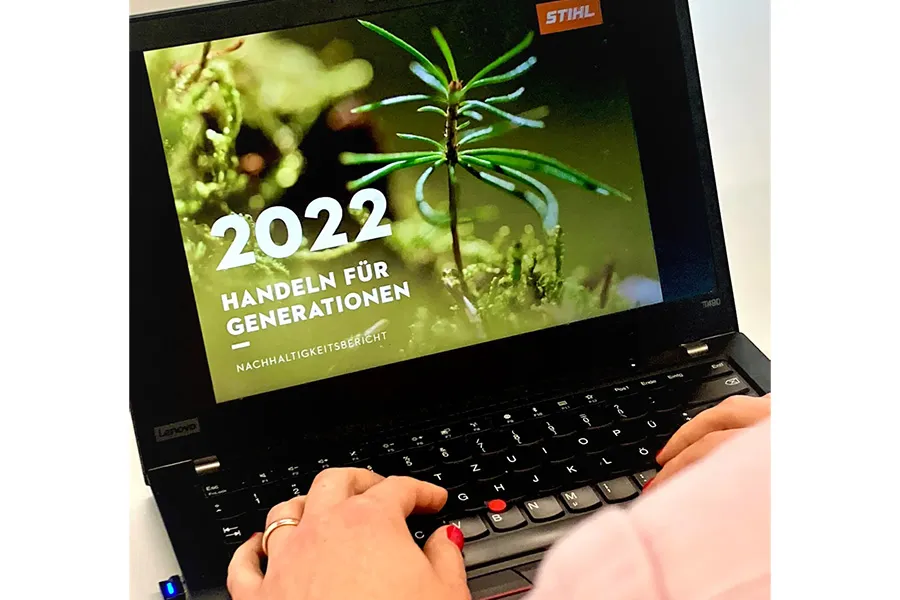
In 2022, STIHL significantly reduced its direct CO2 emissions (Scope 1 and 2) compared with the previous year, by 43 per cent. This was largely made possible by switching STIHL’s production sites worldwide to green electricity. This is revealed in the 2022 sustainability report (https://sustainabilityreport.stihl.com/2022/), published by the family-owned company on 25 May.
To fulfil its sustainability responsibilities, STIHL has launched a number of initiatives, including switching to green electricity. By 2030, STIHL also aims to reduce natural gas and oil consumption across all its companies by 40 per cent compared with 2019. To this end, the company has implemented around 100 individual measures worldwide, with a particular focus on technological innovations. Product Environmental Footprints (PEFs) have been defined for a number of product groups to reduce emissions from the upstream and downstream processes associated with activities across the value chain (Scope 3). These PEFs calculate a product’s environmental footprint throughout its entire life cycle in CO2 equivalents. Where possible, the footprints will then be analysed across the entire product range so that the findings can be incorporated into the product design process.
Recyclable products and less plastic
As a proponent of the circular economy, the company aims to develop products that are as recyclable as possible. At the end of 2022, a pilot project was launched to explore the potential of a fully recyclable product, in this case a brushcutter. Other projects have also been launched to reduce plastic packaging and CO2 emissions, such as replacing plastic packaging for cutting heads with solid and corrugated cardboard packaging. This measure is expected to avoid the use of more than 100 tonnes of plastic by the end of 2023.
Sustainable supply chains
Sustainability is now also an integral part of STIHL’s supplier relationship management. The main purchasing criteria, price, quality and logistics, have been supplemented with sustainability considerations. Other measures include an analysis of the risk exposure of all suppliers, enabling them to be assigned to different risk categories and preventive measures to be determined accordingly. STIHL has also set up a self-assessment platform to check whether suppliers meet key sustainability and compliance standards. To improve transparency and sustainability, STIHL has also begun a comprehensive analysis of potentially critical supply chains. Those for magnesium, cobalt and textiles are currently being examined in depth.
“With all these sustainability-focused activities, we want to make a positive contribution to climate protection, use resources sparingly and continue to guarantee fair working conditions, so that we can make it easier for people to work with and in nature in the future,” says Michael Prochaska, Head of Human Resources and Legal Affairs at STIHL and responsible for sustainability.
All information about our activities, sustainability strategy and objectives can be found in the STIHL 2022 sustainability report, available online at https://sustainabilityreport.stihl.com/2022/ (in English).
A business enquiry for Andreas STIHL NV? Get in touch
Companies in this story

Keep following this
Get an email when a new story is published. No account needed.
- SubjectSustainability
- CompanyAndreas STIHL NV