









The foundation of every green roof: good substrate
Text Nolanda KlunderImage Dakbloemenweide, The Urban Jungle Project, Rooftop Revolution, Jan Henk Tiggelaar
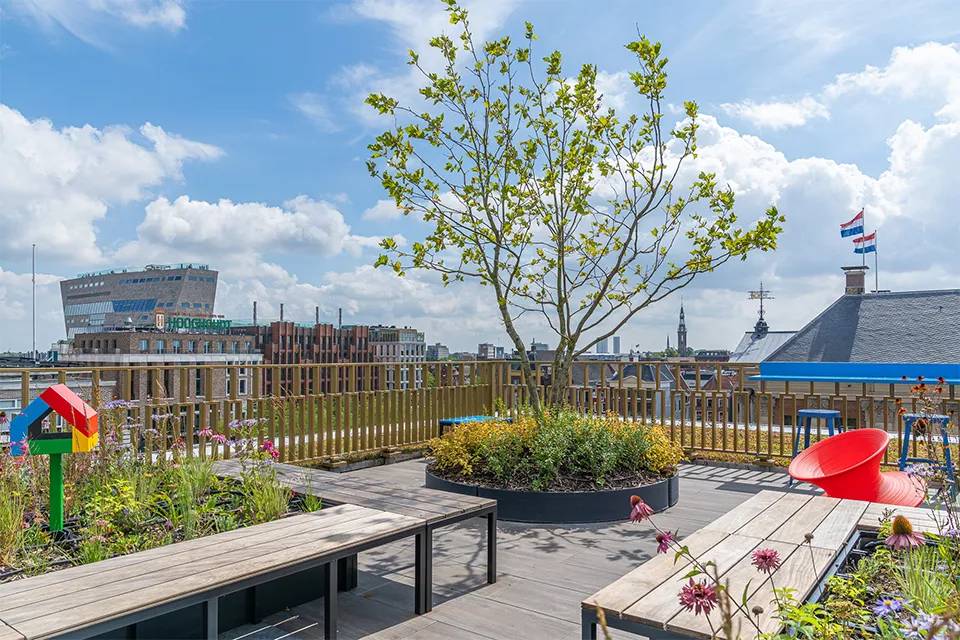
Round-table discussion on the ideal growing medium for roofs
No plant can grow without good soil. What is taken for granted at ground level is just as true on a roof. How important is good substrate, and how do you put together the ideal mix? Five organisations discussed the issue. “Substrates are among the least visible elements, but they are crucial.”
Healthy plant growth on a roof depends above all on the soil in which the plants grow. But what factors determine the ideal composition of a substrate? Jan Henk Tigelaar (Rooftop Revolution), Michiel van de Bunt (ZinCo Benelux BV and Vereniging Bouwwerk Begroeners), Joost Vlot (Dakbloemenweide BV), Daan Grasveld (The Urban Jungle Project) and Albert Vliegenthart (De Vlinderstichting) share their views on substrates.
Crucial
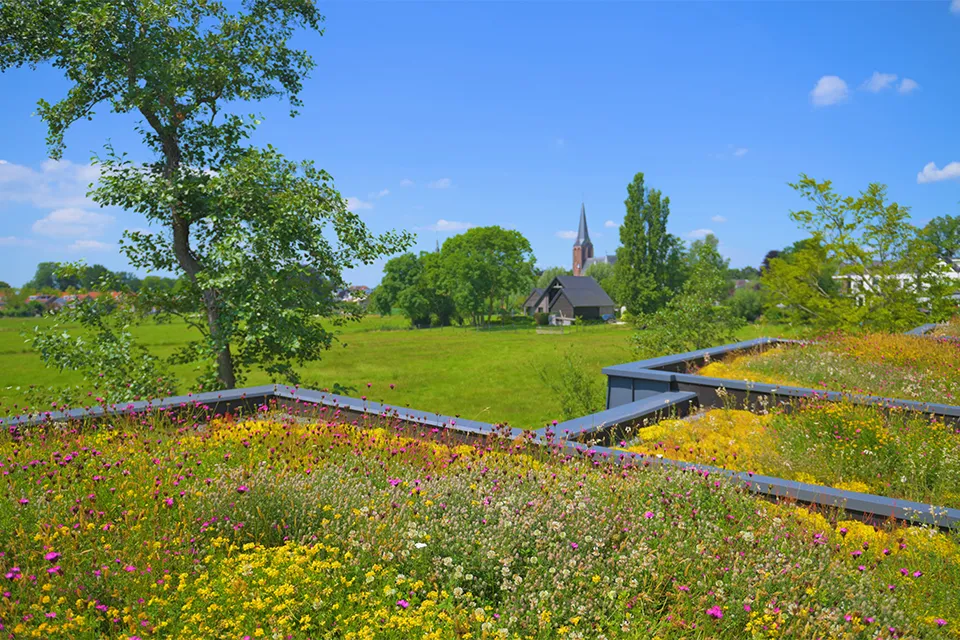
“At Rooftop Revolution, we are committed to bringing more nature into the city,” says Jan Henk Tigelaar. “That nature can find a home on the largest derelict site in the Netherlands: rooftops. A successful green roof has a healthy balance of soil life, plant life and the insects that are attracted to it. This creates a mini-ecosystem on the roof, which can make a demonstrable contribution to biodiversity. It all starts with the foundation: the substrate. Substrates are literally among the least visible elements, but they are crucial.”
Vegetation as the starting point
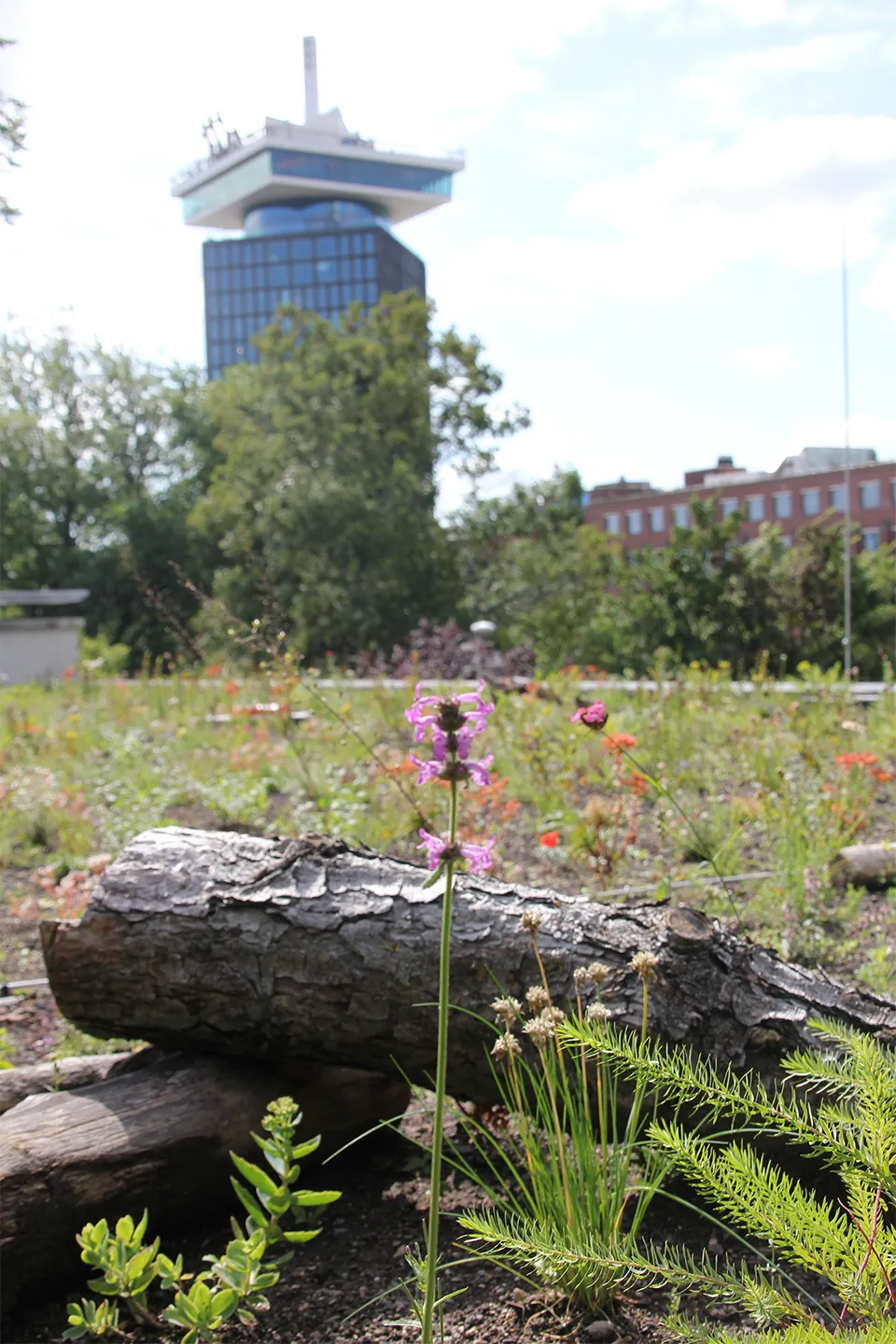
“It’s the soil, not the seed,” stresses Joost Vlot of Dakbloemenweide. “What I mean is that the extent to which a substrate supports a living, biodiverse soil is essential to the ecological quality of a roof garden. If you want a roof garden to make a real contribution, you need to start with an ecologically high-quality substrate. When we developed our roof flower meadow, we did not initially start from what roofs could accommodate, but from the vegetation we wanted. We want functional diversity on our roofs: animals should be able to find food, places to reproduce, shelter and nesting material. So the first questions are: What vegetation is needed to support that functional diversity, and what kind of soil does it require? We then worked through the specifications to develop a substrate with a low specific weight, allowing a diverse flower roof to be installed within the weight allowance for a sedum roof.” One of the aims was to create a substrate that needs minimal intervention. “The soil should be able to sustain itself for a long time without fertilising or mowing.”
A middle ground
“The question you need to ask yourself is: what are you optimising for?” says Daan Grasveld of The Urban Jungle Project. “With our modular Jungle Blocks, we make intensive green roofs possible on buildings where only sedum could otherwise be installed. We aim to achieve the greatest possible positive impact on biodiversity, while offering plug-and-play, lightweight solutions. Structural constraints are part of the equation for us. For each project, we try to find a middle ground between maximum impact and practical feasibility. When developing our substrate, in collaboration with various partners such as BVB Landscaping, Boomkwekerij Ebben and TU Delft, the aim was to minimise weight while maintaining a high-quality growing environment for the plants. Substrate development is a cornerstone of our R&D, and we continually invest time and resources in it. We are looking for the right balance between our ambitions: low weight, sustainable production and supporting long-term plant growth.”
Life cycle on the roof
“A green roof is not just about insulation, experience and climate benefits, but also about restoring biodiversity,” says Albert Vliegenthart of De Vlinderstichting. “In our view, a green roof is only functional if species can complete their life cycle there, which means reproducing. That is why De Vlinderstichting has researched the survival prospects of butterflies in different substrates. Many butterflies overwinter as pupae in the soil. Caterpillars were found to be able to develop into butterflies on a green roof if they can burrow into the soil properly. This is possible when the substrate layer is at least 7 cm thick and sufficiently permeable. Insulation is an important factor for butterflies: temperature changes need to happen very gradually. More vegetation is better for butterflies, as it moderates temperature fluctuations and provides more water and nectar.”

Regulations
Grasveld: “As a supplier, we need an independent knowledge partner to set the framework, working with research institutes and industry specialists. We are all carrying out our own research, but as a sector we could work together to achieve a greater sustainable impact. There is a need for more independently validated principles and guidelines.” Michiel van de Bunt of VBB explains: ‘In Germany, they work with the FLL, Forschungsgesellschaft Landschaftsentwicklung Landschaftsbau. It sets standards in various fields, including roof gardens. VBB bought the licence from FLL and adapted it for the Dutch context: the VBB-FLL standard. One added benefit of this standard is that if the various components, for example the drainage system and the substrate, comply with FLL, they are all compatible. This means, for example, that the substrate is not too fine and will not clog the filter fleece.” Grasveld: “The FLL guidelines do indeed provide a good practical basis for the responsible technical construction of a green roof. In my view, however, the technical construction should be secondary to achieving an impactful and sustainable result. For example, tenders often specify a minimum thickness for the substrate layer. But if your goal is to maximise impact, thickness is not the starting point. You focus on ecological impact, water storage capacity and the footprint of the materials used. It is then up to the market to develop the right solutions.” Vlot adds: “Technical guidelines, regulations and innovation are important, but they should not take precedence at the expense of ecological value. If ecological impact is your starting point, certain rules are no longer needed. You will naturally remove certain elements from your substrate because they do not serve your biotope.”
Cooling
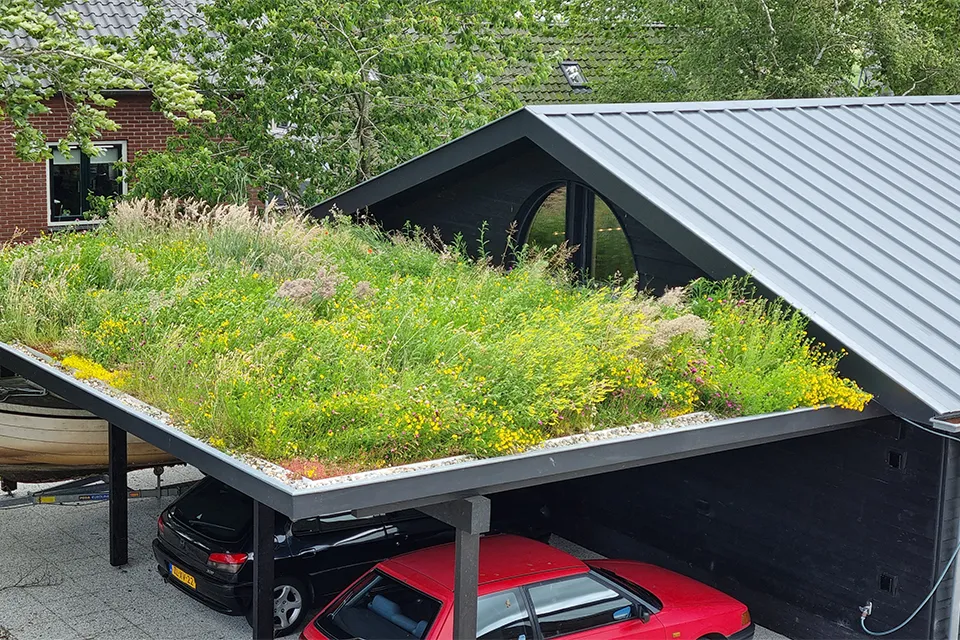
The discussion participants recognise that not every client is driven by the same intrinsic motivation. Sometimes the focus is more on achieving BREEAM certification, or the client is mainly interested in the cooling effect of a green roof. Van de Bunt says: “Green roofs have a cooling effect thanks to the moisture in the green roof build-up. Evaporation creates cooling. This means the roof structure beneath it heats up less, so the insulation has less heat to keep out. A roof garden therefore helps the insulation perform better. If a roof garden build-up dries out completely, the area beneath it will get just as warm. To reduce weight, roof garden build-ups are being developed that retain less moisture. Irrigation is an option, but our position at ZinCo is that substrates should have good moisture management in their own right, with sufficient reserves. This benefits cooling and the plants, which develop more robustly without a daily drip-feed.”
Bringing clients on board
If we want to significantly improve the ecological quality of green roofs, clients need to be on board. Grasveld: “Ecology is not a property company’s core business, so it is up to us to bring clients along and encourage them to aim higher.” Vlot has had the same experience: “You can see that there is interest in more valuable green spaces if you explain things properly. I had a client who wanted to install 5 m of moss concrete. I was able to explain that a façade garden with, among other things, firethorn would cost less and make a much greater impact.” Vliegenthart: “It is about ownership. The client should not want a green roof, but more biodiversity. That is the question they should bring to green-roof specialists: how can you help us create biodiversity on our roof?”
More knowledge
Developing and sharing knowledge is essential if the green roofs being installed are to make a genuine contribution to nature in the city. Rooftop Revolution plays a part in this, says Tigelaar: “For example, we organise the Rooftop Symposium every year, this year on 19 September. We are also starting a major study into what happens on green roofs, together with Yuverta mbo, Hogeschool Utrecht and other partners. Substrate is one of the most influential factors. It is time to give as much thought to substrates on green roofs as to the planting, because soil is the foundation of life on a roof too.”
Question about this story? Ask your question
Keep following this
Get an email when a new story is published. No account needed.
- ThemeSpace for urban green
- SubjectGeneral







