









The man who lets gardens breathe
Text Armand LandmanImage Generatie Alles, Armand Landman
A day out with Piet Oudolf
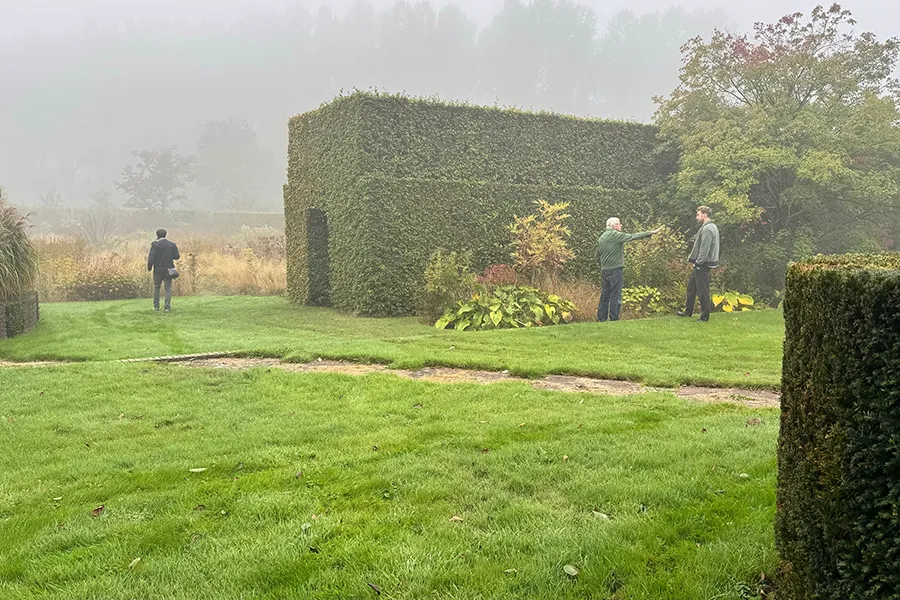
It is still early as the autumn sun falls in veils across Broekstraat in Hummelo. Mist hangs close to the ground, as if someone has yet to draw back the stage curtain. Here, behind the converted farmhouse De Koesterd, lies Piet Oudolf’s (81) famous private garden: 4,000 square metres of discipline and freedom, of a guiding eye and nature left to its own devices. A garden no longer open to the public, so it whispers rather than calls out. Today, it gets a chance to speak.
At a garden table, mug of coffee in hand, Oudolf looks up. “Lads,” he says softly, as if he does not want to startle the plants. “Welcome.”
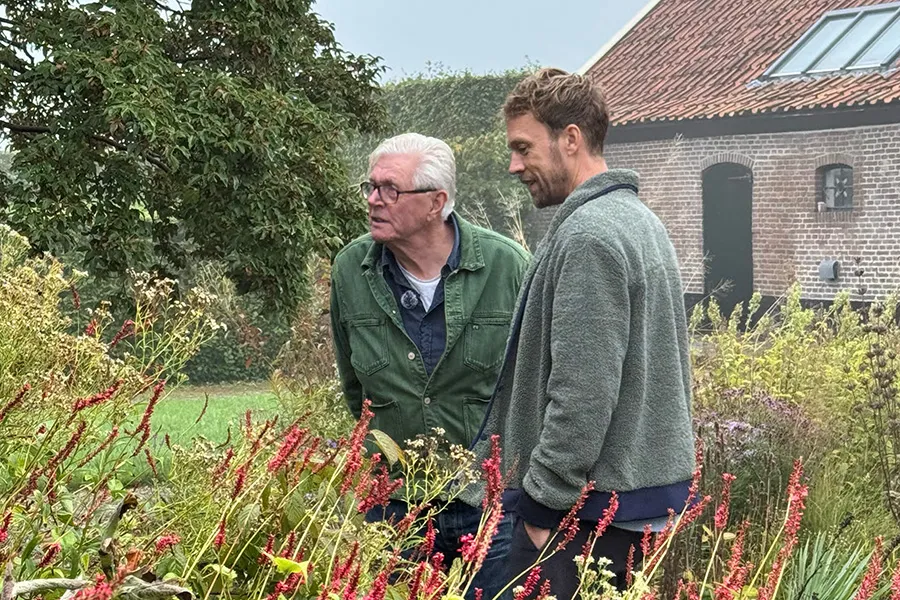
In the yard, three generations of craftsmanship form a semicircle around him: the designer himself, his wife and business partner Anja, and Arjan Boekel, a younger-generation garden and landscape architect and project leader at the De Bloeimeesters cooperative. A film crew from creative studio Generatie Alles is there to make a short documentary. And there is Brett Gilman, an American landscape architecture student from Middlebury, Vermont, who pronounces Oudolf’s name with something of a pilgrim’s reverence. He grew up an hour by metro from the High Line in New York. “I’ve been there six, eight times,” he says, “and every time I thought: this is what I want to do.” So when he was able to get in touch with Boekel and Oudolf through his lecturer Noël Kingsbury, he seized the opportunity with both hands.
Being here today, in the holiest of holies, the private garden of the godfather of garden designers, makes him feel humble. The garden has not been open to the public since 2018. We are here today thanks to the documentary and the conversation between an old master and his younger followers.
Editing a landscape
We walk into the garden. The paths meander, and the planting keeps them in place with studied nonchalance. Oudolf taps the edge of a clump of Deschampsia with his foot. “This is what happens when you let a system go and guide it,” he says. “You’re editing, not rewriting.” He points to the areas where a winter of high water has erased parts of the garden. “We’ve lost a lot of species here. That seems like a disaster, but it also opened things up. Strong species filled the gaps. Now I mostly guide things along. Like a conductor who occasionally turns down the violins.”
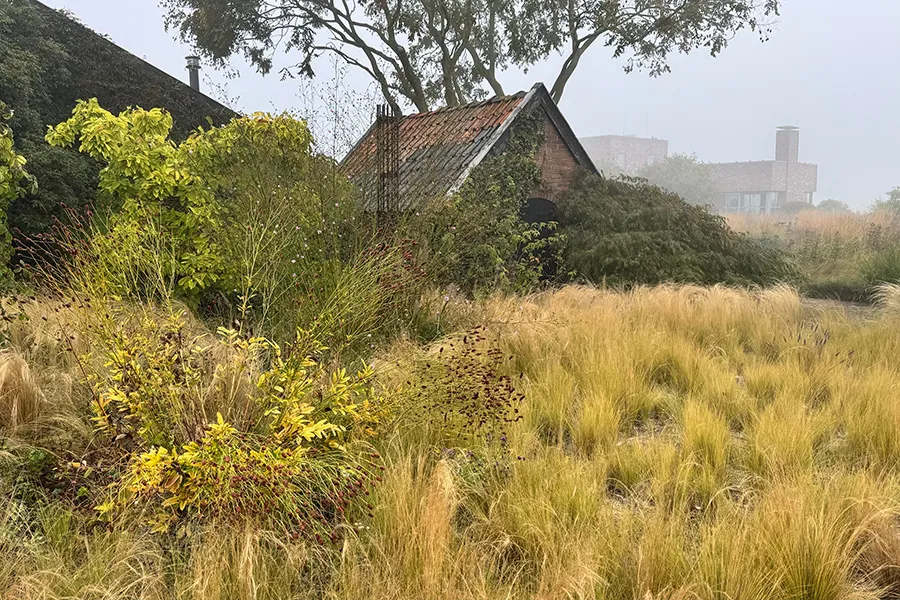
Boekel nods. “To a layperson, this looks like a garden that needs no work.” Oudolf smiles. “I can already see what I’ll need to take out next year. You have to know when to put your foot down and when to hit the brakes. This is a four-dimensional profession: you design for today, for the season, for next year, and for the moment in between.”
Oudolf speaks in images. It is the language of someone who sees plants as characters in an ensemble: clump-formers that stay put, pioneers introduced only later, and noise removed before it becomes a refrain. Verbena behaves itself as long as the whole is full. Molinia keeps self-seeding in check. “The foundation is plants that can live alongside one another,” he says. “Clump-forming, with no running roots. You add self-seeders later. Otherwise, you end up with one huge patch of Verbena.”
Work for professionals
He stops by a wooden gate. “This whole site takes two days’ work, at least,” he says in passing. Not to complain, but to acknowledge the reality. Gardening also means office work, ordering and budgeting. It means observing, correcting and accepting. “You can’t do this job from behind a desk,” he says. “You still have to take the turns that aren’t on the route planner.”
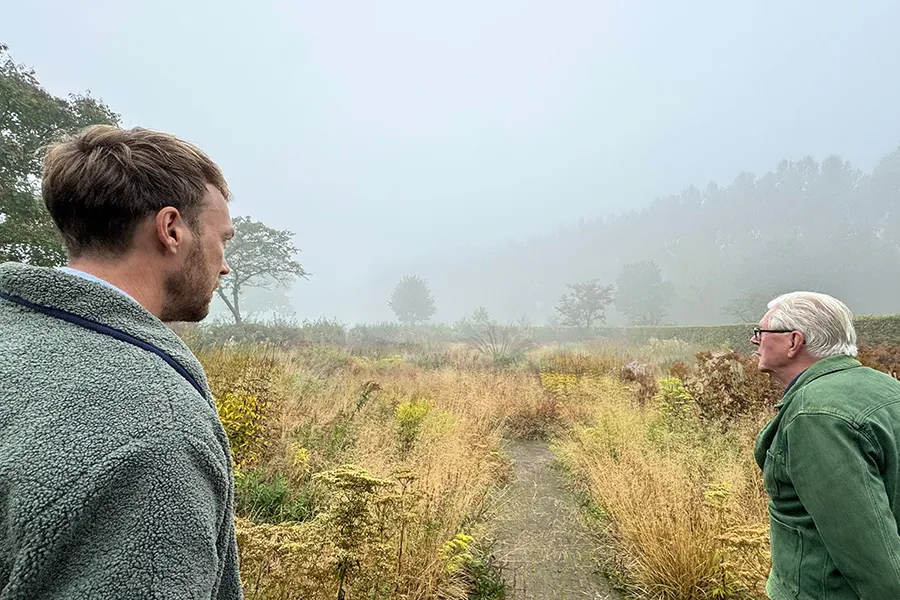
As we continue, the conversation turns to public spaces, where ecologists build nests of rules and maintenance budgets eat into ambitions. Oudolf mentions a project where maintenance was ‘someone else’s responsibility’. After returning years later, he saw that it looked good, but also that unwelcome plants had seized their chance. “Sometimes people expect you to come back for free because it’s ‘your masterpiece’. But good maintenance is a profession too, and it comes at a price.”
Oudolf adds: “These days there are more and more ecologists deciding what you’re allowed to do, saying: we want this percentage to be native, that percentage to be something else. But no one thinks about what you can do with your own vision. It’s not just about native plants, it’s about plants that live in a community, that are attractive and non-invasive, but don’t come from this place. Our gardens have been designed around them for centuries.”
Imagined nature
In Hummelo, nature is made, and that is what makes it convincing. “Imagined nature,” he calls it. Not a romantic woodland, but a composed landscape that occasionally rises like a gust of wind, even when the air is still. Zoom in and you see a geranium leaf piercing through the grass. Zoom out and the picture comes together. Repetition, flow, calm created by mid-height planting, with the occasional accent. It evokes the landscape we have lost, and which, thanks to design, we can experience again for a moment. “If you do this well,” says Oudolf, “plants that don’t belong here will naturally be pushed back out.”
We stop where the garden frays into the yard. Verbena Hastata already carries the winter scene within it, while self-seeding Lythrum Virgatum, Pennisetum Viridescens and Deschampsia slip into open spaces like pioneers. “It’s a living experiment,” says Boekel. “You build in back-ups. If this drops out, that takes over.” Oudolf says: “That’s what we see at Lurie Garden in Chicago too, twenty years after it was planted: the same garden, but different. The right people keep it on course. Plants are removed when there are too many or they disrupt the picture.”
Miscanthus, Panicum and the length of summer
Among a group of plants, we hear a conversation about ornamental grasses. Miscanthus, once a favourite, is now too much of a good thing in some places because of longer summers. South of New York, it self-seeds freely; in the Netherlands it flowers, but rarely produces ripe seed. Smaller cultivars are coming back into the picture, for their autumn colour and growth habit. Panicum? “Not so often the tall ones,” says Boekel. “I once fell for ‘Rotstrahlbusch’ at a nursery in Heiloo. That was a trigger.”
The technical language of the trade slips effortlessly into poetry: a blade of grass is not material here, but a line you can place in a sentence. It is what keeps the Dutch Wave, the work of Oudolf, Henk Gerritsen and Ton ter Linden, relevant today: natural plant communities, art and seasons as the grammar of a poem.
Superbloom
After midday, the group moves on to Arnhem, to Superbloei: a site designed by Boekel where the experiment is in full bloom. Among office workers, skaters and smartphone cameras, he talks about layers of sand and root strategies. Drilling through compacted ground, three holes per square metre, deep-rooting plants loosening the soil with their roots. A top layer of paving sand that just does the job, though he would have preferred a coarser grade, but it works because the plants understand the system. “Don’t make them big above ground,” says Boekel, “make them big below ground. Then they can cope with drought.”
Oudolf listens, walks, looks, and bends down where necessary. “You could have used more Sporobolus here too,” he murmurs, almost tenderly. “A good back-up plant. It fills the gaps.” Sometimes they disagree, more often they speak the same language. It is collegial friction: the spark that brings craftsmanship to life.
At the edge of the design, beside a concrete border, Brett Gilman stands with a camera larger than his hand. “This is the perfect day to be here,” he says. The English of the East Coast meets the Achterhoek sand and finds its footing. The High Line, that cathedral of steel and grass in Manhattan, seems a long way away, yet close at hand. It shows how knowledge travels: from Hummelo to New York, from Chicago to Arnhem, then back to a student who sees his calling through the mist.
The lesson of Hummelo
At the end of the afternoon, we sit again at the table where the day began. The sun has folded up the mist and tucked it into the hedge. The yard smells of autumn and coffee. What stays with you is not a single piece of wisdom, but a guide to the profession: design with resilience at the core, clump-formers first, pioneers later; guide the system, edit, correct, let go; think in seasons and years, the job is four-dimensional; see maintenance as design that continues, budgets are tools too; and accept disruption, water, wind, failure, as part of the composition.
Oudolf looks around the yard, as if he wants to set the garden straight one last time with his gaze. “Nature includes flooding too,” he said earlier that day. He adds: “A garden is never finished. We’re not trying to imitate nature here, but to understand it.”
As we set off, it is as if the garden takes a brief breath out. As if it knows it has been seen, and can now continue growing in silence. Before long, the sun will be setting again.
Watch the short documentary filmed by Generatie Alles in late September, capturing the meeting between Oudolf and Boekel.
Question about this story? Ask your question
Keep following this
Get an email when a new story is published. No account needed.
- SubjectGeneral







