









‘The market needs plant obsessives with in-depth knowledge’
Text Armand LandmanImage HAS Green Academy, Stefan Sanders Fotografie

HAS green academy sharpens its green-space education
The Dutch construction and green sectors are crying out for specialists with in-depth knowledge of plants. When climate-resilient neighbourhoods, nature-inclusive renovations and roof gardens are developed, the same problem keeps emerging: the foundations are shaky, with too little knowledge of plant ranges, soil and management. HAS green academy in Den Bosch is actively trying to bridge that gap with a relatively new course focused entirely on the technical and practical application of green space in urban environments.
Two and a half years ago, HAS launched the Associate degree in Green Living Environment, specialising in Ecology. This is not a standard higher professional education bachelor’s degree, but a two-year practice-oriented course at level 5. Practice is the starting point, with theory providing support, exactly the opposite of the approach taken in a traditional bachelor’s degree.
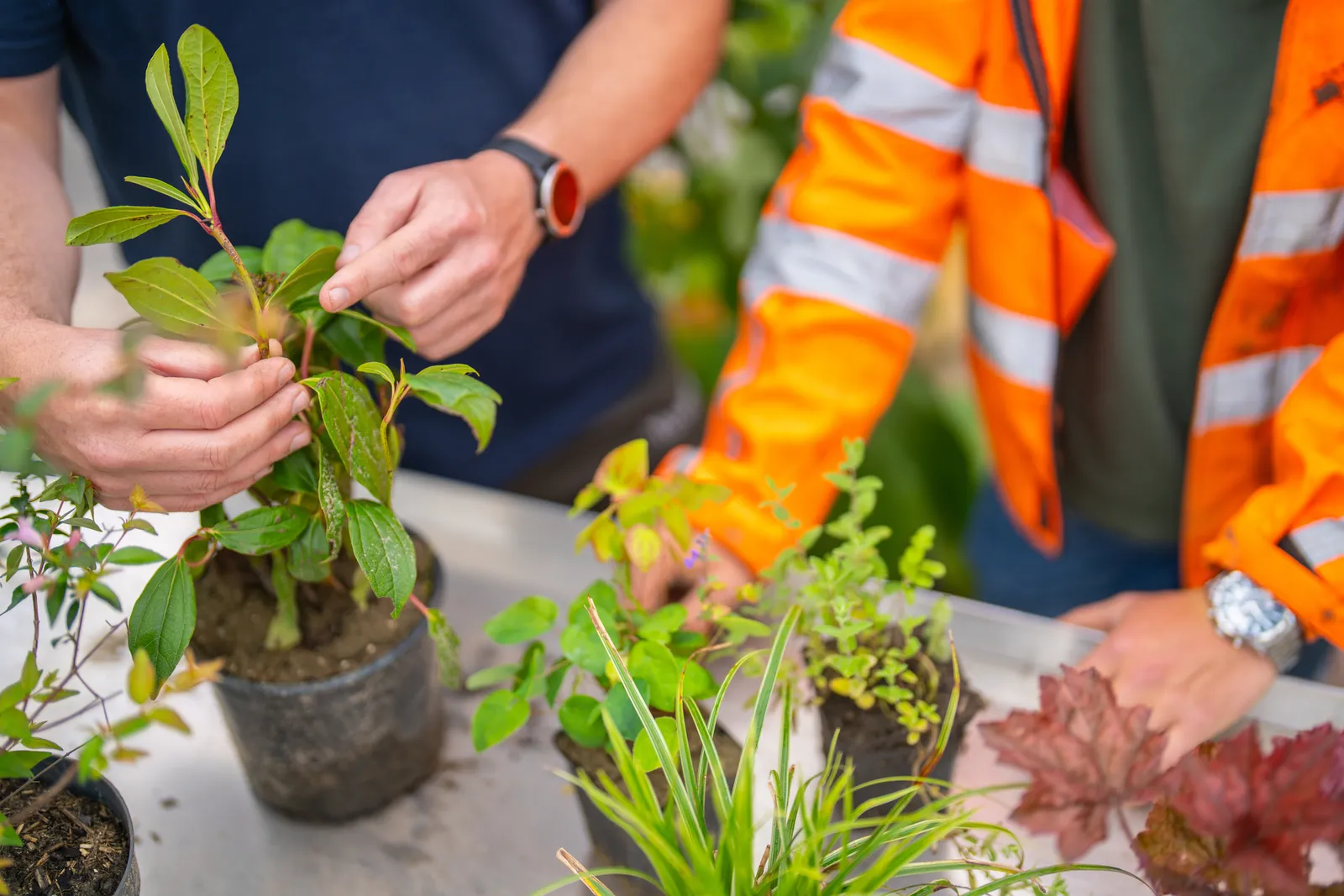
The course is explicitly not aimed at designers. Visuals can increasingly be created using AI, but the technical design, feasibility and manageability of green projects require genuine professionals. “We provide very practical training for roles such as work planner, project manager and urban green-space manager,” says lecturer and account manager Mattijs van Dalen. “We don’t train designers, but green professionals who know how to turn a design into an outdoor space that can be built and managed.”
There is clearly strong demand for these professionals. This academic year, the Associate degree in Green Living Environment has added the Ecology specialisation, which attracted 85 applications; the full-time Green Living Environment programme received a further 27. From September, students will also be able to take the course part-time or through a dual programme. This option is intended for career changers and professionals looking to deepen their knowledge of the field.
Van Dalen finds that students coming from senior general secondary or pre-university education have little knowledge of plants. Those with a vocational background are more likely to have a basic grounding, but it is heavily focused on private gardens, rather than the complexity of urban green space. That is why every HAS student receives a solid grounding in botany, including trees, shrubs, perennials and herbs. New this academic year is the integration of fauna with plant knowledge. Alongside flora, students learn about 100 fauna species found in the Dutch natural environment. This helps connect their learning to biodiversity development and the growing demand for knowledge of nature-inclusive construction.
“You can compare it to a chef,” says Van Dalen. “They also need to know what vegetables and herbs are before they can cook. We give students the basics, but you only learn the full range of plants in practice.”
Green space moves up the construction agenda
HAS green academy also bridges the gap between the office-based side of the profession, including planning and specifications, and on-site delivery. Municipalities, engineering consultancies and large landscaping contractors are increasingly hiring students and graduates. Even construction companies are bringing green specialists in-house to build up their knowledge of flora and fauna and respond more quickly on projects.
There is still plenty of room for improvement, particularly when it comes to collaboration between disciplines. Van Dalen finds that architects and contractors often lack specialist knowledge of green space. Construction solutions in projects do not always align well with the planting planned for the site. This makes it all the more urgent for people from different disciplines to sit down together during the design phase, to create green spaces that are both sustainable and manageable. “The best projects are those where design, delivery and management are all part of one package. Then everyone shares responsibility and learns from one another.”
HAS is investing heavily in lifelong learning. Professionals in the field can take courses and training in everything from plant ranges and biodiversity to technical design and management. New from March: a basic green-space course for the property and construction sectors.

Van Dalen says this is urgently needed. “A landscaper working on roof gardens can learn all about roof structures from an organisation such as BDA. But the property sector often knows very little about green space. You don’t need to become an encyclopaedia, but basic knowledge makes discussions much more equal.”
He believes trade organisations such as NL Greenlabel and VHG could also play a greater role in connecting education, the sector and construction.
The paradox is that demand for plant experts is growing, but work-placement opportunities are scarce. Many specialists have become self-employed or work for small consultancies that do not have enough time to supervise students. At larger consultancies, the number of planting experts has actually fallen.
As a result, students who want to specialise in plant ranges and planting design find it difficult to secure a placement. “The market wants them, we train them, but the industry can’t always give them the right support,” says Van Dalen. “It’s a real chicken-and-egg problem.”
A sector in transition
The course in Den Bosch is striking a chord: the green sector faces enormous challenges and opportunities. Climate adaptation, biodiversity and urban densification call not only for more green space, but above all for better green space. That requires professionals who speak the language of construction as well as that of plants.
With its blend of practice-oriented education, specialisations and a solid grounding in plant knowledge, HAS green academy is working to develop exactly this kind of professional. The interest shown by both students and the industry suggests the time is right.
As Van Dalen puts it: “Learning doesn’t stop after a two-year course. You have to keep learning, right up to retirement.”
Question about this story? Ask your question
Companies in this story

Keep following this
Get an email when a new story is published. No account needed.
- ThemeTrees and plants for tomorrow
- SubjectGeneral
- CompanyNL Greenlabel







