Quercus ilex, an evergreen hedge with character
Box hedges have taken a battering in recent years in our region, thanks to the box tree moth. Holly, yew and hornbeam hedges make good alternatives, but if Hugo Maes has his way, it will be Quercus ilex (holm oak), grown as a hedge. Maes is one of the few people in our country to specialise in growing this hardy woody plant from southern Europe and North Africa.
The holm oak stands out for its thick, leathery, dark green leaves, with a felt-grey, silvery underside. In May and June, it produces an abundance of soft yellow flowers. Its leaves can have smooth or holly-like serrated edges. Quercus ilex is evergreen, but can lose some of its leaves during prolonged cold spells. These are immediately replaced by fresh young foliage. This evergreen quality makes the holm oak particularly suitable for planting as a hedge.
Looks good when closely clipped
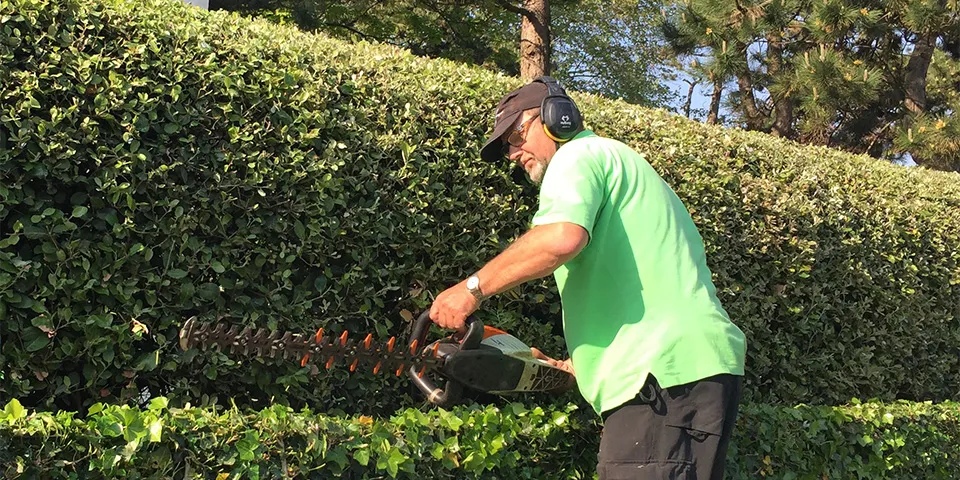
The holm oak is naturally a tree that can grow tall in its native habitat. However, young plants respond well to formative pruning, making it easy to keep them in check and shape them into neat, compact, continuous hedges or screens. Two trims a year, in April and September, are enough to maintain a good hedge shape. Looser forms are also possible, requiring just one trim a year.
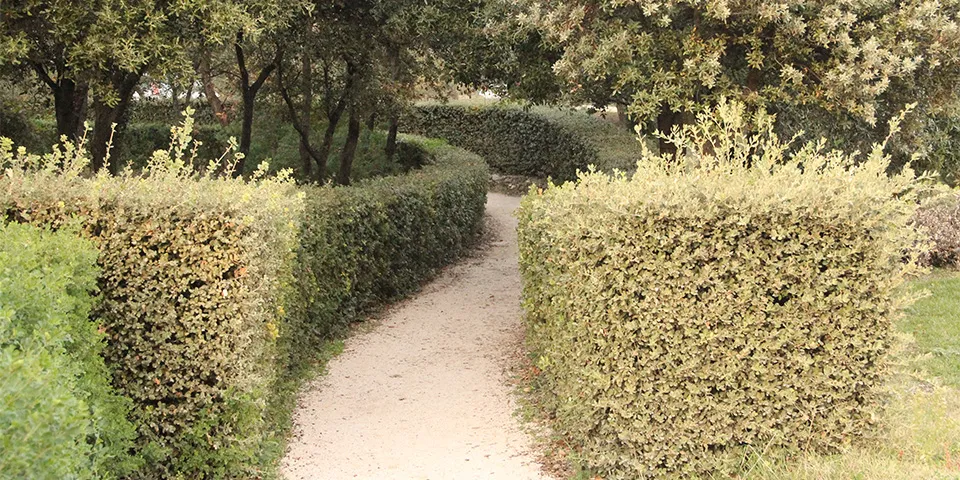
Quercus ilex hedge in a playful, curved form.
Boundaries, garden rooms and windbreaks
The uses of holm oak as a hedge are exceptionally versatile. More and more garden designers are planting holm oak in their own gardens, which is highly significant. Quercus ilex hedges can serve as almost impenetrable garden boundaries, providing complete privacy. By varying the height at which they are clipped, they can also be used to create attractive, intimate garden rooms. Quercus ilex also thrives in salty, often windy coastal climates, which is why it is frequently planted in coastal gardens as a particularly resilient evergreen windbreak.
Resilient in every respect
Every year, Hugo Maes travels to southern France. High in the cold hills of the garrigue, with its lime-rich soils, he gathers ripe, pointed holm oak acorns. He germinates them himself and grows them on as hedge plants. The care taken during cultivation allows the plants to acclimatise to our climate and soil conditions, making them hardy to at least -18°C. Regular trimming and careful attention to the young plants ensure they grow into well-branched, dense specimens that quickly establish themselves in their new surroundings after transplanting.
By carefully selecting the seeds himself, Maes has produced locally grown holm oaks with much smaller leaves than imported Italian specimens. Hugo Maes’s years of pioneering work have led more and more garden designers to specify plants of Belgian origin, particularly for their attractive leaf shape and size.
Question about this story? Ask your question
Keep following this
Get an email when a new story is published. No account needed.
- SubjectMachinery & equipment