The green transformation of industrial heritage
Text Armand LandmanImage LOLA Landscape Architects
Another important aspect is community involvement
Geometric shapes recur throughout the design, referencing cellular structures. Water and planting also play an important role in the design, as they are essential elements for survival in the desert. “The whole building is actually a collection of planters,” says Hoen. Working with local experts, the team is piecing together a complex technical puzzle to make the building green and sustainable despite the extreme conditions in Abu Dhabi. “We are pushing the limits of what is possible with as little water as possible, which is a major challenge in this region,” says Hoen.
Greening and social safety
Alongside ecological considerations, social safety is also a key concern. Green spaces in the city can make it more liveable, but need to be carefully planned. Sightlines, good lighting and consultation with the community are essential to ensure people feel safe in parks and gardens. “It is a design challenge that involves bringing together green space, safety and use,” says Houben. “Mecanoo aims to design public spaces that are welcoming both during the day and in the evening.”
A landscape of remembrance
Another special project Mecanoo is working on is the Westerbork memorial camp. Here, the landscape is used to tell the story of the past. “It is a very special landscape, given everything that happened here,” says Houben. Mecanoo has chosen to preserve and enhance the spatial structure of the camp through subtle landscape interventions. “We have created barrack fields that mark the places where barracks once stood. In this way, the landscape tells a story and offers space both for remembrance and reflection. Maintenance is also important here, to preserve the ecological and historical value of the site.”
De Meelfabriek in Leiden
De Meelfabriek in Leiden is a major transformation project that has been in development for decades. Ab van der Wiel, director and owner of Van der Wiel Bouw en Ontwikkeling, is the driving force behind this ambitious project. What began as an area where nobody wanted to live has become a lively part of the city, with industrial heritage innovatively transformed into a vibrant neighbourhood offering space for culture, green space and housing, including some social housing.
Van der Wiel talks about the long road he has travelled to bring the project to fruition. “We have been working on it for nearly forty years,” he explains. It has been a challenging process. He had to overcome opposition from local residents and appeared in court several times to push the plans through. The buildings at De Meelfabriek were eventually given listed status, thanks in part to support from Stichting Industrieel Erfgoed Leiden (STIEL). This made it possible to preserve the historic structures and give the complex new uses.
An important part of the transformation was the collaboration with LOLA Landscape Architects and renowned garden designer Piet Oudolf. LOLA and Oudolf worked on creating a garden on the De Meelfabriek site. The project’s green heart creates a unique living environment, with biodiversity and sustainability at its core. The buildings have been made entirely gas-free and equipped with sustainable energy technologies, in line with Van der Wiel’s vision of making the city greener and more sustainable.
Original structural frames
“De Meelfabriek was on the wrong side of the city,” says Van der Wiel. “Nobody really wanted to live here.” That changed when he saw the potential to preserve the industrial heritage buildings and turn them into a vibrant new area. By keeping the original façades and structural frames intact, the character of De Meelfabriek was preserved. The neighbourhood has since become an attractive place for residents, businesses and visitors, thanks in part to the green space and social facilities added to the project.
International attention
Van der Wiel considers the collaboration with Piet Oudolf crucial to the project’s success: “Oudolf has a vision that fits perfectly with what we want to achieve here: a green living environment that contributes to quality of life.” The result is a public space that is accessible to everyone and improves the city’s liveability. The project even attracted international attention, bringing Van der Wiel into contact with some high-ranking people in New York, Norway and Argentina.
Despite the many obstacles and the patience required, Van der Wiel is pleased with the result. He sees De Meelfabriek as a model for future urban development projects, with sustainability, heritage preservation and community involvement at their heart. “At the end of my life, I want to be able to say that I contributed something,” says Van der Wiel. With De Meelfabriek, he seems to have achieved more than that.
A new green lung within industrial heritage
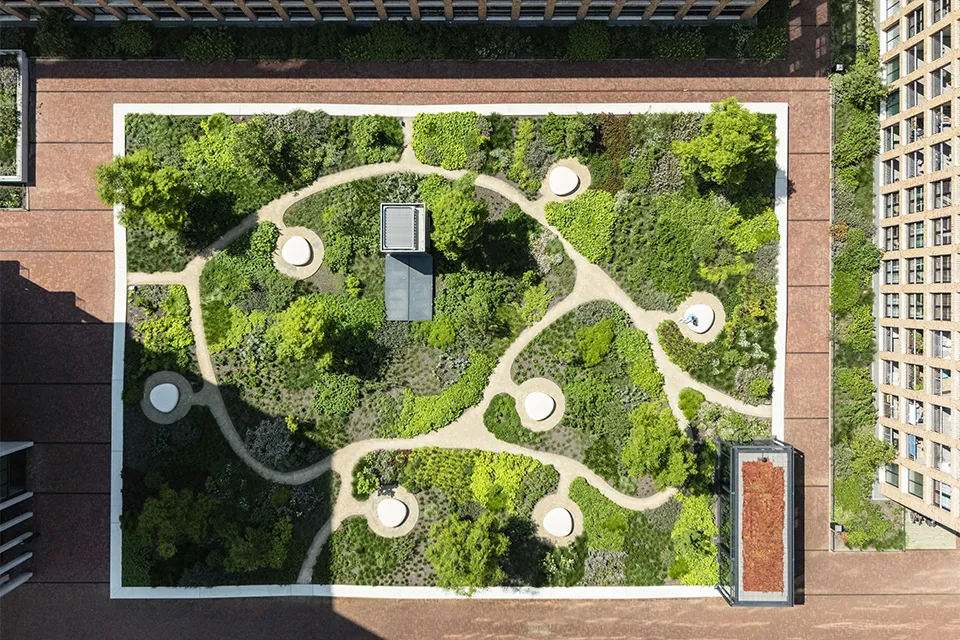
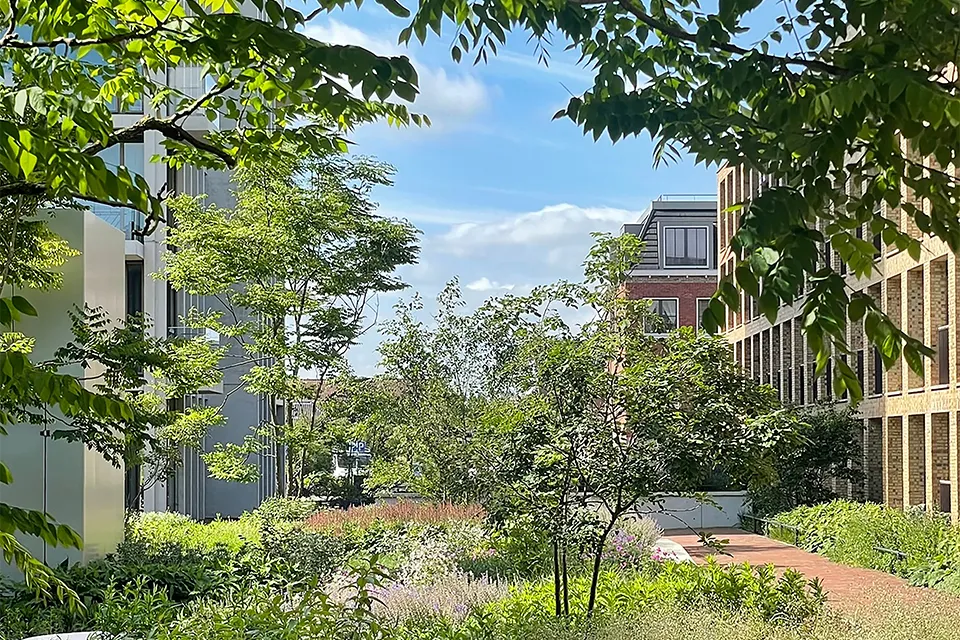
The transformation of De Meelfabriek in Leiden has taken on a new dimension with the opening of the Meelfabriektuin, a green oasis designed by LOLA Landscape Architects in collaboration with renowned planting designer Piet Oudolf. Located above the new underground car park, the garden brings together historic heritage and modern urban nature in the heart of Leiden.
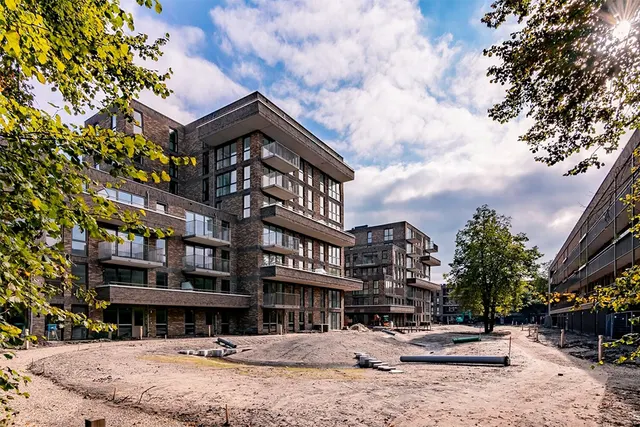
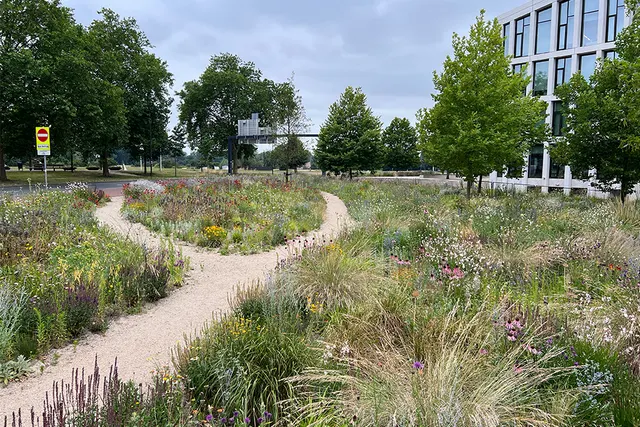
De Meelfabriek, an iconic industrial complex whose earliest sections date from the late 19th century, has been transformed into a lively mixed-use area, with a hotel, wellness centre and shops among its facilities. The garden serves as a green lung at the heart of this redeveloped urban space. LOLA’s design is a carefully framed green landscape that feels like a living painting. The garden offers a new colour and atmosphere in every season, thanks to Oudolf’s dynamic planting. This approach makes the Meelfabriektuin not only an aesthetic space, but also a place of calm and reflection for residents and visitors.
A chain of urban gardens
Work on the Meelfabriektuin began as early as 2017, when LOLA Landscape Architects, together with Studio Akkerhuis and other partners, became involved in the redevelopment of the site. Peter Veenstra, partner at LOLA Landscape Architects, explains: “It was crucial for us to be involved in the project from the outset, so that we could create the right conditions for a high-quality green space. This makes a huge difference to the quality of the final design.” The collaboration with Piet Oudolf, who had previously worked on the design of nearby Singelpark, resulted in a garden design that combines continuity with Singelpark and a distinctive character of its own. Oudolf was responsible for the planting, creating a rich diversity of native species that make the most of the changing seasons.
Veenstra adds: “The basic idea for the design came from our masterplan for Singelpark. We wanted every garden in this chain of urban gardens to have its own distinctive character. The Meelfabriektuin is intended as a clear, enclosed space where visitors can really unwind.” The sculptural seating and concrete seating edges designed by LOLA invite visitors to enjoy their surroundings, adding to the vitality of the area.
According to Veenstra, working with Piet Oudolf brought a special dynamic to the project. “Piet has unrivalled knowledge of planting, while we focused on the spatial framework and infrastructure of the garden. It was important for us to complement one another and create a garden of a high standard, both aesthetically and functionally.”
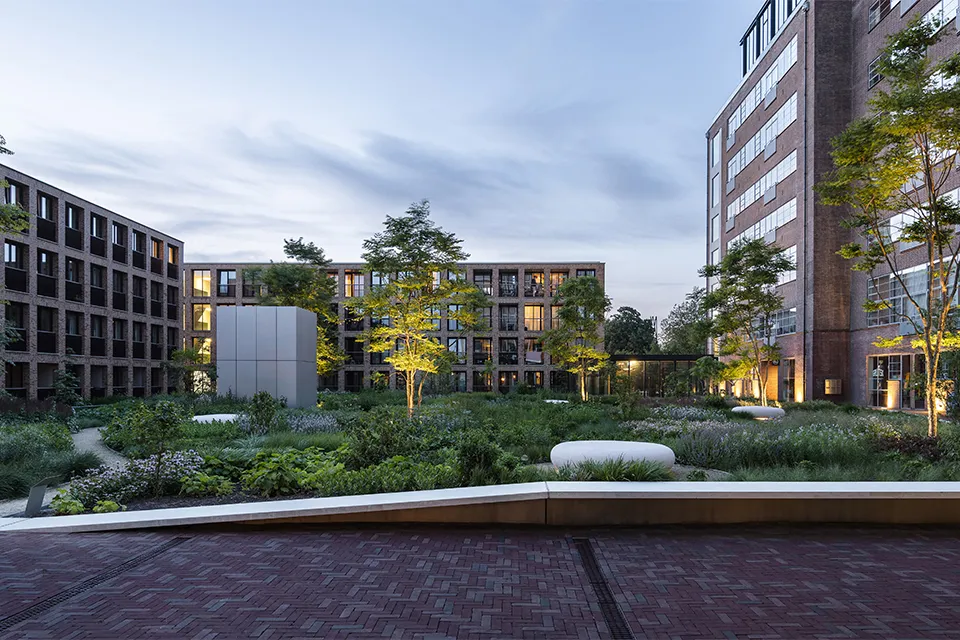
Veenstra stresses the importance of getting involved in a project like this at an early stage. He sees the Meelfabriektuin as an inspiring example of how green heritage can be connected with contemporary urban needs without compromising on design quality. “It is essential to us that green elements are not treated as an afterthought, but as an integral part of the design. Fortunately, this was also the vision of the developer, Ab van der Wiel, which made the whole process much easier.”
Open to the public
The distinctive character of the Meelfabriektuin also lies in its accessibility. Although the garden is on private land, it is fully open to the public, which is unusual for this kind of private redevelopment. Veenstra says: “The fact that this garden is open to the public makes the project especially distinctive. It means it is not just a place for residents of the complex, but for everyone in the city. That is ultimately what we wanted to achieve: a garden that truly becomes part of urban life.” The garden is therefore an example of how nature can promote inclusivity and appeal to a wide audience, from local residents to tourists visiting the area.
The project shows that it is possible to create high-quality public spaces, even on top of complex infrastructure such as a car park. “We really had to make an effort during this project to maintain the high quality of the planting,” says Veenstra. “It is often tempting to cut back on green space because of budget constraints, but here we and the developer decided not to cut the planting budget. The result is a garden that truly comes into its own and that everyone can enjoy.”
‘The more it grows, the less work we have to do’
Every two weeks, gardener Joris Anthonissen of Hoek Groen walks through the public garden at De Meelfabriek in Leiden. Designed by LOLA Landscape Architects in collaboration with renowned planting designer Piet Oudolf, the garden is a green oasis in the middle of the city. Together with works planner Jaap Betting, Anthonissen talks about the unique challenges and pleasures of maintaining this special garden.
“I discover something new every time,” says Anthonissen as he starts his round. The garden has been planted with a huge variety of ornamental plants, many of which he had never encountered before starting this project. “Some plants are so unusual that we had to order them from several growers because no one had enough in stock,” says Betting. The Meelfabriek garden is no standard landscaping project; it is a living work of art in which Oudolf’s hand is clearly visible.
The public garden is on the roof of the underground car park. With 1,330 square metres of growing medium, this roof garden provides a solid base for its profusion of flowers. Anthonissen points to the paving: “There are 932 tonnes of gravel beneath those stones. And look at those trees, they are anchored underground, so there is no need for tree stakes.” These technical features contribute to the garden’s natural appearance while also ensuring stability and durability.
In the winter months, the garden is cut back hard, with the time for this coming at the end of January. “After that, the garden more or less looks after itself,” Anthonissen says with a laugh. “We never have to water it. That’s thanks to the retention crates installed beneath the growing medium on top of the car park.” This clever water storage system enables the garden to supply its own needs, even during the hot summer months. The planting offers a rich palette of colours throughout the year, although not everything blooms at the same time. “That’s exactly what makes it so exciting,” Betting explains. “There’s always something to see.”
One way or another
Anthonissen follows a set routine when carrying out maintenance. One time he walks round the garden anticlockwise, then two weeks later he goes clockwise. “You notice different things each time,” he says. During his rounds, he keeps a close eye on the specimen plants in the borders. “It’s an Oudolf trademark to place a single plant here and there among the others. Sometimes I have to think carefully about whether a plant belongs there or has self-seeded by accident.” The care Anthonissen takes in his work is typical of the garden’s maintenance.
The Meelfabriektuin is well used by the local community. Passers-by walk through it, children play on the paths and local residents enjoy the flowers. “Sometimes people want to cut flowers to take home, but of course that’s not allowed,” Anthonissen says with a smile. “It’s nice to be able to make them happy with prunings that can still fill a pretty vase.” It is clear that the garden is not only a place for nature, but also a place that brings people together. “Green spaces bring people together,” says Betting. “You can tell that local residents are proud of it, and that’s exactly what we want to achieve.”
Question about this story? Ask your question
Keep following this
Get an email when a new story is published. No account needed.
- ThemeGardens from design to maintenance
- SubjectPublic green spaces