‘Tree management is about finding a balance’
Text Armand LandmanImage Armand Landman en Simen Brunia
A walk through Belmonte Arboretum with Simen Brunia
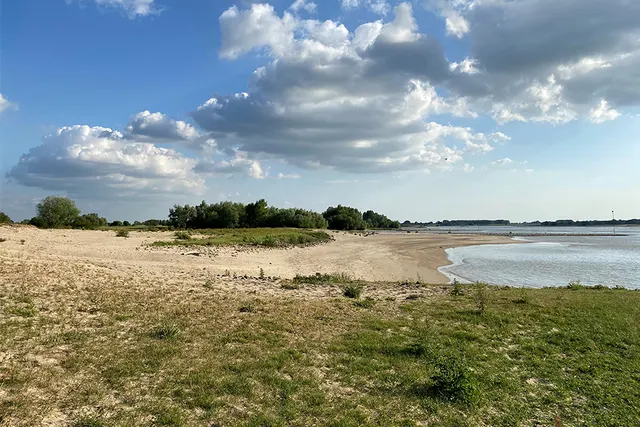
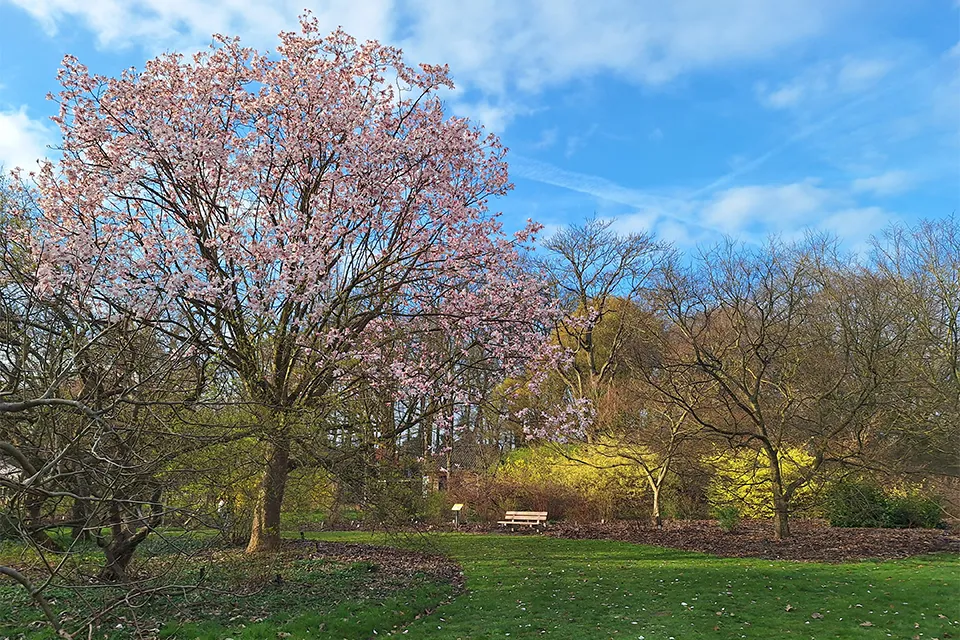
It is the first day of spring. The kind of day when the light falls differently, as if the landscape itself is breathing a sigh of relief after a long winter. Belmonte Arboretum looks beautiful on top of Wageningen Hill. At the edge of the grounds, the land slopes gently away towards the Nederrijn. The water glistens below; on the far bank, the Betuwe lies on the horizon.
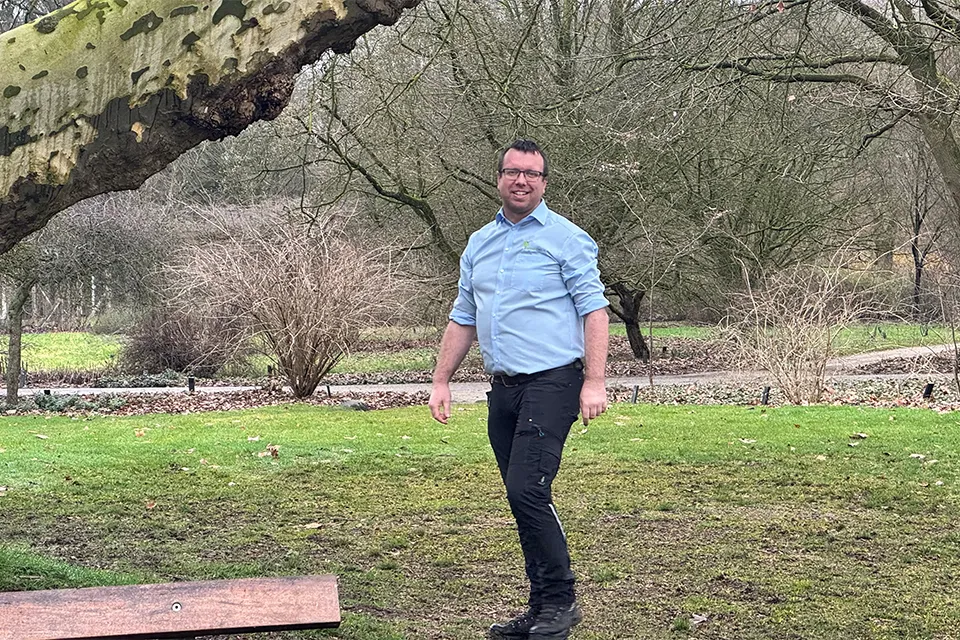
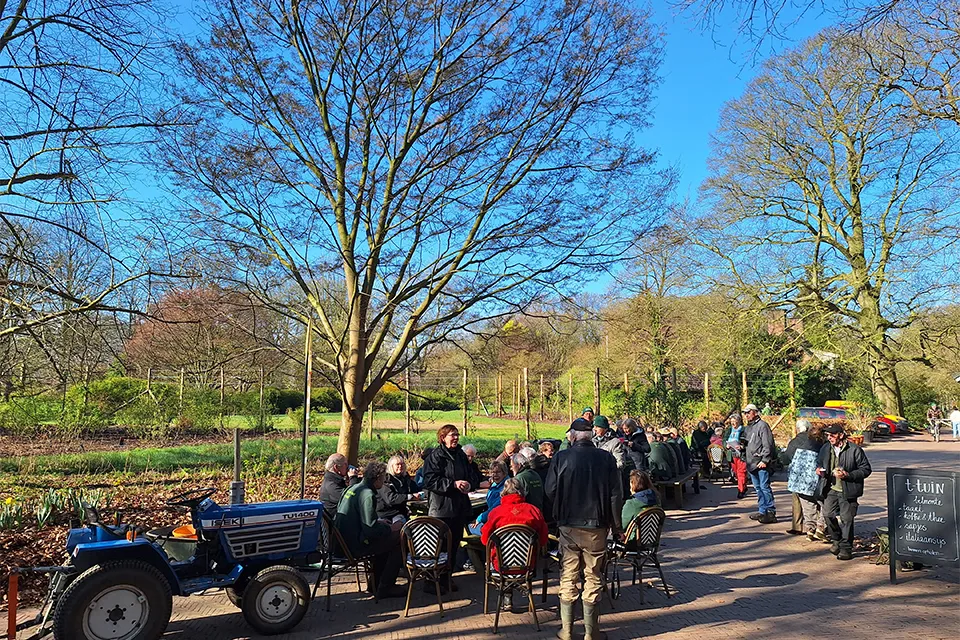
Here, in a place where thousands of trees and shrubs from around the world grow together, is Simen Brunia, who describes himself in his email signature as a European Tree Technician and Certified Veteran Tree Specialist. These days, though, he prefers to call himself a knowledge-sharer. He walks at an easy pace, often looking up, and speaks in sentences that frequently begin with an observation. First you look. Then you interpret. “Throughout my working life, I’ve always been a tree specialist,” he says as we follow a gently winding path into the arboretum. “Researcher, consultant, tree specialist. But for the past six years I’ve called myself a knowledge-sharer. I realised that sharing knowledge might well be the most important part of the job, and I’ve found that it doesn’t drain my energy, it gives me a great deal of it.” Since early 2025, Brunia has been curator of Belmonte Arboretum in Wageningen. It sounds like an academic role, but in practice it is rather more down to earth. “When I started here,” he says, “I was given a fairly simple explanation. There’s funding for a director one day a week, a curator one day a week and a collections manager one day a week. The head gardener works four days. Everything beyond that is really just a matter of working together and organising things.” Belmonte relies largely on volunteers, and there are a lot of them. “Even on a drizzly morning, there are thirty or forty people here,” says Brunia as we watch a group working among the rhododendrons. “That’s really special. There’s a team for the roses, a team for the rhododendrons, someone who looks after the moles, people who work with the tractor. There’s always something going on.” As a result, the arboretum feels less like a park and more like a small community. “There’s a constant energy here,” he says. “That makes it such a lovely place to work.”
From tree technology to observation
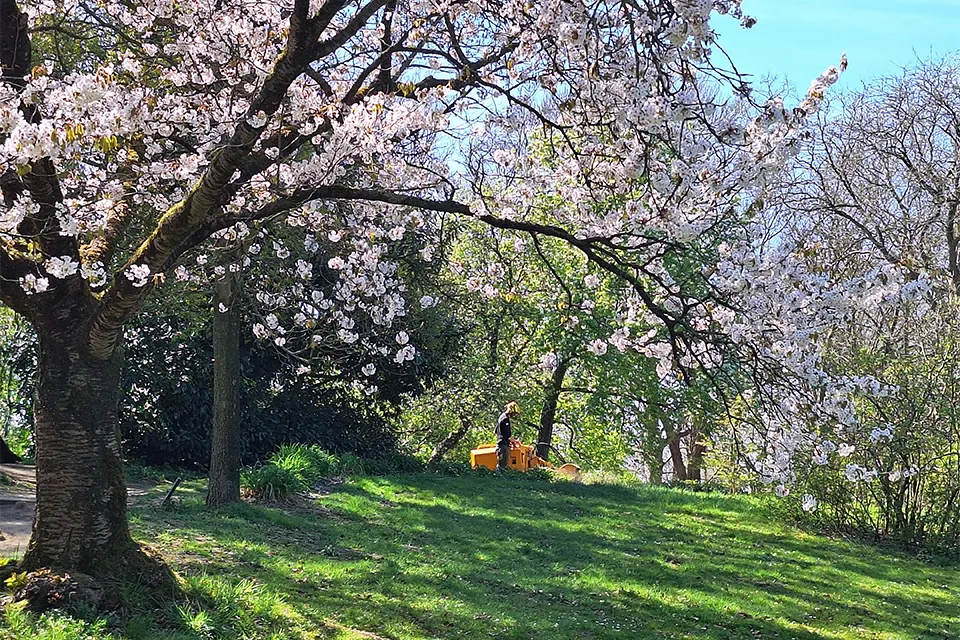
Brunia’s path to Belmonte followed years of work in the tree sector. The curator studied Garden and Landscape Design at Larenstein and then worked for, among others, Copijn and Bomenwacht Nederland. “At first, the work is very technical,” he says. “Inspections, reports, risk assessments. Of course, that’s part of the job. But over time I realised I was more interested in investigating the exceptions, the unusual things you can’t immediately explain.” That eventually led him in a different direction. “The work became more and more about volume,” he says. “More data, more systems, more standardisation. But trees are always individuals. And it was that individual story that interested me.” So in January 2020, he started working for himself. “That was exactly when Covid began,” he says with a laugh. “Everyone said it was bad timing. But I actually thought the opposite. At last, time to build things up slowly.” One of his first assignments was Amsterdam’s tree replacement programme. For every tree that had been felled or blown over in a storm, I had to determine exactly which cultivar would replace it. Should it be replanted or not? Should it be converted to a different species, or should exactly the same one be planted again? In the same spot, or somewhere slightly better? “I cycled around the city for months. It was fantastic. Just looking at trees. Seeing how they grow, how they respond to their surroundings. Those are the moments when you really learn.”
We stop beside an old beech. A bracket fungus is growing on its trunk. “That’s often immediately seen as a problem,” says Brunia. “But I call it a tree guest.” He pauses to look at the fungus before continuing. “If I come to your house, I’m a guest too. Some guests you’d rather keep out. Some you let in for a while, some stay too long on the sofa. And some can’t stay long enough.” It’s a comparison he often uses because it gets to the heart of what he thinks matters: first, understand what is happening. “Wood-decay fungi are often seen as parasitic, dangerous, aggressive,” he says. “But in reality they’re often simply part of the ecosystem around the tree.” The instinct to intervene straight away runs deep. “We tend to fight things. Spray them with chemicals. Prune. Clear up. But sometimes there’s no need at all. Sometimes you first need to look at what’s actually happening. Then you realise that most of the trees here have been around longer than we have.”
Safety and risk
During our walk, the conversation inevitably turns to safety. It may well be the issue tree managers deal with most often. Local authorities, insurers and residents first look at risk. Could a branch fall? Could a tree blow over? Could something happen? Brunia understands the concern. “Of course you have to take safety seriously,” he says. “If a tree really is dangerous, you have to do something about it. There’s no debate about that.” But, he says, the tension lies in everything in between. “Very often, it’s not clear danger but uncertainty. And uncertainty is quickly translated into risk.” He points to a large old tree beside the path.
“When you look at a tree like that, you might see deadwood, a crack, a fungus. The instinct is to think: that has to go. Because what if something happens?” But, Brunia says, that is precisely when knowledge is needed. “You need to understand what you’re looking at. Not every crack means a tree is going to fall over. Not every fungus means a tree is losing its stability.” That is why he argues for a more considered approach. “The problem is that removal always seems like the safest decision. Once the tree is gone, it can’t fall over any more.” He shrugs. “But you lose something that might have stood for decades more, and in some cases has already been standing for many decades. And with a tree like that, an entire ecosystem around it disappears too.”
For Brunia, tree management is therefore often about finding a balance. “You have to take risks seriously, but you also have to understand that absolute safety doesn’t exist. Trees are living organisms. A certain degree of uncertainty comes with that.” He looks up at the canopy above us. “The skill lies in understanding that tension and dealing with it responsibly.”
Patience as a management strategy
He stops beside a large sweet chestnut. Its crown is asymmetrical: heavy on the left, still young on the right. “The conventional response is to correct that,” he says. “Prune it, balance it, make it safe.” He looks up at the young branches. “But if you come back here in twenty-five years, the right side will be just as heavy.” Patience, he says, is an underrated management strategy. “It may be less exciting,” he says, “but for the tree, it’s often exactly what’s needed.”
There’s a bench beneath a large old tree. It’s one of the most popular spots in the arboretum. “Branches fall here regularly,” says Brunia. “Sometimes small ones, sometimes slightly larger ones.” The standard solution would be to prune the tree regularly. “But I don’t have any budget for that,” he says. Instead, he looks at it the other way round. “Maybe the bench should simply go somewhere else.” He looks at a spot a few metres away. “Why should we adapt the tree to people when we could move people a little instead?” It sounds simple, but it changes the way management is approached.
Freaky trees
A little further on, branches hang so low that they almost touch the ground. “In many places, they’re removed straight away,” says Brunia. “Because the lawnmower can’t get underneath.” Here, he leaves them in place. “If a branch touches the ground, it can take root again. The tree then rejuvenates itself.” He smiles. “You get these almost freaky-looking trees. But that’s what makes them interesting.” Some visitors and volunteers take a little getting used to it. “We’re used to trees being neat and tidy. But trees aren’t neat at all.”
Veteran trees
One of Brunia’s main specialisms is working with veteran trees. “That doesn’t necessarily mean a tree is very old,” he explains. “It means it’s old for its species.” A willow can be a veteran at eighty. A beech only much later. A pedunculate oak perhaps only after hundreds of years. “In the Netherlands, we often think we don’t have many veteran trees,” he says. “But try paddling a canoe through the Biesbosch. There are thousands of old willows there. Hollow, decayed, full of deadwood. They’re veterans, plain and simple.”
What is often seen as a defect is actually part of this stage of life. “Hollows, fungi, deadwood: these aren’t faults. They’re stages.” He points to a beech with a large wound that has been slowly overgrown for decades. “Just look at the vigour this tree still has,” he says. “I love seeing that.”
Native and non-native
In the Arboretum’s rose garden, with hundreds of varieties from around the world, the conversation turns to origins. “The debate about native and non-native species is often simplistic,” says Brunia. He recalls a conversation he once had with a well-known garden designer. “They said: green is green. And there’s something in that.” Ultimately, he says, it’s about how plants function. “If our beech starts to struggle here because of climate change, you don’t have to look straight away to Japan or Chile. Maybe you should simply look at a beech from central France.” The ecosystem remains comparable, but the genetic adaptation is slightly different. “You’re really just speeding up a process that’s already under way, partly because of climate change. Nature is moving northwards. Native or non-native is a non-issue, then. Everything has been in motion for millions of years.”
In front of us are hundreds of different rose varieties, from wild species to cultivated forms. “This is a lovely illustration of how complicated the debate can get,” he says. “When you bring so much variation together, insects, pollen and genetics naturally start mixing.” Brunia says biodiversity is often treated in black-and-white terms, as if only completely ‘pure’ native species have value. “But nature doesn’t fit neatly into our categories at all.” He points to the rose beds, where bees move constantly from flower to flower. “That bee doesn’t care about provincial borders or labels. It simply flies from one rose to another.” This naturally gives rise to new cross-pollination and genetic hybrids. “By the time you collect seed here from a so-called native rose, it has already been genetically influenced by other varieties nearby.
Bomenbieb
Alongside his fieldwork, Brunia has spent the past few years building a knowledge platform: Bomenbieb. “Fifteen years ago, there was hardly any reliable information about trees online,” he says. “So we thought: we’ll make it ourselves.”
What started as a small initiative has grown into an extensive database of tree species and tree associates. “We have now described almost 500 tree species and cultivars, and in time we will have roughly the same number of tree associates.” Sometimes the platform proves more influential than expected. “Recently, I received a message saying that Bomenbieb had been cited in a scientific paper,” he says. “I thought: ‘Oh, apparently it’s being used across all sorts of circles’.”
Taking a longer view
At the end of the walk, we are back at the edge of the arboretum. The Nederrijn flows calmly past below. Brunia looks up once more at the crown of an old tree. “Perhaps the most important thing we need to learn,” he says, “is to take a longer view.” Not only of what could go wrong, but of what a tree could still become. “Showing people what trees are capable of,” he says, “that is really one of my biggest missions.”
Question about this story? Ask your question
Keep following this
Get an email when a new story is published. No account needed.
- ThemeTrees and plants for tomorrow
- SubjectPublic green spaces