









A new neighbourhood whose residents reap the rewards
Text Armand LandmanImage Gemeente Utrecht
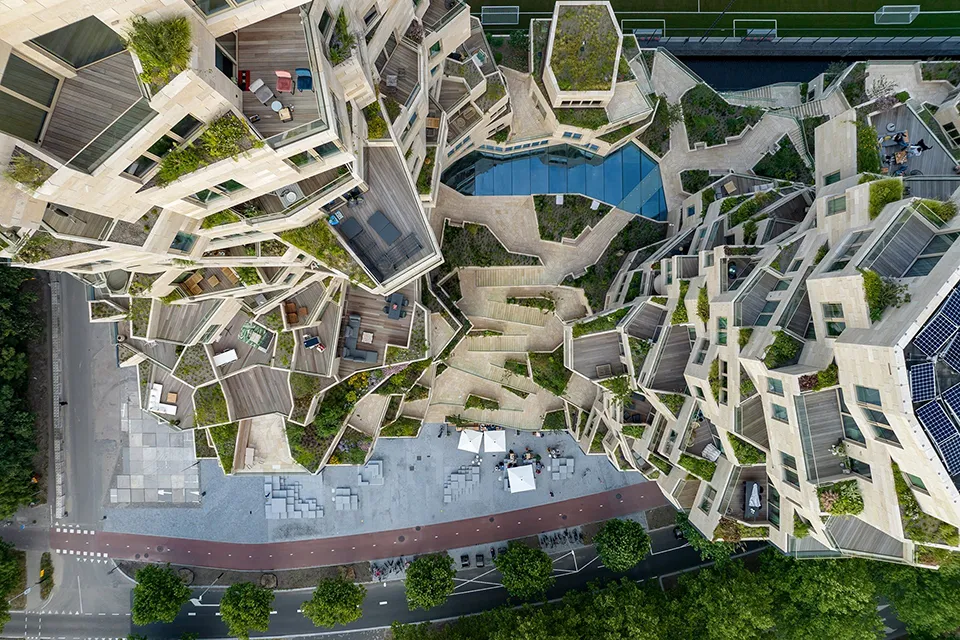
Rijnvliet combines sustainability, social cohesion and an innovative approach to urban development
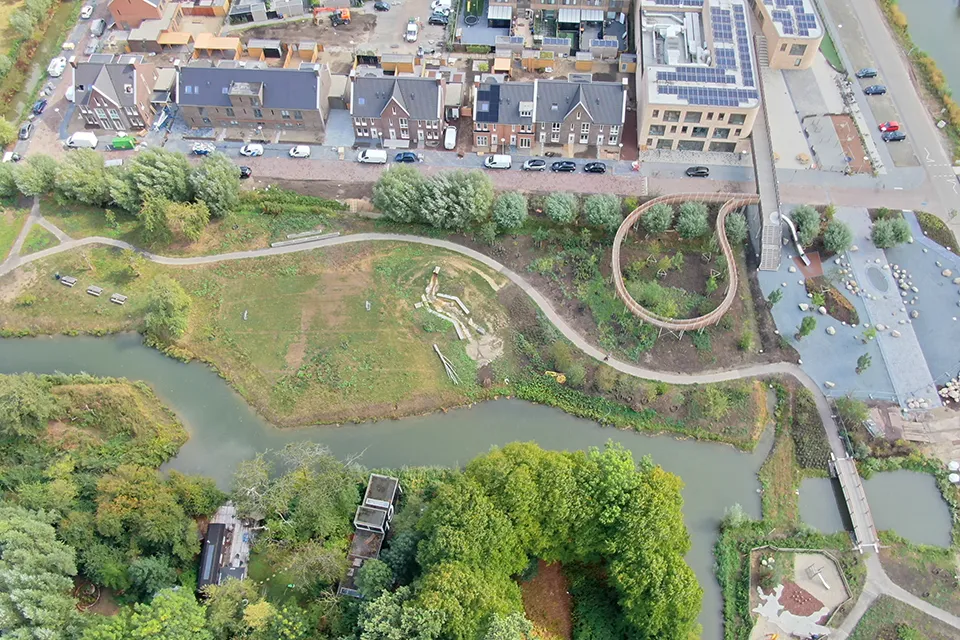
The new-build Rijnvliet project in Utrecht is bringing a unique concept to life: a residential neighbourhood where all the greenery is edible. This would never have been achieved without close collaboration between the municipality of Utrecht and Felixx Landscape Architects & Planners. Ruben Jonker, Rijnvliet project manager at the municipality of Utrecht, and Marnix Vink, landscape architect at Felixx, talk at length about the challenges and successes of this special project.
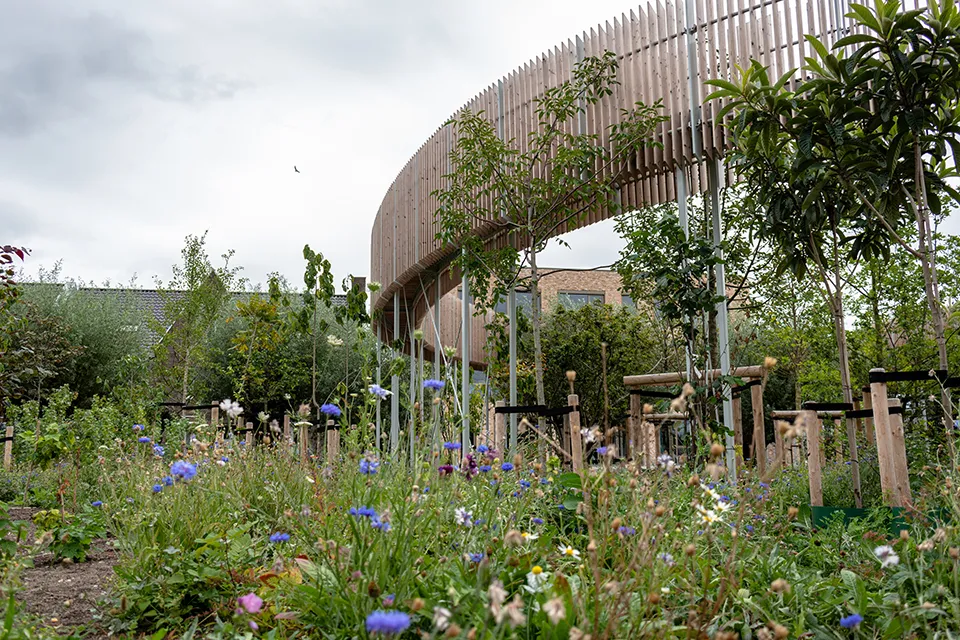
The idea behind Rijnvliet, part of Leidsche Rijn, is as simple as it is revolutionary: all the greenery planted in public spaces is edible for people or animals. This means residents, as well as insects and other animals, can pick fruit from trees, gather nuts and use herbs growing along the streets. Some plants are needed to create a favourable climate for insects. Those insects, in turn, are needed by the edible plants for people. Everything is part of the same food chain. “We deliberately chose a concept in which all the greenery adds value,” says Marnix Vink. “It’s not just about aesthetics, but also functionality and social interaction. The edible planting brings residents together and creates a unique living experience.”
According to Ruben Jonker, the project has attracted a great deal of interest from other municipalities. “We’ve had between ten and fifteen municipalities visit to see how we made this happen. The question we’re often asked is: how did you get the municipal council to approve it? The answer lies in carefully explaining the added value of the project. Of course, establishing a food forest is more expensive and complex than putting in conventional planting, but the social cohesion it creates is invaluable.”
Bottom-up
The project began with a workshop involving residents of the nearby historic ribbon development, the Rijksstraatweg. “These residents, who called themselves ‘the green lungs of Rijnvliet’, wanted to contribute their ideas for the design of the new public space,” says Vink. This bottom-up initiative led to a plan that was further developed by the municipality of Utrecht and Felixx. The residents’ wish to bring nature and edible crops back into the area provided an important source of inspiration for the final design.
“For example, we looked at edible species that thrive in our climate but do not necessarily originate here, together with Xavier San Giorgi, a food forest expert,” Vink explains. “Together with Xavier and the municipality, we developed a concept that is unique in Europe on this scale.” This meant that not only did the planting design have to be different, but those responsible for management and implementation also had to be involved in a different way. “We organised courses for the management team to familiarise them with the specific requirements of a food forest,” says Vink. “Conventional green-space management simply doesn’t work here. It calls for a different approach.”
In-house management department
Creating an edible residential neighbourhood brings many challenges. Jonker says existing structures had to be adapted to make the concept work. “Our management team, for example, had to get used to the idea that certain areas are not mown because the plants bear fruit,” he explains. “It requires a tailored approach, but with the right people in the right places, it can be done.” Fortunately, the municipality of Utrecht still has its own management department, which helps ensure continuity in the care of this unique greenery. “We don’t have to deal with external contractors who change every five years, which makes it easier to maintain our vision.”
Erik Vrieling, architect and partner at de Architekten Cie., stresses that we should not be too cynical about green façades and other forms of what he calls ‘non-rational’ greenery, which sometimes attract criticism from ecologists and green-space managers. “You can argue it all away, but it’s precisely important that these projects exist. They serve as pilots in our search for a better living environment,” he says. “Projects like these help us discover what works and what doesn’t, even if they are expensive or difficult to implement. I think it’s good that we undertake these experiments. The underlying movement is crucial: we need to keep observing, keep taking action and keep the debate about greener cities alive.”
He praises the Rhapsody project as an example of a laboratory for urban renewal. “It is a prime example of how greenery can contribute to a liveable city, without needing extra concrete to create an oasis in a place that was previously unattractive because of noise and smells.” He notes that adding greenery at this location in Amsterdam, right next to the A10, not only improved air quality but also changed how people perceive the surroundings. “People now experience it as a park, which makes them feel more comfortable, even in a place that used to be seen as unattractive.”
MVRDV and Hydraloop
Winy Maas, co-founder and namesake of architecture firm MVRDV, knows better than anyone what greenery can do for buildings. His mother was a florist, and Maas grew up in his father’s garden centre. Among other projects, he designed Depot Boijmans van Beuningen in Rotterdam, where a complete forest grows on the roof of the mirrored building, and the Valley next to Amsterdam’s ring road, with roof gardens and balconies filled with shrubs and trees. Projects like these have shown him just how important it is for architects to involve other disciplines in their designs at an early stage. “Not just landscape architects, ecologists and planting specialists, but technical innovators too. And you have to dare to experiment, because architects don’t know everything. New technologies shouldn’t be added afterwards, but built into the design from the outset.”
He points to Sabine Stuiver, who is developing innovative water-saving technologies with Hydraloop. These are essential for creating greener living environments. Stuiver stresses that the need to save water is becoming increasingly urgent, even in the Netherlands, a country with abundant water. “Of the 900,000 new homes that need to be built, 300,000 cannot be completed because the drinking water supply is inadequate.
“By recycling water locally, we can tackle this challenge while reducing pressure on our water resources,” she says. Hydraloop offers solutions that not only save water but also help make environments greener: recycled water can, for example, be used to maintain urban greenery.
“We need more initiatives like Sabine’s,” says Maas. “On a much larger scale, to ensure these innovations really work and become standard practice in construction.”.
Maas explains that clients play an important role in driving innovation. “If clients make sustainability and innovation firm requirements in their brief, we can make progress much faster,” says Maas. He sees that clients are often reluctant because of the cost, but stresses that the long-term benefits, such as lower energy costs and higher building values, more than justify these investments. “It is crucial that clients are prepared to look not only at the initial costs, but also at a building’s entire life cycle,” he adds. “By including requirements for circular water use, green roofs or energy-efficient systems, clients can have a major impact on how cities are shaped.”
Question about this story? Ask your question
Keep following this
Get an email when a new story is published. No account needed.
- SubjectGeneral







