Protecting trees through vaccination
Text Nolanda KlunderImage idverde NL
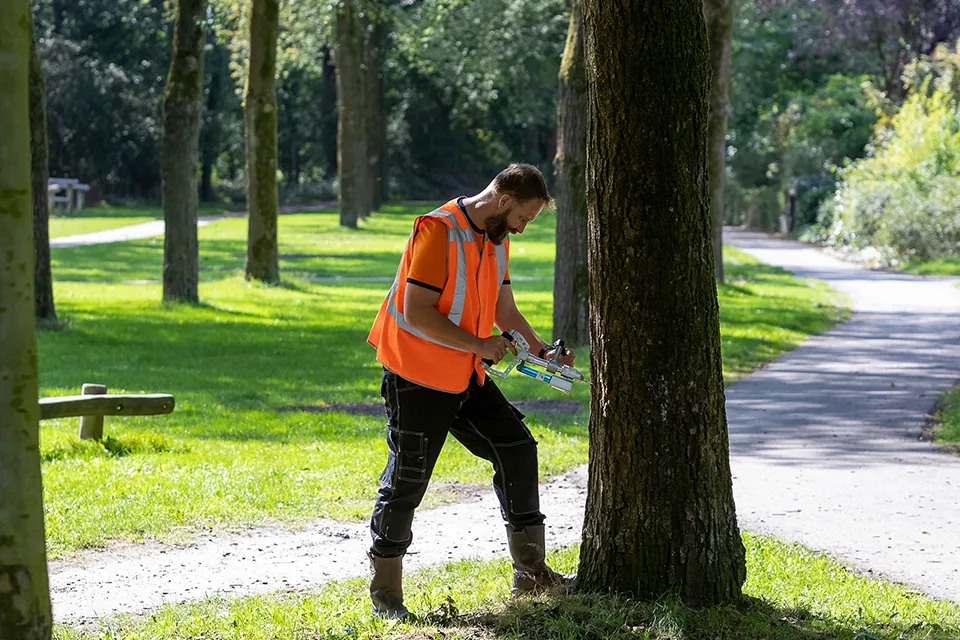
‘Dutch elm disease can be prevented with an annual injection’
Dutch elm disease is becoming increasingly common, partly due to climate change. Fortunately, trees can be effectively protected with an annual injection. “Vaccination reduces the mortality rate from over ten per cent to half a per cent,” says Ron Schraven of idverde NL.
“Dutch elm disease has been a major problem in Europe for more than a hundred years,” says Ron Schraven, Head of Tree Diseases and Damage at idverde NL. “Elms are at high risk of becoming infected, and once infected, they are very likely to die, often within a short time: there are often only six weeks between the initial infection and the tree dying.” Infection occurs in two ways: elms can be infected by beetles, and infected elms can also infect each other through underground root contact.
Developing the vaccine
In the 1960s and 1970s, Dutch elm disease was more or less under control as a result of a nationwide programme. To prevent it from spreading, diseased elms were identified and removed very quickly. Research was also carried out into less susceptible elm species. This worked well until a mutation of the disease emerged in North America, infecting trees in Europe as well. The University of Amsterdam then investigated the possibility of vaccinating elms. Schraven: “Various forms and organisms were tested, and the choice fell on the fungus we use today: a common soil fungus with properties to which the tree’s defence mechanism responds well. This defence mechanism then protects the tree against infection.”
Injection
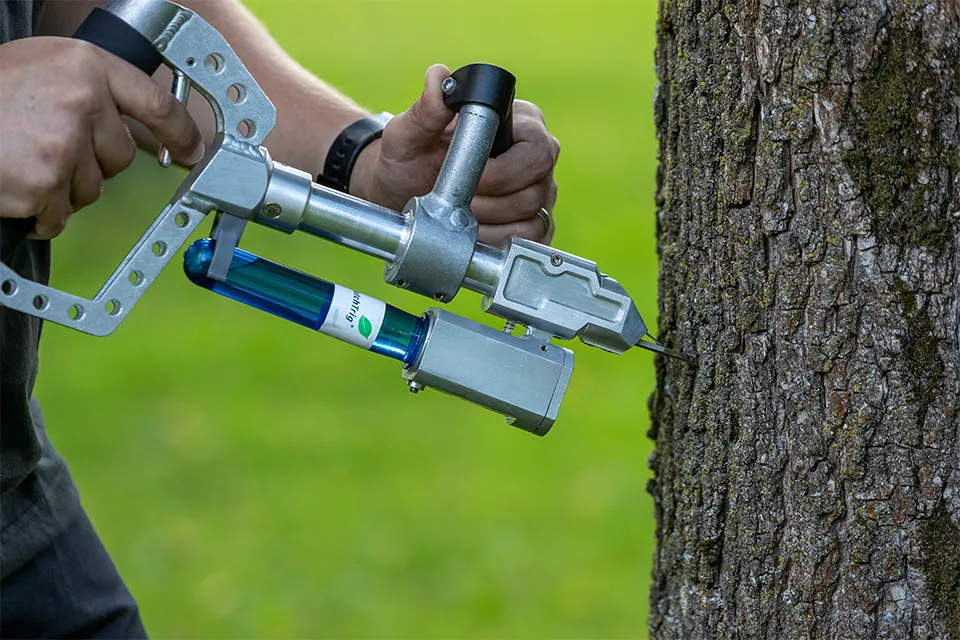
“Once it had been scientifically established that vaccination with this fungus could protect elms, we set about developing the idea in practical terms, in the product ‘DutchTrig®’,” says Schraven. “The two questions were: how can you inject a tree without damaging it, and how can you vaccinate as many trees as possible during the short window when this needs to be done, between late April and mid-June? That requires good planning and a device that allows you to work quickly.” The injector was developed for this purpose. “This hand tool makes use of the negative pressure naturally present in trees,” Schraven explains. “We use the injector to pierce the vessels, after which the tree absorbs the product itself. This method allows us to work with small quantities, requires only minimal wounding and enables us to vaccinate very quickly.”
Climate change
“Dutch elm disease is a major problem in the Netherlands,” says Schraven. “And the problem has worsened in recent years. Fortunately, we are seeing many municipalities include annual vaccination with DutchTrig® in their policies.” In the Netherlands, idverde NL is the only company vaccinating elms with this injection product. Climate change is one of the factors behind the increasing prevalence of Dutch elm disease. Schraven: “Milder winters mean the beetle population becomes active earlier, and three, perhaps even four, generations of beetles can be produced in a single season, instead of the two generations seen previously.”
Ecosystem services
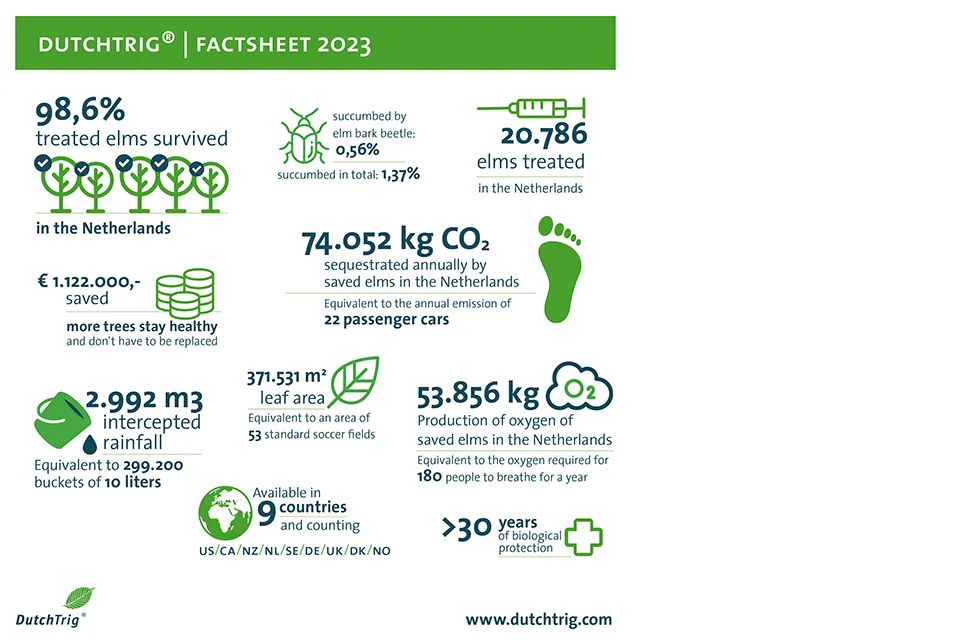
“Without vaccination, more than 10% of elms die from this disease on average,” says Schraven. “After injection, only 0.5% die: so 99.5% survive. This means vaccination leads to enormous cost savings. Felling a tree and then planting a new one and ensuring it establishes is a significant expense. Keeping a tree alive also preserves its ecosystem services. A mature tree makes a greater ecological contribution than a new one. That is the essence of DutchTrig® for us: helping to conserve elms and ensure these trees are there for future generations.”
Question about this story? Ask your question
Keep following this
Get an email when a new story is published. No account needed.
- SubjectTrees & plants