Specialist knowledge for investigating tree strength and stability
Expedio Arbori is naturally active in the market for surveying and inspecting entire populations of trees. Projects of this kind are part of the job. But for Ronald, tree technology only gets really interesting when very specific information is needed about one tree or a small number of trees. This is when his knowledge, skills and experience really come into their own. Examples include in-depth investigations into the stability or strength of an old tree in a city centre, or safety inspections of trees infected with fungi.
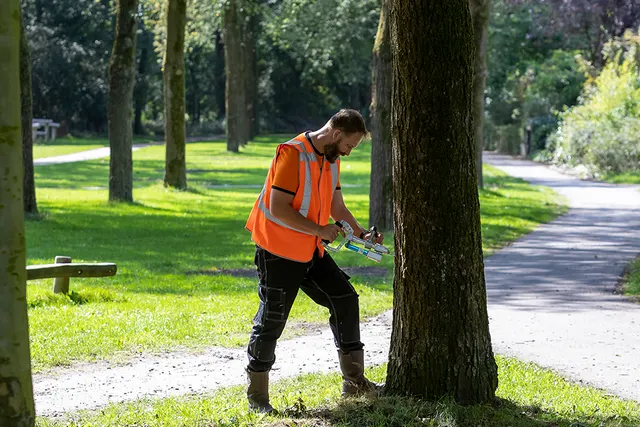
We meet in a medium-sized town in the central Netherlands. There we find Ronald Wobben of Expedio Arbori in his natural habitat: a city centre, logically surrounded by trees. He has laid out the tools he uses most often: a spade, a wooden mallet and a so-called probing rod. The rod lets you look a little way “into” the tree, but more on that later. Ronald gets started: ‘You can’t see my most important tool for surveying and analysing a tree, though. It’s my knowledge, skills and experience, which I put to use simply by looking at the tree. A visual inspection already yields a wealth of useful information, provided you know what to look for. I can use the probing rod to “look” inside the trunk by inserting it into existing holes. The resistance I encounter can indicate, for example, wood decay. You can also hear it by using the tree as a sounding board and tapping it with a wooden mallet. I only use diagnostic measuring equipment if my own visual inspection shows that it is necessary.’
Tree strength investigation
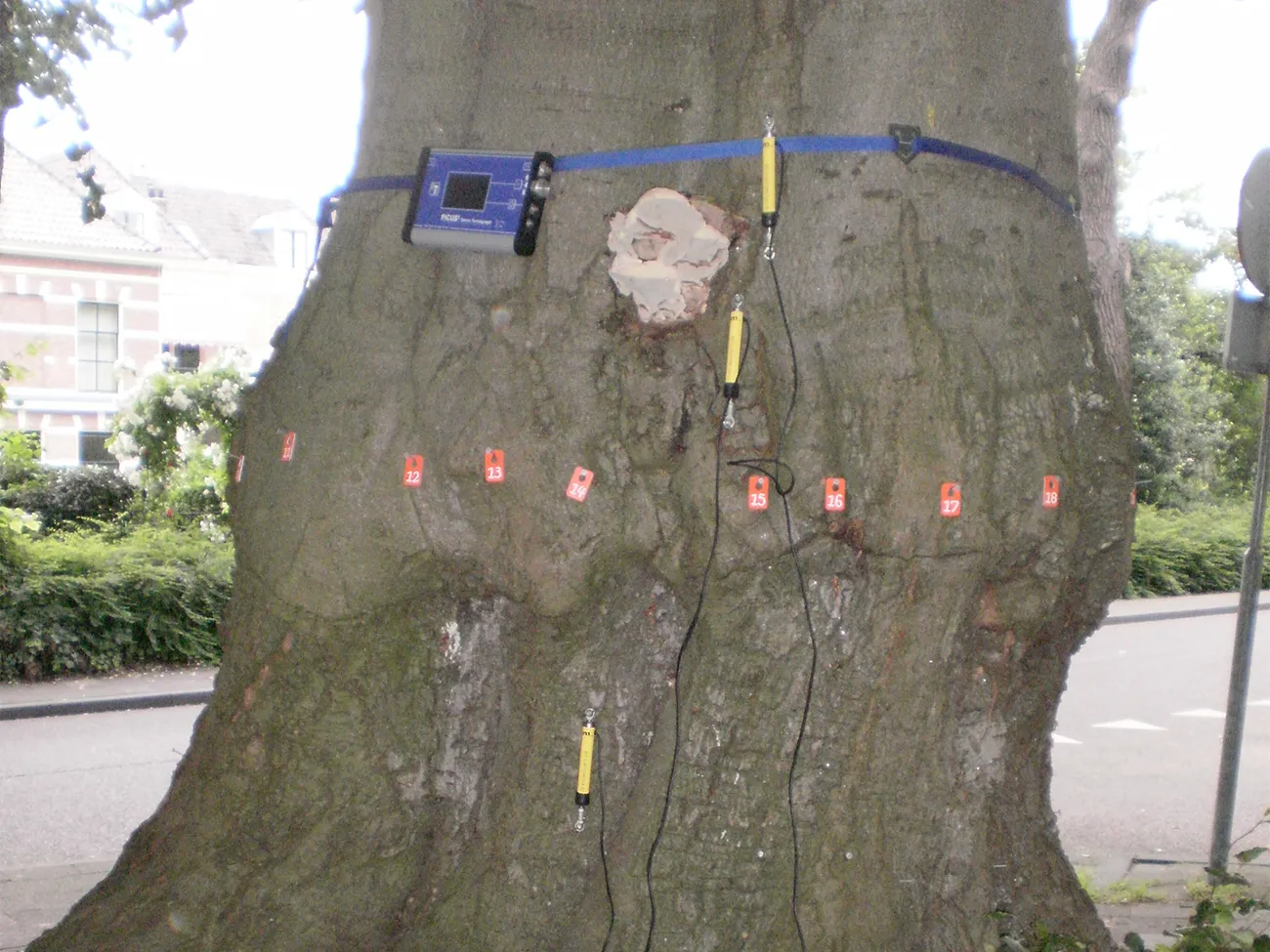
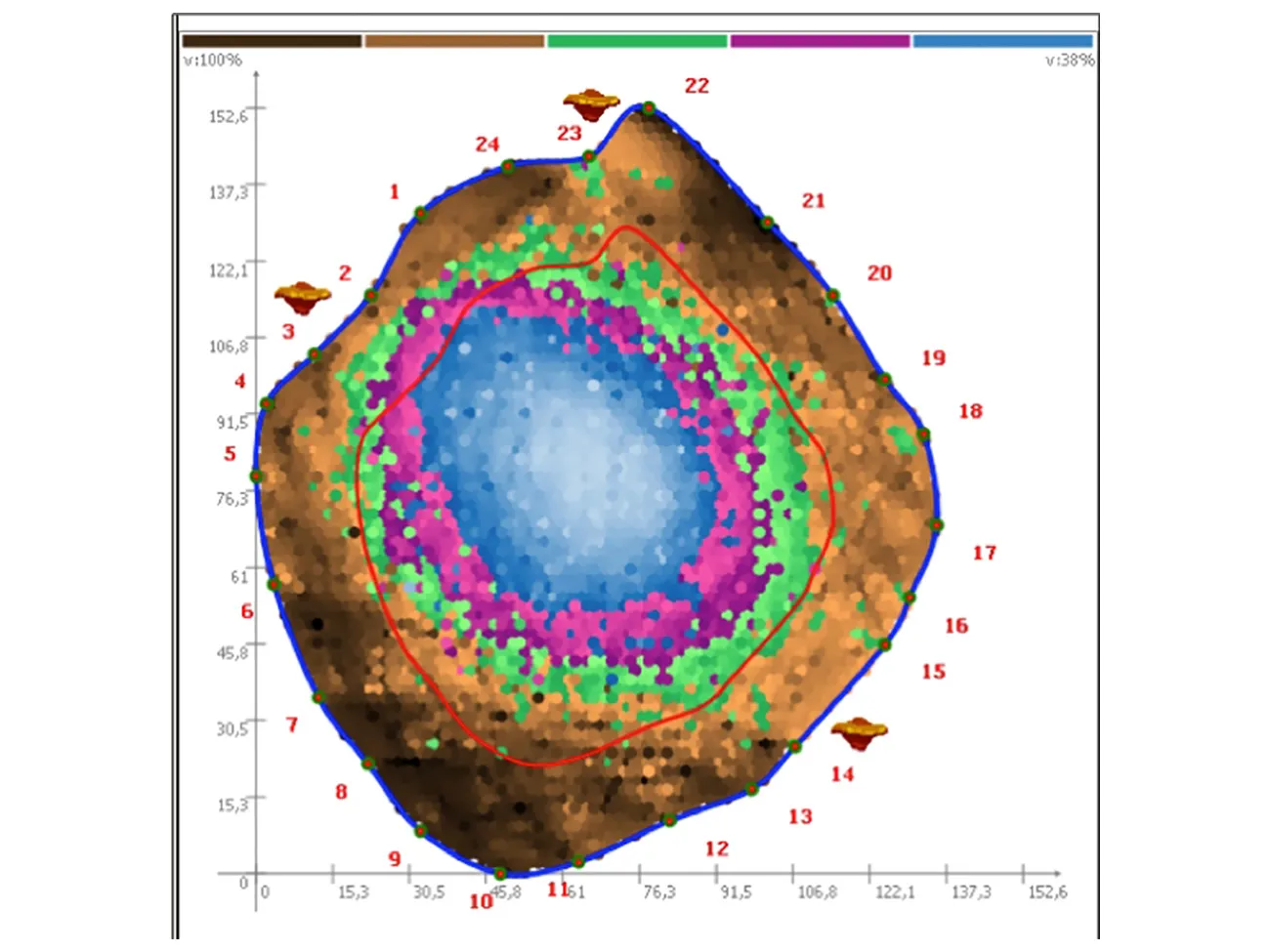
Expedio Arbori has a Picus sonic tomograph for looking inside trees. A number of pins (0.8-2 mm) are driven into the trunk, around its circumference, as far as the first annual growth ring. When the pins are struck with a hammer, the resulting sound waves are recorded and analysed, providing a clear picture of the inside of the tree in question.
Whereas Picus uses sound waves to show the extent of wood decay in measurable terms, TreeTronic uses a weak electric current.
The wood’s electrical conductivity can provide a clearer picture of the type and/or extent of the damage.
TreeTronic can therefore detect decay at an early stage and/or estimate its extent at the base of the trunk, including below ground level.
Stability investigation
Although an indication of a tree’s stability can also be obtained using Picus or TreeTronic, it can also be physically tested by carrying out a so-called pulling test. This method simulates the wind load on a tree by ‘pulling’ it with a cable attached to the tree. An inclinometer at the base of the trunk records movement in the root plate, and thus the tree’s stability.
Question about this story? Ask your question
Keep following this
Get an email when a new story is published. No account needed.
- ThemeTrees and plants for tomorrow
- SubjectTrees & plants