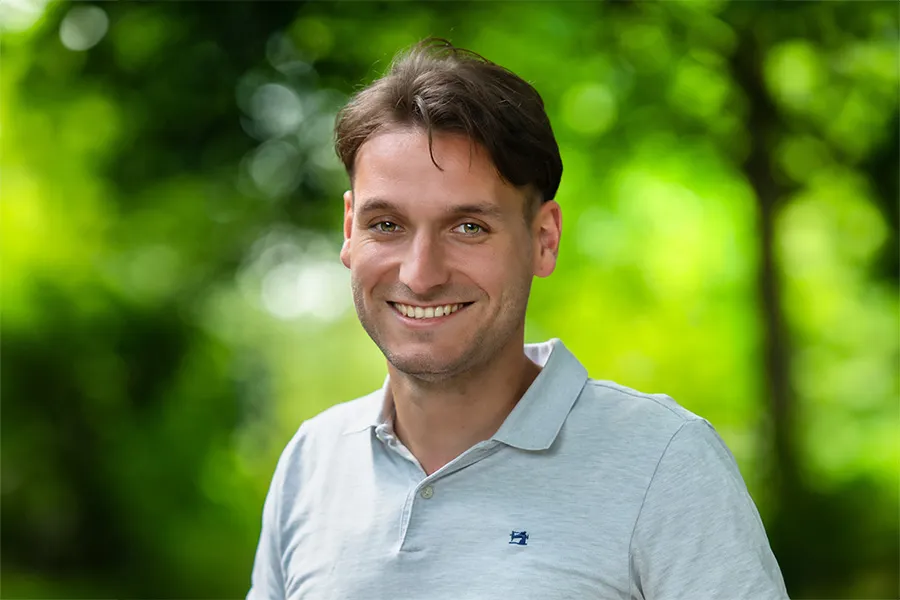
Lars van Ginkel: ‘Water is a scarce resource’
For years, we thought water could be taken for granted. It came out of the tap, ran down the drain and disappeared; problem solved. But that era is over. Anyone who still thinks of water as something to “get rid of” has not been paying attention.
As a landscaping company, we see it every day: droughts are lasting longer, and downpours are becoming more intense. One moment we have flooding, the next a water shortage. At the same time, there are growing calls for more greenery in cities. Parks, roof gardens, green façades, climate-adapted neighbourhoods: all wonderful, but they need water. And rightly so, because water enables greenery to evaporate water and provide ecosystem services. So choices have to be made. What will we do when drinking water becomes scarce? Will we choose people or greenery?
That sounds dramatic, but it is the reality we are heading towards. That is why we must no longer see water as something to be ‘disposed of’, but as something to be cherished. As a landscaping company, we are increasingly moving away from simply being the people who “come and plant things” and becoming a partner throughout the entire construction and management process. Sometimes, with a wink, I call it a “green installer”.
That calls for a different way of working. We no longer join the process at the end to add a little greenery, but are at the table from the first design. Greenery as a starting point affects everything: detailing, load-bearing capacity, insulation, accessibility, maintenance and water demand. If you only start thinking about that once the construction crane is already at work, it is too late, and more expensive.
The good news is that more and more clients are beginning to understand this. Not only local authorities, but developers and builders in particular. Rainwater regulations and certifications such as BREEAM have long been encouraging us to manage rainwater intelligently: store it, slow its flow and reuse it. In many cases, a roof garden is no longer a luxury, but part of the planning permission for a building.
Even so, the regulations are still hopelessly fragmented. Local authorities implement regulations on circular water management to varying degrees, if at all. We focus on drainage times, but not always on storage or infiltration. We do little to incentivise reuse. And the real urgency, the recognition that water is becoming as scarce as energy, is still too often lacking.
As far as I’m concerned, water should be at the top of every design drawing. Not as blue lines somewhere at the bottom, but as a guiding principle. Only then can we build green, future-proof cities that are also resilient to drought and torrential rain.
Green can no longer be separated from blue. And anyone who has not yet realised that will soon be left with dry ground beneath their feet.
Question about this story? Ask your question
Keep following this
Get an email when a new story is published. No account needed.
- SubjectThe Pen